Fast identity verification services protect your business by confirming director identities against official databases in real time to prevent corporate fraud. They block unauthorized filings at Companies House, validate official credentials instantly, and safeguard your company’s legal status against hostile takeovers and financial loss.
Corporate identity theft poses a severe threat to commercial enterprises across the United Kingdom. Criminals exploit administrative vulnerabilities to alter official company registers, submit fraudulent documentation, and assume control of corporate entities. Fast verification solutions intercept these unauthorized actions before legal or financial damage occurs.
Organizations face immediate exposure when director details remain unverified during major corporate changes. Fraudulent actors attempt to secure loans, register fraudulent bank accounts, and order high-value supplies under hijacked company names. Implementing robust authentication mechanisms creates an absolute barrier against corporate impersonation.
The modern regulatory landscape demands stringent compliance mechanisms from every registered company officer. UK regulatory frameworks mandate that corporate entities verify director credentials against verified state registers. Immediate authentication ensures uninterrupted trading capability while maintaining complete compliance with statutory requirements.
How Do Corporate Identity Scammers Target UK Businesses?
Corporate identity scammers target UK businesses by altering registered office addresses and changing director details on the Companies House register. Fraudsters use forged documents to divert official mail, take over existing credit lines, and lease assets using your legitimate company profile.
Criminal organizations actively monitor public registers for vulnerable corporate profiles. Entities with static director structures, outdated address records, and minimal administrative oversight represent prime targets for hostile takeover schemes. Scammers file unauthorized forms to replace legitimate officers with fictitious or stolen identities.
Once fraudsters alter official records, they intercept sensitive correspondence and statutory notices. Diverting mail allows bad actors to hide their activities from legitimate company owners for months. During this window, criminals acquire loans from lenders who rely on the manipulated public register.
Corporate impersonators exploit credit terms provided by trade suppliers across multiple industries. They place substantial orders for equipment, vehicle fleets, and raw materials under the compromised business name. The legitimate entity bears the financial liability and severe credit rating damage when defaulted invoices emerge.
What Key Components Drive Real-Time Fraud Protection Systems?
Real-time fraud protection systems use automated database checks, biometric matching, and official document validation to confirm director identities. These components compare submitted credentials with passport registers, driver databases, and government records to detect discrepancies immediately.
Automated document validation forms the primary defense layer for corporate identity verification systems. Advanced software algorithms examine government-issued identification cards, passports, and utility bills for microscopic structural anomalies. The system verifies security features, embedded microchips, and machine-readable zones against global database parameters.
| Verification Layer | Data Source Checked | Operational Purpose |
| Document Validation | Passport & Driving License Registers | Detects physical and digital document alterations |
| Biometric Liveness | Real-time Facial Geometry Scans | Prevents impersonation using static photographs |
| Address Verification | Electoral Roll & Utility Databases | Confirms legitimate residency of company directors |
| Corporate Linking | Companies House Registry | Validates official connection between director and firm |
Biometric matching technology compares real-time facial scans against photo identification documents. When a director submits a selfie scan, Liveness Detection checks ensure a real person performs the transaction. This process prevents criminals from using static photographs, pre-recorded videos, or deepfake digital images.
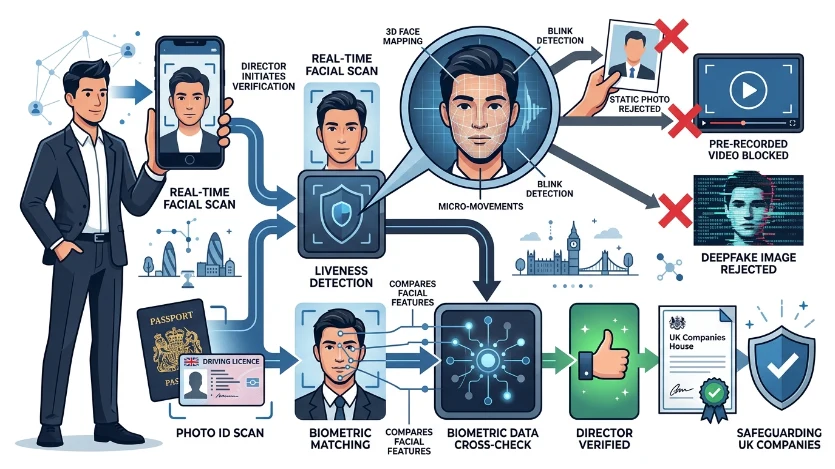
Database cross-referencing connects individual identities directly to official government registries. Verification platforms cross-check submitted details against the Electoral Roll, UK driver databases, and international sanction watchlists. Comprehensive cross-referencing identifies fraudulent applications within seconds while eliminating manual administrative delays.
Which Verification Methods Stop Corporate Identity Theft Instantly?
Three main verification methods stop corporate identity theft: biometric facial recognition, passport chip reading, and direct Companies House cross-checking. These automated technologies validate physical identity markers against official state databases within seconds.
Biometric facial recognition evaluates unique facial geometry parameters to establish definitive human identity. Algorithms map facial landmark points, measuring distances between eyes, nose position, and jawline contours. This mathematical profile undergoes automated comparison with the image embedded inside government identification documents.
Advanced Near-Field Communication (NFC) technology reads encrypted data directly from physical passport microchips. Mobile devices scan the passport chip to retrieve cryptographically signed digital information directly from issuing government authorities. This method renders physical forgery completely ineffective during administrative submission processes.
Direct API integrations connect commercial validation systems directly to the Companies House database infrastructure. When administrative changes occur, the verification system authenticates incoming director credentials against historical registry data. Suspicious entries trigger immediate security alerts that halt filing processing prior to register publication.
When Should Companies Execute Director Identity Verification Procedures?
Companies must execute director identity verification procedures during company formation, board appointments, and updates to company officer registers. Immediate verification is also mandatory when changing registered office addresses or transferring shares.
Mandatory verification must occur during the initial business incorporation process. Validating initial director credentials prevents high-risk individuals and fictitious entities from entering the commercial ecosystem. Implementing strong controls at formation ensures a secure corporate structure from day one.
Board appointments and executive transitions require identical verification rigor. When companies appoint new directors, administrative teams must validate identity documentation prior to submitting statutory notices. Securing administrative updates prevents unauthorized individuals from gaining binding corporate authority over company operations.
Critical structural modifications trigger mandatory identity re-validation protocols. Changing registered office addresses, transferring shareholdings, or altering beneficial ownership records requires rigorous identity checks. Proactive verification ensures that administrative modifications stem exclusively from authorized business representatives.
Companies seeking comprehensive defense against unauthorized administrative alterations utilize Fraud Protection mechanisms to monitor public registers. Active registry monitoring alerts corporate officers to unauthorized filing attempts instantly. Automated security barriers protect corporate reputation and preserve financial stability.
How Does Identity Fraud Impact Business Credit Ratings and Operations?
Identity fraud damages business credit ratings by creating unpaid debts, default notices, and legal judgments under your company name. These fraudulent liabilities halt banking operations, freeze credit lines, and disrupt normal commercial supplier relationships.
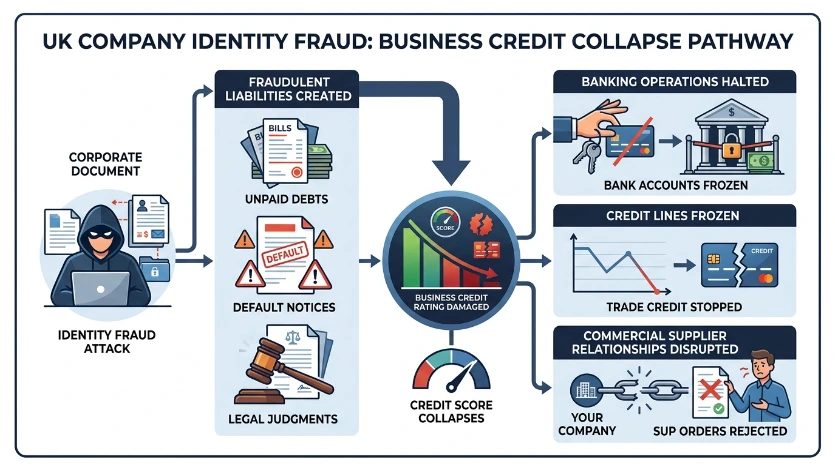
Lenders record default notices against compromised corporate profiles when fraudulent debts remain unpaid. Credit reference agencies decrease corporate credit scores automatically following unpaid invoice reports. Low credit scores prevent legitimate entities from securing equipment financing, commercial mortgages, or operational overdraft facilities.
Banking institutions freeze corporate bank accounts upon detecting conflicting registry entries or fraudulent activity alerts. Account freezes stop routine commercial transactions, including payroll processing, vendor payments, and operational expense handling. Resolving banking freezes requires extensive legal documentation and administrative validation procedures.
Suppliers cancel trade credit terms when credit reference agencies report heightened risk metrics. Losing trade credit forces companies to fund raw materials and inventory through upfront cash payments. Capital depletion strains daily operational liquidity and restricts commercial expansion capacity.
Businesses evaluating risk mitigation strategies often review Fraud Protection vs. Insurance: How to Shield Your Business Identity to structure complete asset security. While insurance policies reimburse financial losses after fraud occurs, proactive verification prevents unauthorized administrative access entirely. Combining preventive verification with institutional protection secures corporate assets continuously.
What Regulatory Requirements Govern UK Identity Verification Standards?
UK identity verification standards are governed by Money Laundering Regulations, the Companies Corporate Governance Framework, and Economic Crime Legislation. These statutory regulations mandate verified director credentials and strict anti-money laundering compliance for all UK businesses.
The Economic Crime and Corporate Transparency Act enforces stringent identity verification requirements for all registered UK directors. Legal mandates require corporate officers to complete verified identity checks before completing company registration. Statutory compliance failure results in severe financial penalties and potential disqualification from acting as a company director.
Anti-Money Laundering (AML) regulations require businesses to maintain documented Customer Due Diligence (CDD) procedures. Companies must verify the identity of ultimate beneficial owners holding more than 25% of company shares. Maintaining audit-ready verification records protects corporate entities during statutory regulatory reviews.
The UK General Data Protection Regulation (UK GDPR) dictates strict data processing protocols for personal verification records. Identity verification systems must process personal data using end-to-end encryption and secure storage architectures. Compliance frameworks ensure identity data remains fully protected against external cyber threats and unauthorized data leaks.
Why Is Manual Identity Verification Obsolete for Modern Firms?
Manual identity verification is obsolete because it is slow, vulnerable to human error, and easily bypassed by sophisticated document forgeries. Automated digital verification processes documents in seconds while catching complex structural alterations that human eyes miss.
Manual review processes require physical document inspections that create operational bottlenecks across administrative departments. Staff members spend hours manually reviewing passports, utility bills, and proof of address documents. Administrative delays slow down director onboardings, client acquisitions, and routine corporate adjustments.
Human checkers fail to consistently identify advanced physical and digital document forgeries. Modern counterfeiters manufacture high-quality fake identity cards containing authentic security holograms and micro-print text. Human reviewers lack the technological equipment required to detect microscopic print alterations or digital image manipulation.
Paper-based validation systems create security vulnerabilities during physical record storage and transmission. Sending unencrypted physical documents via post or unencrypted email exposes sensitive personal data to interception. Modern enterprises require automated verification workflows to ensure absolute data privacy and regulatory compliance.
Small business owners seeking to prevent operational disruptions should evaluate Are Your Competitors Stealing Your Leads After Hours? to streamline administrative efficiency and business security. Optimizing administrative response workflows prevents client loss while maintaining continuous operational security. Modern automation safeguards client acquisition pipelines and administrative registers simultaneously.
How Does Form My Company Streamline Identity Authentication?
Form My Company streamlines identity authentication by integrating automated verification directly into UK company formation and maintenance workflows. Our platform validates director credentials against official databases instantly, ensuring complete compliance and legal security.
Our advanced digital platform automates director identity checks during initial business registration. Enterprise technology validates government-issued identification documents and biometric facial data in real time. Automated processing eliminates administrative delays while delivering total legal accuracy for corporate filings.
Form My Company provides continuous oversight of corporate records to prevent unauthorized changes at Companies House. Form My Company monitors company registers constantly to identify and intercept fraudulent filing attempts immediately. Form My Company gives corporate officers complete visibility over administrative entries and corporate filings.
Form My Company delivers full compliance management for expanding UK enterprises. Form My Company handles regulatory updates, director identity validation, and statutory record management through a single dashboard. Partnering with Form My Company secures your corporate identity while simplifying ongoing administrative compliance.
Explore our Fraud Protection guide,
Launch a UK Company That Banks, Scales, and Stays Compliant
Start and Plan Your UK Business Around 2026 Bank Holidays
Frequently Asked Questions
What is corporate fraud protection and how does it protect UK businesses?
Corporate fraud protection safeguards registered companies by monitoring official registries for unauthorized administrative changes and filing attempts. Services like Form My Company’s Fraud Protection block fraudulent alterations to director details, registered office addresses, and share capital records at Companies House. This continuous security monitoring prevents business identity theft, hijacked credit lines, and unauthorized corporate takeovers.
How does Companies House identity verification prevent business impersonation?
Companies House identity verification requires all directors and beneficial owners to validate their credentials using biometric checks and official government documentation. By cross-referencing identification data against state databases, automated identity verification systems prevent criminals from registering fake officers or hijacking existing corporate profiles. Enterprise fraud protection platforms integrate these verification protocols to stop illegal filings before public publication.
Why do UK companies need proactive identity verification services?
Proactive identity verification services protect commercial entities from default judgments, frozen bank accounts, and severe credit score degradation caused by identity theft. Manual reviews often fail to detect sophisticated document forgeries, leaving organizations exposed to fraudulent loan applications and asset leasing schemes. Automated authentication ensures continuous compliance with UK Anti-Money Laundering (AML) regulations and Economic Crime legislation.
What happens if unauthorized changes are filed against a company register?
Unauthorized filings can lead to diverted official correspondence, unauthorized commercial loans, and corporate credit rating damage within days. Implementing Form My Company’s Fraud Protection provides real-time alerts whenever a filing is submitted against your company profile, allowing immediate intervention. Instant notification allows directors to challenge fraudulent changes with Companies House before commercial suppliers or financial institutions react to manipulated public data.
Who is legally required to undergo identity verification under UK business law?
Under the Economic Crime and Corporate Transparency Act, all existing company directors, persons with significant control (PSCs), and individuals forming new UK companies must complete verified identity checks. Corporate service providers and administrative officers must also authenticate their identity using certified compliance frameworks. Utilizing structured verification mechanisms ensures full statutory compliance while securing business operations against unauthorized administrative modifications.