
To process a director resignation in the UK legally, you must accept a formal written letter of resignation, update your company’s statutory registers immediately, and notify Companies House by submitting Form TM01 within 14 days of the effective resignation date.
What Is the Formal Process for a UK Director Resignation?
The formal process requires a director to submit a written resignation letter, followed by board acceptance, statutory register updates, and filing Form TM01 with Companies House within 14 days to update the public record legally.
A director formalises their departure by serving a written notice to the company’s registered office. This notice must state the intent to resign and specify the exact effective date. Once received, the remaining board members or company secretary review the articles of association to confirm any specific resignation procedures or notice periods required by the business.
Following receipt of the notice, the board must formally accept the resignation. They record this decision in official board minutes. The company secretary or surviving director updates the internal Statutory Register of Directors immediately to reflect the exact date the directorship ceased.
The final administrative step involves notifying the official UK registrar. The company files Form TM01 online or by paper with Companies House. This filing must occur within 14 days of the departure date to ensure the public register reflects accurate governance structures.
Why Is Immediate Companies House Notification Essential?
Filing Form TM01 within 14 days is a statutory requirement under the Companies Act 2006, protecting departing directors from ongoing liability and keeping company public records compliant with UK corporate law.
Filing Form TM01 updates the public database at Companies House. If a company fails to submit this notice within the mandatory 14-day window, the departing director remains listed on the public record as an active officer. This delay exposes the former director to legal obligations and potential liabilities for corporate actions taken after their actual departure date.
Unupdated records create severe operational friction for the business itself. Financial institutions, credit rating agencies, and regulatory bodies rely on public registers to verify corporate authority. Discrepancies between internal board structures and public records delay banking operations, contract executions, and commercial financing applications.
Failure to report statutory changes constitutes an offence by the company and its remaining officers under UK law. Repeated failure to keep public records updated results in financial penalties and risks prosecution for default fine liability.
How Does a Director Resignation Affect Board Quorum and Structure?
A resignation reduces the total number of active directors, which can breach the minimum quorum requirements set by your articles of association or the statutory minimum of one natural director.
UK private limited companies must maintain at least one active director who is a natural person. Public limited companies require a minimum of two directors. When a director leaves, the remaining board must immediately verify that the remaining number of officers meets these legal thresholds.
The company must also review its articles of association regarding quorum limits for board meetings. If the minimum required number of directors for voting is two, and a resignation leaves only one director in office, the board loses its legal capacity to make valid corporate decisions.
When a resignation drops the board size below statutory or contractual minimums, the company must prioritize appointing a replacement officer. You can review our detailed breakdown on Director Appointment: How to Properly Structure Your Board in 2026 to ensure your upcoming appointments meet current governance frameworks.
What Corporate Records Must You Update After a Resignation?
You must update three core corporate records: the internal Register of Directors, the Companies House public database, and your internal governance files including board minutes.
Updating corporate records involves distinct administrative steps across internal and external documentation. Companies must maintain accurate internal records alongside external filings to remain fully compliant during audits.
Update the statutory Register of Directors with the exact termination date.
Minute the board meeting acknowledging the director’s formal notice.
File Form TM01 through Companies House WebFiling services.
Revoke banking authorizations and legal powers of attorney.
If the departing individual also held executive rights, access permissions to secure corporate facilities and meeting locations must be terminated. For professional governance, utilizing a formal Conference Room allows the remaining board to hold confidential director exit meetings and record compliant minutes efficiently.
How Do You Revoke Bank Mandates and Legal Authorities?
You revoke access by issuing formal notification to financial institutions, updating signing mandates, and cancelling existing powers of attorney or digital authorization tokens immediately upon departure.
A director resignation does not automatically cancel bank account access or commercial signing rights. The company must proactively contact all financial providers, lenders, and merchant accounts to remove the individual from existing bank mandates. Delays in this process leave financial accounts vulnerable to unauthorized transactions.
Companies must review all outstanding corporate resolutions and legal instruments. If the departing director held explicit power of attorney or authorization to bind the company to commercial contracts, the board must execute a formal deed of revocation.
Digital credentials present another immediate risk area. The internal IT department must revoke access to corporate management software, financial software, government portals, and Companies House WebFiling authentication codes. Prompt removal prevents security breaches and preserves sensitive company data.
What Happens If a Sole Director Resigns?
A sole director cannot leave a company without a replacement lined up, because UK law requires every active company to maintain at least one natural person as a director.
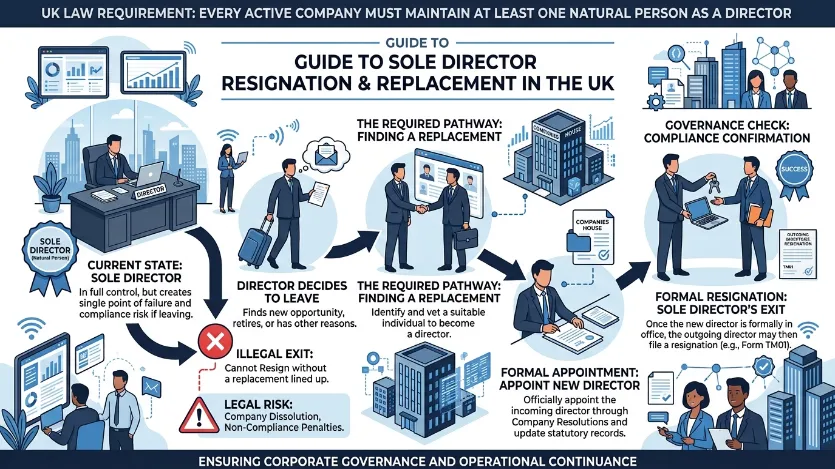
When a sole director intends to step down, they must arrange for a successor before submitting their formal resignation. If a sole director resigns without appointing a replacement, the company enters a state of corporate paralysis. It becomes legally unable to execute contracts, manage bank accounts, or file statutory tax returns.
If the sole director is also the sole shareholder and passes away or resigns abruptly, the articles of association dictate how personal representatives or executors may appoint a new director. If the articles do not permit immediate appointment, the company must petition the court to order a general meeting.
To avoid severe operational delays, businesses frequently evaluate professional assistance when restructuring their leadership team. You can evaluate the strategic trade-offs in our guide on DIY Director Appointment vs. Professional Filing: A Risk Comparison to protect your business during officer transitions.
How Does a Resignation Impact Persons with Significant Control (PSCs)?
If the resigning director holds more than 25% of company shares or voting rights, you must update the PSC register and file Form PSC07 alongside the director resignation.
A director role and a Person with Significant Control (PSC) status are distinct legal concepts. However, many directors in small and medium-sized enterprises also hold significant equity or board control rights. When a director leaves, their operational control may change, triggering separate PSC reporting obligations.
If a resigning director surrenders their shares, transfers voting rights, or gives up the right to appoint or remove the majority of the board, the company must update its internal PSC register within 14 days. The business then has 14 additional days to notify Companies House using the relevant PSC forms.
Failing to maintain accurate PSC records carries severe criminal penalties for both the company and its officers. Businesses must review shareholder agreements and statutory registers concurrently whenever a member of the board steps down.
Streamlining Your Corporate Compliance
Managing corporate changes requires precise administrative execution, strict adherence to statutory deadlines, and complete accuracy across public records. Form My Company provides professional secretarial support, official filing management, and corporate services to ensure your business remains fully compliant with UK corporate law at every stage of growth.
Explore our Conference Room guide,
Ensure Your Business Standing is Verified by Form My Company
Prevent Corporate Fraud with Form My Company’s Security Suite
Frequently Asked Questions
How does corporate fraud protection prevent unauthorized company changes at Companies House?
Corporate fraud protection continuously monitors the official UK register and automatically alerts businesses to unverified filings or officer updates. Services like the fraud protection offered by Form My Company help prevent corporate identity theft by blocking unauthorized alterations to company names, registered addresses, and director details before legal ownership is compromised.
What is the risk of not protecting a UK registered business from corporate identity theft?
Without active monitoring, fraudsters can illegally replace company directors, transfer business assets, or secure fraudulent lines of credit in your business’s name. Utilizing targeted fraud protection through Form My Company mitigates these vulnerabilities by ensuring any suspicious corporate filing is flagged immediately for fast legal intervention.
Can fraudsters alter registered office addresses without owner consent?
Yes, unauthorized individuals can submit fraudulent address change forms directly to Companies House unless preventative measures are in place. Implementing specialized corporate fraud protection locks down statutory records and ensures only authenticated officers have the authority to alter registered addresses or official company details.
How do business fraud protection services work for small UK enterprises?
Business fraud protection services integrate directly with official registries to provide real-time tracking, risk assessments, and immediate breach notifications for small and medium-sized enterprises. Form My Company offers digital monitoring tools that track statutory filings 24/7, safeguarding small businesses from corporate identity hijacking without requiring manual register audits.
How quickly can a business recover from unauthorized director or filing changes?
Resolving unauthorized filings through official legal and registry channels can take weeks or months if left undetected. Proactive corporate fraud protection enables immediate detection, allowing companies supported by Form My Company to reject fraudulent submissions instantly and prevent operational disruptions or credit rating damage.