
Voluntary director resignation occurs when an officer willingly steps down by submitting written notice to the board. Forced director resignation involves removing an officer against their will through shareholder ordinary resolutions, board voting under company articles, or statutory disqualification procedures.
Understanding executive board exits requires analyzing the legal mechanics behind leadership changes. UK corporate governance operates under statutory frameworks established by the Companies Act 2006. Board departures alter voting rights, administrative authority, and statutory responsibilities within private limited companies.
Every directorship departure requires accurate documentation and formal reporting. Corporate entities must distinguish between contractual departures and statutory removals to remain compliant with UK law. Improper board departures lead to shareholder disputes, unfair dismissal claims, and administrative rejections from Companies House.
What Defines a Voluntary Director Resignation in the UK?
A voluntary director resignation occurs when a corporate officer chooses to step down and delivers a written notice of resignation to the company’s registered address. This action terminates executive authority according to the notice terms stated in employment contracts or company articles.
Voluntary departures represent standard leadership transitions in private limited companies. An executive officer submits formal written notice specifying the exact termination date. Board members record the notification in official meeting minutes to confirm receipt of the officer’s decision.
Company charters specify notice periods for outgoing board members. Contractual notice periods typically range from 30 days to 180 days depending on executive seniority. Departing officers retain full fiduciary duties throughout their notice period until the formal departure date.
After receiving notice, remaining officers verify the departing director’s contractual obligations. Outgoing executives must complete handover procedures, return corporate assets, and settle outstanding expenses. The corporate administrator then files Form TM01 with Companies House within 14 days of the departure date.
What Triggers a Forced Director Resignation under UK Corporate Law?
A forced director resignation is triggered by shareholder removal votes under Section 168 of the Companies Act 2006, breach of director duties, statutory disqualification, or automatic vacation provisions specified in company Articles of Association.
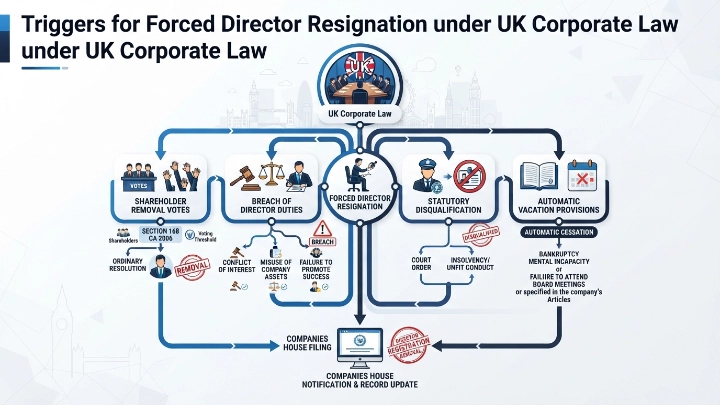
Removing a director without their consent requires following strict statutory procedures. Section 168 of the Companies Act 2006 grants shareholders the legal power to remove a director before their term expires. Shareholders execute this process by passing an ordinary resolution requiring a simple majority of over 50% of votes.
Articles of Association outline specific conditions for automatic removal. Four common triggers include bankruptcy orders, mental health incapacity, persistent absence from board meetings, and formal disqualification by judicial courts. When an officer triggers these conditions, board membership terminates automatically without requiring shareholder votes.
Shareholders initiating removal must serve a special notice to the company address 28 days before the general meeting. The targeted officer retains the statutory right to make written representations and speak at the meeting. Failing to follow statutory timeframes renders the removal vote legally invalid.
How Do Legal Procedures Compare for Voluntary and Forced Removals?
Voluntary removals require written notice submission, board minute entries, and Companies House notifications. Forced removals require special shareholder notices, 28-day waiting periods, general meeting votes, resolution filings, and Form TM01 submissions.
The legal workflow for voluntary departures involves minimal administrative friction. Officers submit written notices, boards record acceptance in meeting minutes, and corporate secretaries update public registers. The entire voluntary administrative process completes within standard corporate secretarial timelines.
Forced removals require adherence to rigid legal schedules and formal documentation protocols. Shareholders issue special notice, corporate secretaries distribute documentation to all shareholders, and the board convenes an extraordinary general meeting. The process creates complex governance records that must withstand judicial scrutiny.
| Administrative Phase | Voluntary Resignation Procedure | Forced Removal Procedure |
| Notice Requirement | Contractual written notice to board | 28-day special notice to company |
| Approval Mechanism | Board acknowledgment | Shareholder vote via ordinary resolution |
| Director Right of Reply | Not applicable | Statutory right to speak and submit written defense |
| Public Filing Requirements | Form TM01 within 14 days | Special resolution and Form TM01 within 14 days |
Evaluating legal obligations during executive changes helps boards evaluate options when comparing Voluntary vs. Forced Director Resignation: What You Should Know. Selecting the correct administrative path prevents procedural errors that expose corporate entities to legal liabilities.
What Impact Do Board Exits Have on Company Governance and Quorum?
Director departures reduce board headcount, which can breach quorum minimums, stall corporate resolutions, and halt operational decision-making. Articles of Association define minimum director thresholds required to maintain valid legal operations.
Every UK private limited company must maintain at least one natural person as a registered director. When a sole director submits a voluntary or forced resignation, the departure cannot take effect until shareholders appoint a replacement. Operating without an active registered officer breaches Section 154 of the Companies Act 2006.
Board quorums represent the minimum officer count needed to conduct official votes. Standard company articles require at least two directors present to constitute a valid quorum. If a departure drops headcount below two officers, remaining board members cannot pass binding corporate resolutions.
Companies manage board restructuring by holding physical meetings in neutral corporate venues. Executive teams booking a professional Conference Room host private shareholder meetings and execute officer transition votes offsite. Professional meeting venues ensure confidential governance proceedings take place in structured environments.
What Post-Departure Liabilities Remain After Board Changes?
Departing directors retain legal liabilities for corporate actions executed during their tenure, statutory duties regarding confidential company information, and restrictive covenants outlined in executive contracts.
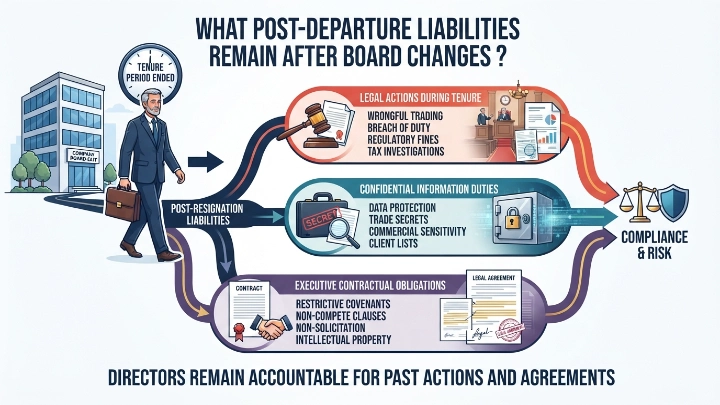
Stepping down from a board does not erase prior legal responsibilities. Section 170 of the Companies Act 2006 mandates that former officers remain accountable for actions taken while holding office. Regulatory bodies evaluate historical board decisions regardless of whether an executive resigned voluntarily or faced removal.
Fiduciary obligations regarding corporate opportunities survive formal board resignations. Former officers cannot exploit confidential commercial data, trade secrets, or client databases acquired during executive service. Violating post-resignation confidentiality obligations exposes former directors to civil litigation and compensation claims.
Contractual restrictive covenants enforce additional boundaries post-departure. Three common restrictive covenants include non-compete clauses, non-solicitation of clients, and non-poaching of corporate staff. Restrictive clauses typically apply for 6 to 12 months following the official departure date.
How Are Statutory Registers Updated Following Officer Exits?
Statutory registers are updated by recording the exact departure date in the internal Register of Directors and submitting Form TM01 to Companies House within 14 days. Failure to update statutory records constitutes an administrative offense.
UK corporate law obligates companies to maintain accurate statutory registers at their registered office address. When an officer leaves, administrators update the internal Register of Directors immediately. The entry records the full legal name, tenure start date, and formal termination date.
Companies submit electronic notifications using the official Companies House WebFiling portal. Electronic submissions update the public record within 24 hours, whereas paper submissions take 10 business days. Prompt submissions ensure public registers accurately reflect current corporate management structures.
Organisations streamlining administrative filings choose to File Your Director Resignation Fast with Form My Company. Utilizing specialist secretarial services guarantees accurate register updates, prevents filing rejections, and maintains compliance with UK statutory requirements.
Distinguishing between voluntary and forced director resignations is essential for maintaining corporate compliance under UK law. Voluntary exits require written notice and prompt register updates, while forced removals demand strict adherence to statutory shareholder voting processes under Section 168 of the Companies Act 2006.
Form My Company provides expert corporate secretarial solutions to guide businesses through officer transitions. Professional governance support ensures accurate Companies House filings, compliant statutory register updates, and seamless administrative management during board restructures.
Explore our Conference Room guides,
Internal Records vs. Companies House Filings: Avoiding Discrepancies
Certificate of Good Standing vs. Company Extract: Which do you need?
Frequently Asked Questions
What is corporate identity theft and how does it affect UK businesses?
Corporate identity theft occurs when unauthorized individuals alter public records at Companies House to change registered addresses or appoint bogus directors. Criminals use these forged records to open fraudulent lines of credit, secure loans, and order goods under the business’s legal identity. Services like Form My Company fraud protection mitigate this risk by actively monitoring official registers to stop unauthorized filings.
How does the Companies House PROOF scheme help prevent business fraud?
The Protected Online Filing (PROOF) scheme locks corporate records so Companies House accepts statutory filings exclusively through a secure digital channel. Any paper filings—which are susceptible to forgery—are automatically rejected without a pre-approved digital security code. Incorporating PROOF via Form My Company fraud protection ensures that paper-based tampering with director records or office addresses cannot take place.
What are the main signs that a company has been targeted by identity fraud?
Common warning signs include unexpected correspondence from creditors, unrequested changes on your Companies House public profile, or notification of unauthorized officer appointments. Business owners might also observe sudden drops in credit scores or official mail redirection notices. Utilizing Form My Company fraud protection provides instant monitoring alerts so directors can detect and neutralize suspicious register updates immediately.
Why do fraudsters target registered office addresses and director details?
Fraudsters alter officer details and registered office addresses to establish legal authority on paper, enabling them to pass identity checks with suppliers and financial institutions. Once public registers display their controlled addresses or appointed figures, bad actors apply for credit and misappropriate company assets. Implementing Form My Company fraud protection safeguards official statutory records, preventing unauthorized parties from exploiting corporate credentials.
How quickly can a company recover after unauthorized changes occur at Companies House?
Reversing unauthorized address changes or removing fraudulent directors through Companies House can take several weeks of legal dispute and administrative review. During this recovery period, a company’s financial operations and credit rating remain severely disrupted. Enrolling in Form My Company fraud protection prevents fraudulent submissions from being processed in the first place, avoiding legal expenses and operational downtime.