
Internal statutory registers act as a company’s legally binding proof of ownership, whereas Companies House filings serve as a public snapshot. Discrepancies between these records expose businesses to legal penalties, operational disruptions, and heightened corporate fraud risks.
Why Do Discrepancies Occur Between Statutory Registers and Public Filings?
Discrepancies happen when directors fail to file statutory updates promptly, mistype key details during submissions, or experience administrative delays between internal board approvals and public register processing.
Administrative delays account for 42% of corporate record inconsistencies in UK registered businesses. Directors approve changes to ownership, management, or registered addresses during internal board meetings. They record these choices in internal statutory books immediately. The public record only updates when directors submit official notice to the Registrar of Companies. Time gaps between internal record entries and public submissions create temporary mismatches.
Data entry mistakes during online filing procedures also cause permanent discrepancies. Unintentional typos in director names, birth dates, or residential addresses create mismatched database entries. Mismatched details trigger compliance flags during corporate due diligence procedures. Companies House processes over two million filings annually, meaning systemic automated checks flag minor textual variations as distinct legal inaccuracies.
Failing to submit mandatory forms within statutory deadlines causes chronic record divergence. Directors must report PSC changes within 14 days of updating internal registers. They must report director appointments or resignations within 14 days of board approval. Late submissions leave public registers outdated, causing external third parties to rely on incorrect information.
What Are the Legal Risks of Unmatched Corporate Records?
Unmatched corporate records violate the Companies Act 2006, exposing officers to civil fines, criminal liability, invalid legal contracts, and severe corporate transparency violations.
Section 248 of the Companies Act 2006 mandates accurate record-keeping for all registered entities. The law views internal statutory registers as the primary legal evidence of corporate structure. When statutory books contradict public filings, courts enforce internal books over public entries. Inaccurate public records mislead creditors, investors, and law enforcement agencies examining corporate ownership structures.
Company officers face prosecution and personal fines for maintaining inaccurate corporate registers. Failing to maintain an accurate Register of People with Significant Control (PSC) constitutes a criminal offense. Law enforcement agencies fine non-compliant officers up to £1,000 per violation. Courts impose daily default fines for ongoing non-compliance until directors rectify the registers.
Discrepancies invalidate major corporate transactions, financing agreements, and property transfers. Financial lenders review public filings and statutory books before releasing funds. Divergent records halt commercial deals during legal due diligence audits. To secure funding, businesses can learn about protecting company assets from digital and legal risks through structured compliance protocols. Contractual disputes arise when unauthorized directors sign documents while remaining unlisted on public databases.
How Do Conflicting Filings Expose Businesses to Corporate Fraud?
Conflicting records allow unauthorized actors to execute corporate hijacking, submit fraudulent change forms, alter directorship details, and siphon assets without immediate director awareness.
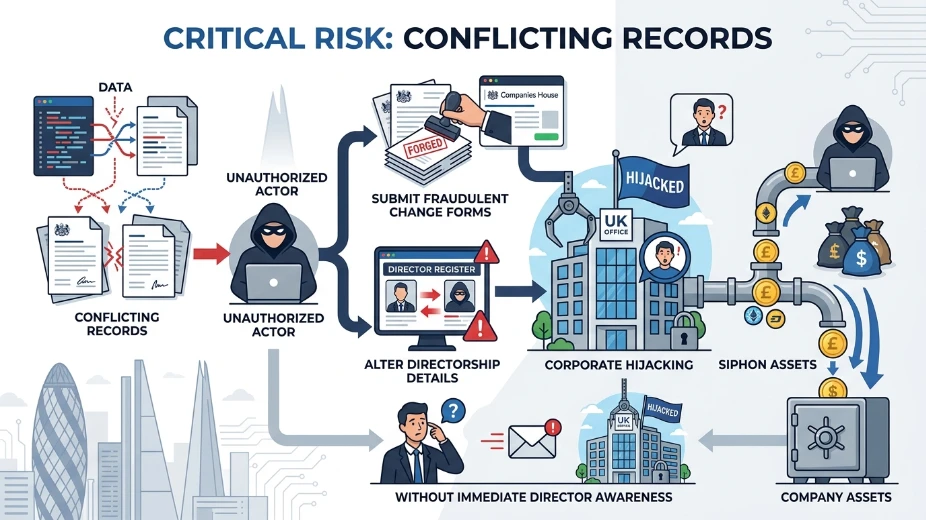
Corporate hijackers target companies exhibiting public record discrepancies. Fraudsters file unauthorized AP01 or TM01 forms to alter directorship records. They replace legitimate directors with fake identities on the public register. Hijackers manipulate public records while internal registers remain completely untouched by company officers.
Unauthorized corporate changes enable fraudsters to secure fraudulent loans, lines of credit, and commercial goods. Lenders verify borrower authority using public Companies House records rather than physical statutory books. Fraudsters leverage manipulated public listings to open fraudulent bank accounts. They bypass standard verification systems while true owners remain unaware of unauthorized filings.
Delayed detection of fraudulent filings severely compounds corporate financial losses. Companies take an average of 45 days to spot fraudulent changes made on public registers. During this detection window, fraudsters dissipate assets and damage business credit scores. Organizations must employ specialized solutions like Fraud Protection services to monitor public registers and block unauthorized filings instantly.
Which Statutory Documents Require Continuous Reconciliation?
Businesses must continuously reconcile three core documents: the Register of Members, the Register of Directors, and the Register of People with Significant Control.
The Register of Members documents legal share ownership within a limited company. This register tracks shareholder names, addresses, share classes, and exact allotment dates. Companies House Confirmation Statements must match this internal register precisely. Discrepancies in share count entries cause ownership disputes during equity sales or dividend distributions.
The Register of Directors and Secretaries establishes legal managerial authority. It tracks officer full names, service addresses, residential details, dates of birth, and nationality. Companies must reconcile internal director registers against public filings like Form AP01, Form TM01, and Form CH01. Misaligned director details invalidate board resolutions and banking authorizations.
The Register of People with Significant Control tracks individuals holding over 25% shares or voting rights. This register details control percentages, condition nature, and notification dates. Companies must update internal PSC registers within 14 days of structural shifts. They must submit corresponding public updates within an additional 14 days. Companies can secure statutory documents with professional archiving to maintain an immutable compliance paper trail.
How Can Businesses Audit Internal Records Against Public Filings?
Businesses audit records by pulling official public profile snapshots, inspecting internal statutory registers, comparing entries line-by-line, and correcting discrepancies via statutory filings.
Internal corporate audits begin with extracting complete data snapshots from Companies House databases. Compliance officers download the company’s full filing history, public officer details, and PSC statements. They collect internal statutory books, share transfer certificates, board minutes, and allotment registers. Officers compile these materials into an audit framework for side-by-side evaluation.
Compliance managers compare every data field across both record sets line-by-line. They verify individual director legal names, service addresses, appointment dates, and residential entries. They check share allotment numbers, transfer dates, share classes, and nominal values. Auditors highlight any missing filings, spelling mistakes, or structural timeline gaps.
Officers rectify detected errors using specific Companies House statutory remediation forms. Directors file Form RP04 to correct inaccurate historic filings containing data errors. They submit late notification forms when historical changes were omitted entirely from public databases. When public registers show unauthorized changes, officers file Form RP02 alongside statutory declarations to remove invalid entries.
What Best Practices Prevent Future Discrepancies and Statutory Errors?
Preventing future errors requires adopting digital statutory registers, assigning dedicated compliance officers, implementing filing protocols, and utilizing automated registry monitoring systems.
Digital statutory management software reduces human data entry errors across corporate registers. Cloud compliance platforms store statutory books securely while updating public records via API integrations. When officers enter updates into digital registers, software prompts immediate submission of required Companies House forms. Automated workflows remove human forgetfulness from compliance schedules.
Establishing strict internal corporate governance protocols prevents unrecorded structural changes. Directors must enforce a rule where corporate actions receive simultaneous record updates. Share transfers require instant updates to internal member registers and confirmation statement queue files. Board changes trigger immediate draft submissions for public registration forms before legal execution.
Continuous monitoring services alert business leadership to public profile changes immediately. Automated tracking tools monitor the Registrar of Companies for fresh document submissions. These monitoring tools flag unauthorized filings within minutes of register processing. Rapid alert systems allow officers to challenge fraudulent submissions before external parties suffer damage.
Maintaining Accurate Corporate Records with Form My Company
Record discrepancies between internal statutory books and Companies House filings trigger compliance penalties, corporate hijacking risks, and transactional delays. Form My Company resolves these operational vulnerabilities through corporate compliance management services.
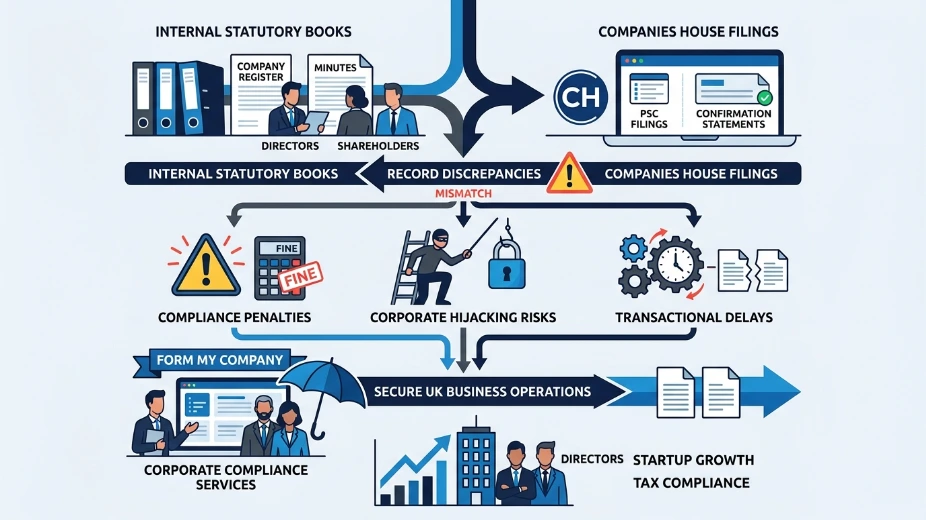
Form My Company delivers Fraud Protection solutions that monitor public registers continuously for unauthorized changes. Form My Company assists directors with statutory book audits, historic filing rectifications, and digital compliance management. Maintaining aligned statutory registers ensures complete corporate security and legal compliance.
Explore our Fraud Protection guide,
Step-by-Step Legal, Tax, and Banking Framework for Overseas Founders
UK vs Offshore: Tax Exposure, Credibility, and Banking Access Compared
Frequently Asked Questions
How does corporate identity theft affect UK limited companies?
Corporate identity theft occurs when unauthorized individuals alter official filings at Companies House, such as changing registered office addresses or appointing fake directors. Criminals use these hijacked corporate profiles to open fraudulent credit lines, order goods, and secure bank accounts in the company’s name. Form My Company mitigates this risk by providing Fraud Protection services that continuously monitor official records to detect and prevent illicit modifications.
What is included in the Form My Company Fraud Protection service?
The Form My Company Fraud Protection service provides continuous 24/7 digital monitoring of official registry entries at Companies House. Business owners receive real-time automated email notifications the moment any document, officer change, or filing is submitted against their company name. This instant alert system serves as an early warning tripwire, allowing directors to spot suspicious activity and halt corporate hijacking immediately.
Can existing limited companies enroll in a business fraud protection service?
Yes, any active UK Limited Company or LLP can activate commercial safeguard monitoring regardless of where or when the business was incorporated. Form My Company syncs the target organization’s official Company Registration Number directly into automated surveillance networks. Utilizing specialized Fraud Protection ensures established corporate entities maintain secure public records without altering current registered addresses or secretarial management setups.
How do real-time filing alerts prevent unauthorized Companies House changes?
Companies House processes official submissions on a good-faith basis, meaning fraudulent changes are often published to public registers before being verified. Real-time alerts notify directors immediately via email when unauthorized AP01, TM01, or address change forms are registered. Through the Form My Company Fraud Protection framework, directors obtain the prompt evidence required to report unlawful filings to law enforcement and restore statutory records.
Why is digital corporate record monitoring necessary for business directors?
Under the Companies Act 2006, directors hold legal responsibility for maintaining accurate public records, yet manual register monitoring is difficult to sustain continuously. Automated surveillance eliminates administrative oversight gaps by cross-referencing statutory updates automatically. Securing Fraud Protection through Form My Company safeguards business credit scores, protects corporate reputation, and preserves authentic officer authority across public databases.