
Professional archiving secures statutory documents by storing physical registers in climate-controlled, tamper-evident vaults while maintaining encrypted digital backups compliant with UK Companies Act 2006 requirements. This dual-layer approach prevents unauthorized modifications, eliminates document loss, and ensures instant audit readiness for regulatory inspections.
Why Is Secure Statutory Document Archiving Essential for UK Companies?
UK companies face strict legal requirements under the Companies Act 2006 to maintain accurate statutory registers, making secure archiving essential to prevent severe financial penalties, operational disruption, and identity fraud targeting corporate records.
Under Section 1136 of the Companies Act 2006, every registered business must retain accurate statutory registers, including the register of directors, members, and persons with significant control (PSCs). Paper-based files stored in office cabinets remain vulnerable to physical theft, damage, and unauthorized manipulation. Corporate identity theft accounts for significant annual losses across the UK, as bad actors alter official address records or director details to secure fraudulent credit facilities. Secure archiving isolates primary company records from unauthorized internal or external access.
Maintaining statutory registers in certified facilities guarantees compliance during regulatory audits or corporate due diligence. When potential investors or buyers review corporate records, missing registers delay transactions or reduce business valuation. Professional storage solutions use strict chain-of-custody protocols to track every record retrieval. Digital indexing systems log every access attempt, creating an immutable audit trail that satisfies statutory auditors, legal counsel, and law enforcement agencies.
What Statutory Registers Must Every UK Business Maintain and Protect?
Every UK limited company must legally maintain seven primary statutory registers, including registers of directors, secretaries, members, charges, directors’ residential addresses, and persons with significant control (PSCs).
Companies House mandates continuous record-keeping to reflect the true ownership and management structure of an enterprise. The primary statutory registers required by UK corporate law include:
Record director appointments, resignations, and full legal names in the Register of Directors.
Detail the residential locations of company leaders separate from public service addresses in the Register of Directors’ Residential Addresses.
Document official corporate secretaries and appointment dates in the Register of Secretaries.
List all past and current shareholders alongside their specific shareholdings in the Register of Members.
Identify beneficial owners holding more than 25% of shares or voting rights in the Register of PSCs.
Track fixed and floating security interests created over corporate assets in the Register of Mortgages and Charges.
Maintain official notes of shareholder resolutions and board meetings in the Minute Book.
Failing to update these documents within 14 days of a corporate change constitutes an offense by both the company and its officers. Professional record management systems streamline these updates by logging statutory changes in real time while preserving original physical documentation.
How Does Professional Archiving Prevent Corporate Identity Theft and Fraud?
Professional archiving prevents corporate identity theft by replacing vulnerable physical storage with restricted-access vaults, continuous electronic monitoring, and multi-factor authentication for digital record access.
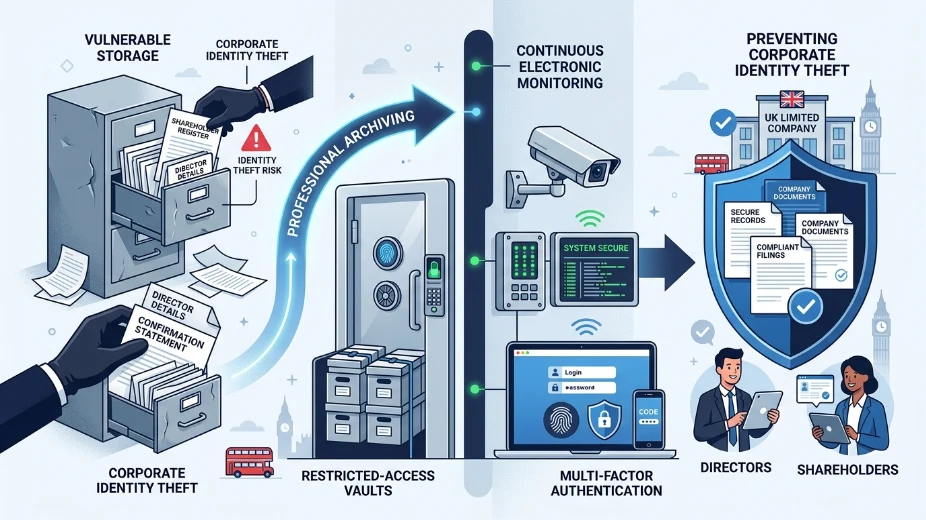
Fraudsters frequently execute corporate hijackings by filing false form AP01 or AD01 notices at Companies House to change director names or registered office locations. Once legitimate officers lose control of public filings, criminals apply for credit, order high-value goods, or liquidate corporate assets. Employing specialized corporate services ensures that internal statutory registers remain protected as the definitive legal proof of ownership, superseding fraudulent external filings.
Companies must monitor public records continuously while safeguarding original registers in secure facilities. When bad actors attempt to register false information at Companies House, physical statutory books held in secure storage provide conclusive evidentiary support to reverse illicit filings quickly. Implementing comprehensive enterprise protection measures through specialized Fraud Protection services creates an immediate barrier against unauthorized filing submissions and identity falsification.
What Are the Steps to Set Up a Secure Archiving System for Company Records?
Setting up a secure archiving system requires auditing existing files, converting physical papers into encrypted digital records, transferring original documents to certified vaults, and establishing role-based access controls.
Transitioning corporate records into a professional archiving framework involves a systematic four-step implementation process:
Audit current statutory registers to identify missing records, historical discrepancies, or unrecorded share transfers.
Digitize all paper documents using high-resolution optical character recognition scans to create searchable, encrypted electronic archives.
Store physical statutory books within climate-controlled facilities featuring 24/7 CCTV surveillance, fire suppression, and biometric entry controls.
Assign role-based access permissions ensuring only authorized corporate officers request physical document release or edit digital files.
When organizations establish structured archiving procedures, they remove operational bottlenecks associated with manual file management. Using professional archiving services enables corporate directors to focus on core operations while ensuring full statutory compliance.
How Do Internal Statutory Registers Differ from Public Companies House Records?
Internal statutory registers serve as the definitive legal proof of company ownership and management, whereas public Companies House filings exist primarily as an information registry for public notice.
Many company directors assume that updating Companies House automatically satisfies legal record-keeping requirements. Under UK company law, the statutory registers kept by the company form the legal reality of corporate appointments and share ownership. If a conflict arises between an internal register of members and a public filing, courts treat the internal statutory register as the authoritative legal document.
Maintaining discrepancies between internal records and public registries exposes corporate officers to regulatory fines and litigation risks. Organizations can review Internal Records vs. Companies House Filings: Avoiding Discrepancies to understand the legal obligations surrounding record reconciliation. Aligning these two record sources through regular audits ensures that public disclosures mirror internal statutory books precisely.
What Are the Legal Penalties for Improper Statutory Record Storage in the UK?
Improper statutory record storage results in criminal liability for company officers, daily court-imposed fines up to £1,000 per violation, and potential disqualification from acting as a corporate director for up to 15 years.
The Companies Act 2006 classifies failure to maintain statutory registers as a criminal offense committed by the corporate entity and every defaulting officer. Companies House and regulatory bodies enforce compliance through strict financial and administrative measures:
| Violation | Legal Ref / Authority | Maximum Penalty / Consequence |
| Failure to Keep Register of Members | Section 113 Companies Act 2006 | Level 3 Fine (£1,000) plus daily default fine |
| Failure to Maintain PSC Register | Schedule 1A Companies Act 2006 | Up to 2 years imprisonment or unlimited fine |
| Refusal of Public Register Inspection | Section 117 Companies Act 2006 | Court order enforcing immediate inspection plus fines |
| Director Disqualification | Insolvency Service / UK Courts | Disqualification from managing companies for 2–15 years |
Professional archiving eliminates non-compliance risks by maintaining accurate records in audit-ready configurations. Storing registers securely ensures that businesses respond to official inspection requests within the statutory 5-day notice period.
How Does Professional Archiving Support Corporate Transactions and Audits?
Professional archiving accelerates corporate transactions, venture capital investment, and annual audits by providing instant, verified access to organized statutory records during legal due diligence.
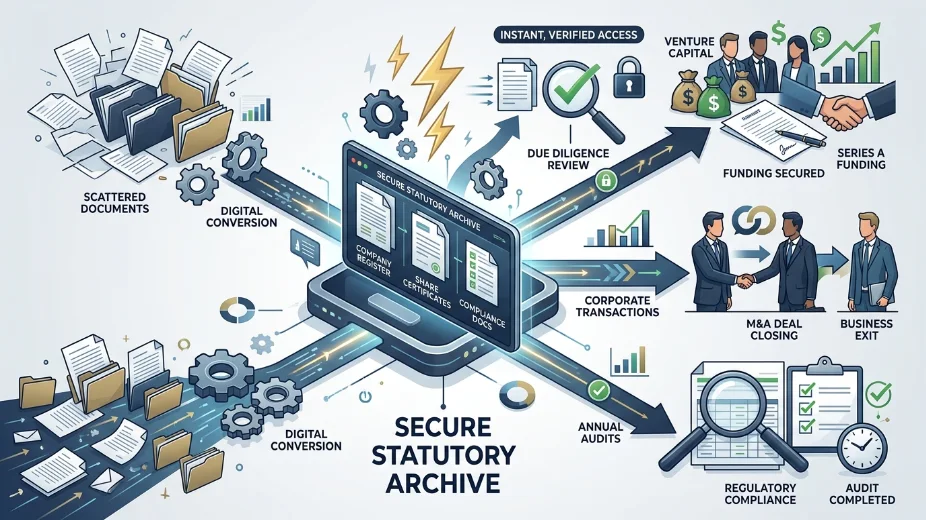
During a corporate acquisition, merger, or funding round, buyers’ legal teams conduct exhaustive due diligence reviews. Missing share certificates, unrecorded board resolutions, or incomplete PSC entries create deal friction and reduce buyer confidence. Verified digital archives allow legal teams to share encrypted access with external advisors instantly, avoiding deal delays caused by lost paperwork.
Using secure statutory record services ensures seamless coordination during annual financial audits. Corporate governance teams must also review broader risk management frameworks, such as Protecting Your Company Assets: A Guide to Digital and Legal Fraud, to secure corporate assets across all administrative touchpoints. Form My Company assists organizations by organizing statutory registers to meet institutional investment and regulatory compliance standards.
Secure Your Statutory Documents with Form My Company
Form My Company provides enterprise-grade statutory archiving and corporate compliance solutions tailored for UK businesses. By combining secure physical vault storage with encrypted digital management systems, Form My Company ensures your legal registers remain accurate, protected, and fully compliant with the Companies Act 2006.
Explore our Fraud Protection guide,
Start Your UK Company from Abroad with Form My Company
Form Your UK Company from 200+ Countries with Full Compliance & Banking Support
Frequently Asked Questions
How does Form My Company protect UK businesses from corporate identity theft?
Form My Company monitors Companies House filings in real time to prevent unauthorized changes to director details, share capital, or registered office addresses. By implementing immediate alert systems and restricted filing protections, this fraud protection service blocks fraudulent filings before bad actors can exploit corporate records.
What is the role of Companies House fraud protection for small businesses?
Companies House fraud protection safeguards small businesses from corporate hijacking, illegal asset transfers, and unauthorized credit applications filed under the company’s name. Services provided by Form My Company ensure statutory registers remain legally sound while stopping fraudulent submissions to public UK registries.
How do statutory document security services prevent legal non-compliance?
Statutory document security services maintain accurate registers of directors, shareholders, and persons with significant control in compliance with the UK Companies Act 2006. Form My Company secures these essential company records in climate-controlled physical vaults and encrypted digital archives to ensure full audit readiness and avoid regulatory fines.
What happens if unauthorized changes are made to a company’s public records?
If unauthorized filings occur, criminals can manipulate corporate identity records to obtain fraudulent financing, purchase goods under company credit, or displace legitimate directors. Utilizing Form My Company fraud protection allows corporate officers to detect discrepancies instantly and reverse illicit Companies House submissions using official legal frameworks.
Why should a business use a professional corporate services provider for document archiving?
Professional corporate service providers establish strict chain-of-custody protocols, biometric access, and 256-bit digital encryption for physical and electronic statutory registers. Form My Company combines professional archiving with automated registry monitoring to deliver complete statutory compliance and corporate asset security for UK enterprises.