
A confirmation statement verifies a company’s legal structure and administrative details with Companies House, whereas annual accounts report a company’s financial performance and balance sheet position over a financial year. UK directors must file both documents separately to maintain statutory corporate compliance.
What Is a Confirmation Statement in the UK?
A confirmation statement is an annual administrative filing that verifies current company information, including registered office details, director profiles, shareholder structures, and persons with significant control. It updates official records without reporting financial performance figures or revenue details.
UK limited companies must deliver this filing to Companies House every 12 months. The submission confirms that public register data matches legal corporate reality. The review period spans 12 months, starting from the company incorporation date or the previous statement date. Directors have a 14-day grace period to submit the filing after the review period ends.
Failing to submit this document causes severe legal penalties for corporate directors. Companies House initiates strike-off proceedings against non-compliant entities, which leads to corporate dissolution and asset forfeiture. Directors who miss deadlines face prosecution, personal fines, and potential disqualification from managing UK corporations. You can review operational strategies by studying Confirmation Statements: Avoiding the Common Pitfalls for UK Directors.
Updating legal filings requires accuracy across every public register field. When details change, corporate officers update information through specific statutory forms alongside the annual filing. Three common data points updated during filings: registered office addresses, officer service locations, and trade classification codes.
What Are Annual Accounts in the UK?
Annual accounts are formal financial reports detailing a company’s income, operational expenses, balance sheet assets, liabilities, and shareholder equity at the end of a financial year. UK law mandates these filings to calculate tax obligations and provide financial transparency.
Every UK business entity prepares annual financial statements for HMRC and Companies House. The document quantifies commercial activity over a 12-month accounting period. Different reporting frameworks apply based on corporate size classifications. Micro-entities prepare simplified balance sheets, while large corporations submit full audited financial reports, cash flow statements, and directors’ reports.
Small business owners monitor accounting periods to align corporate actions with tax filings. Private limited companies submit their first accounts within 21 months of incorporation. Subsequent submissions are due nine months after the financial year closes. Public limited companies follow a stricter six-month deadline following the accounting reference date.
Late filings trigger automated financial penalties from Companies House. Fines double when a company files late in two consecutive financial years. Filing accurate financial reports ensures operational transparency for trade vendors, investors, and commercial lenders.
What Are the Main Differences Between Confirmation Statements and Annual Accounts?
The primary difference lies in content and purpose: confirmation statements verify administrative structure and legal ownership, while annual accounts evaluate financial performance, asset valuations, and tax liabilities. Both filings follow separate regulatory frameworks, statutory deadlines, and Companies House reporting formats.
Evaluating both obligations clarifies compliance structures for corporate officers. Comparing these duties side-by-side demonstrates distinct functional purposes within UK company law:
| Compliance Feature | Confirmation Statement | Annual Accounts |
| Primary Focus | Company administrative data and legal ownership | Financial performance, profit, balance sheet assets |
| Recipient Agencies | Companies House | Companies House and HMRC |
| Filing Deadline | 14 days after the 12-month review period | 9 months after the financial year-end |
| Core Information | PSC registers, shareholders, registered office address | Income statements, balance sheets, capital notes |
| Financial Data Included | None (purely administrative data) | Full (revenue, costs, tax calculations) |
Administrative filings ensure legal transparency on public registries. Financial filings compute corporation tax liabilities and evaluate solvency for external commercial partners. Maintaining distinct preparation tracks prevents costly operational confusion.
When Are the Filing Deadlines for Both Documents?
Confirmation statements are due within 14 days following the end of a company’s 12-month review period, whereas annual accounts are due nine months after the financial year-end for private limited companies. Each document operates on an independent statutory submission timeline.
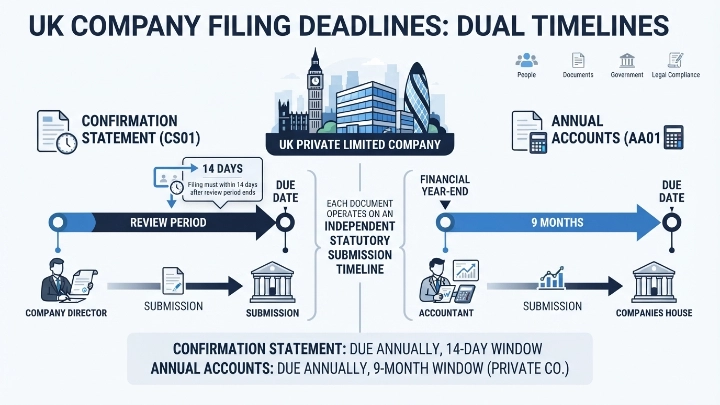
Corporate management teams track distinct accounting dates to avoid filing overlap. The review period for administrative updates starts on incorporation day. Companies submit structural validation reports annually on that specific calendar marker. Changing accounting reference dates alters financial submission deadlines without shifting the administrative confirmation timeline.
Financial accounts follow the business financial year established upon business registration. When companies extend or shorten an accounting reference period, financial deadlines shift accordingly. Directors calculate filing windows precisely because Companies House imposes immediate fines on overdue financial reports.
Scheduling compliance audits prevents accidental administrative defaults. Professional management workflows track these separate statutory markers through modern compliance software.
What Information Must Be Included in a Confirmation Statement?
A confirmation statement must include the registered office address, director details, company secretary records, single alternative inspection locations, shareholder lists, capital structure allocations, and person with significant control declarations. It contains zero corporate earnings or expenditure data.
The filing confirms specific operational data points across corporate registers. If structural changes occur between annual filing dates, directors declare updates during this submission window. Three specific data elements verified: Standard Industrial Classification codes, issued share capital totals, and PSC identity information.
Shareholder disclosures record ownership percentages and equity transfers across the reporting year. Officers verify that share classes match the legal records held in corporate minute books. Discrepancies between internal registers and public records flag compliance warnings during financial due diligence.
Maintaining accurate officer service addresses protects personal privacy while satisfying legal transparency rules. Directors often utilize external corporate addresses to shield private residences from public records. When planning executive board meetings, corporate managers utilize a professional Conference Room to maintain corporate governance standards and privacy.
What Information Must Be Included in Annual Accounts?
Annual accounts must include a balance sheet, profit and loss account, notes to the financial statements, and a directors’ report detailing operational performance. Micro-entities and small companies file streamlined balance sheets using reduced disclosure reporting standards.
Financial reports quantify business performance over the preceding 12-month accounting reference window. The profit and loss account calculates gross revenue, cost of sales, operating expenses, and net profit before tax. The balance sheet measures corporate solvency by balancing assets against liabilities and equity holdings.
Financial reporting requirements vary based on threshold metrics. UK statutory frameworks establish four business categories: micro-entities, small, medium, and large companies. Micro-entities qualify when meeting two of three criteria: turnover under £632,000, balance sheet total under £316,000, or ten or fewer employees.
Notes to the financial statements provide details regarding accounting policies, director remuneration, and creditor debts. Accompanying tax computations calculate Corporation Tax obligations owed directly to HMRC.
Can You File Both Documents Together?
No, you cannot file both documents together as a single combined submission because Companies House processes administrative confirmation statements and financial annual accounts through entirely separate legal systems, statutory forms, and operational workflows.
Although both filings go to Companies House, their internal processing units remain distinct. The confirmation statement updates corporate registry databases, whereas annual accounts pass to public financial evaluation archives. Each submission incurs different statutory filing fees and compliance reviews.
Companies prepare administrative disclosures using dedicated electronic confirmation forms. Financial reports require technical tagging formats like iXBRL for joint submission to HMRC and Companies House.
Sequential management workflows prevent missed compliance targets. Companies often complete administrative validation early in the year to ensure public registers remain fully updated. You can streamlined compliance execution when you Submit Your Confirmation Statement with Form My Company through dedicated corporate filing services.
What Are the Penalties for Non-Compliance?
Failing to file annual accounts results in automatic financial penalties ranging from £150 to £1,500 for private companies, while missing a confirmation statement leads to criminal prosecution of directors, legal strike-off notices, and potential corporate dissolution.
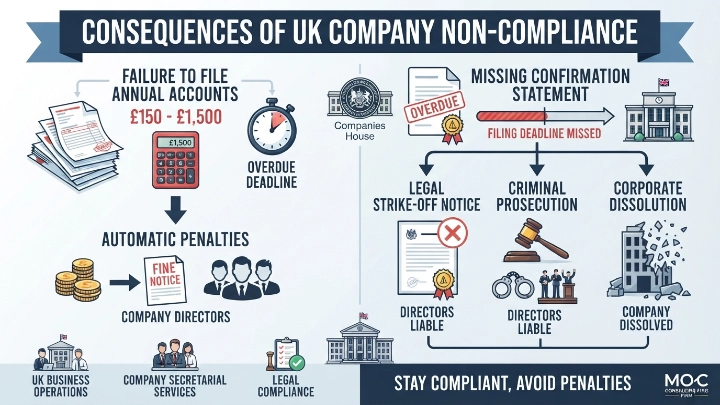
Financial penalties for overdue accounts double automatically if filed late for two consecutive financial years. The financial assessment begins immediately on the day after the statutory deadline passes. Continued failure to submit financial reports leads to personal court summonses for active corporate directors.
Failure to submit confirmation statements carries severe legal consequences beyond monetary fines. Companies House assumes non-filing entities are inactive and initiates legal strike-off procedures. Three consequences follow corporate strike-off: bank account freezing, asset forfeiture to the Crown, and loss of legal trading status.
Directors face personal liabilities for corporate governance defaults. Disqualification orders prevent individuals from serving as UK company officers for up to 15 years. Maintaining proactive filing practices protects personal professional standing and legal entity security.
How Form My Company Delivers Complete Compliance Solutions
Form My Company provides comprehensive statutory management solutions for UK directors and limited companies. The platform simplifies complex administrative requirements, ensuring timely submissions to Companies House and official regulatory bodies. Through structured legal support, corporate entities maintain active legal status without operational disruption.
Managing legal registries requires precise tracking of changing compliance regulations. Form My Company automates administrative reminders, processes official document updates, and manages corporate records across public registers. Professional oversight eliminates risk exposure, protecting directors from late filing penalties and legal strike-off proceedings.
Explore our Conference Room guides,
Voluntary vs. Forced Director Resignation: What You Should Know
Bundle Filing vs. Separate Filings: Saving Time and Money
Frequently Asked Questions
How does corporate identity theft affect UK limited companies?
Corporate identity theft occurs when unauthorized individuals alter company details at Companies House, such as changing registered office addresses, director appointments, or shareholder records. Criminals hijack official records to secure loans, intercept company mail, or order commercial goods in the business name. Installing Form My Company‘s Fraud Protection provides automated monitoring to detect unauthorized filings before severe financial or reputational damage occurs.
What is the Fraud Protection service from Form My Company?
The Fraud Protection service is a 24/7 security watchdog that monitors official UK company registers for unauthorized filings and corporate identity hijacking. It sends real-time email alerts whenever updates—such as address or director changes—are submitted to Companies House. This allows UK business owners to take immediate action against fraudulent submissions and maintain complete profile integrity.
How does Form My Company prevent unauthorized paper filings at Companies House?
Companies House processes paper submissions under a standard procedure where signatures are not automatically validated against physical records. Form My Company helps block fraudulent paper filings by enrolling your entity into electronic-only filing protocols. This ensures paper forms altering company officers or addresses are automatically rejected, forcing all filings to require secure electronic authentication.
Can existing UK companies enroll in Form My Company’s Fraud Protection service?
Yes, Form My Company offers Fraud Protection services for both newly incorporated businesses and established UK limited companies or LLPs. The service connects directly to your existing Company Registration Number to initiate continuous registry surveillance. Directors do not need to transfer their registered office or original incorporation provider to activate this protective coverage.
What should you do if an unauthorized filing is detected on your company register?
If an unauthorized filing alert is triggered, company directors must act immediately to minimize commercial liabilities and notify law enforcement. Form My Company provides early notification so business owners can rapidly submit legal rectification forms to Companies House and alert Action Fraud. Early detection ensures prompt resolution before third-party lenders or suppliers accept fake corporate credentials.