
A UK company is truly inactive when it registers zero accounting transactions during a financial year, excluding basic administrative costs. Filing dormant accounts requires confirming that no commercial activity, asset trading, or income generation occurred between your official financial start and end dates.
What Defines a Truly Inactive Company Under UK Law?
UK law defines an inactive company as a registered entity with zero significant accounting transactions during its entire accounting reference period. Companies House classifies an entity as dormant when it generates no commercial revenue, manages no operational expenses, and executes no trade.
The Companies Act 2006 governs corporate status across England, Wales, Scotland, and Northern Ireland. Section 1169 defines dormancy based strictly on entry logs in corporate ledgers. A single financial entry creates a active status automatically.
A transaction becomes significant when it impacts bank balances, alters balance sheets, or modifies financial ledgers. Buying inventory, taking out loans, or paying employee wages immediately ends dormant status. Directors must file full trading accounts if any of these events occur.
Certain administrative payments do not trigger active trading status. Companies House allows four specific transaction types during a dormant period:
Pay official company registration fees to Companies House
Submit annual confirmation statement filing fees
Settle penalty charges for late paper submissions
Receive initial share capital from subscriber shares upon incorporation
Directors often confuse a non-trading business with a legally dormant company. A business holding active bank accounts with automatic software subscriptions remains active under statutory guidelines. You must close or freeze operational bank accounts to maintain compliance.
Which Financial Transactions Trigger an Active Company Status?
Financial transactions that trigger active status include issuing client invoices, purchasing business equipment, paying staff wages, or receiving interest payments. Executing any commercial exchange automatically revokes dormant status and obligates directors to submit statutory accounts.
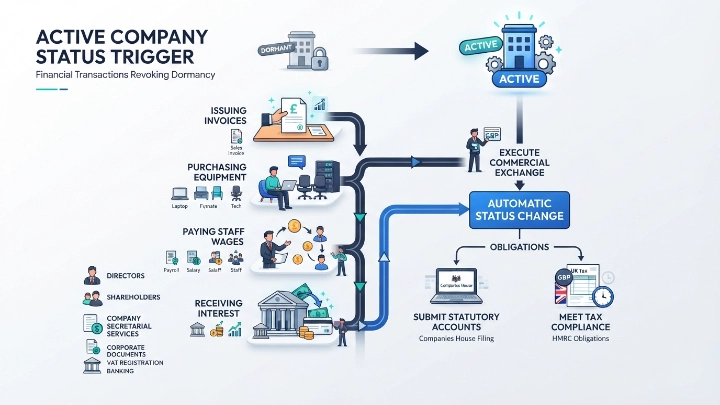
Distinguishing between minor expenses and active trading is vital for legal compliance. Receiving a payment of £1 into a corporate account changes your status immediately. Bank charges, monthly account fees, and interest earned also count as financial transactions.
Holding physical assets or real estate active status can complicate reporting. If a business holds property, renting that property creates continuous commercial transactions. Collecting rent payments creates income, which requires active corporate reporting.
Professional services and utility subscriptions also void inactivity. Continuing web hosting payments, utility bills, or retainer fees for legal counsel counts as standard business trading. Directors must terminate all recurring contracts before marking the business dormant.
Transferring assets between group companies alters financial records. Shifting equipment, intellectual property, or capital reserves triggers ledger entries. If your group transfers assets across accounts, you must prepare standard financial accounts rather than dormant filings.
Understanding the difference between active operational entries and idle corporate holding status prevents unexpected penalties. Directors who need deeper comparative details should review Trading vs. Dormant Accounts: Which One Does Your Business Need? to evaluate their specific financial framework.
What Are the Key Filing Requirements for Dormant Companies?
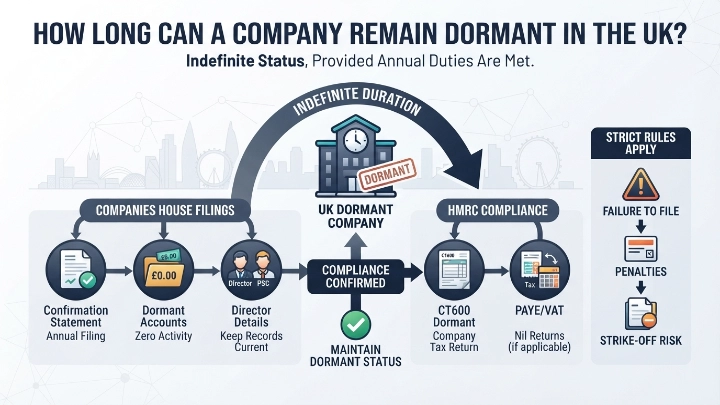
Dormant company filing requirements mandate submitting annual balance sheets to Companies House and an annual confirmation statement. Directors must also inform HM Revenue and Customs that the business is inactive to pause Corporation Tax reporting cycles.
Filing deadlines for dormant entity accounts follow strict statutory windows. You must submit your initial financial accounts within 9 months of your accounting reference date. Subsequent filings must follow the same annual timeline to avoid financial penalties.
A dormant balance sheet requires basic financial disclosures. Directors must report current assets, share capital, and net corporate liabilities. The total assets value must equal total equity reserves exactly on every filing.
HMRC maintains distinct filing protocols from Companies House. You must inform HMRC directly when your status becomes inactive. HMRC will issue a statutory notice confirming that your business is exempt from filing CT600 Corporation Tax returns.
Filing an annual confirmation statement remains compulsory for all dormant entities. Form CS01 updates official records regarding registered office addresses, director details, and shareholders. Failing to file Form CS01 leads to corporate strike-off actions by the Registrar of Companies.
Managing dormant administrative duties requires secure business locations for official filings and director meetings. Companies looking for professional, physical spaces for statutory meetings can use a dedicated Conference Room to maintain corporate compliance records.
How Long Can a Company Remain Dormant in the UK?
A UK company can remain dormant indefinitely provided directors fulfill annual filing duties with Companies House and HMRC. UK corporate law sets no maximum legal limit on how many consecutive years a registered entity may maintain dormant status.
Many entrepreneurs hold dormant entities for strategic long-term goals. Registering a unique brand name prevents competitors from acquiring that trade identity. Holding a company name dormant reserves intellectual property safely for future operational launches.
Holding corporate entities ready for new commercial projects is another common strategy. Shell structures allow business owners to secure vendor accounts, trade domain names, and brand trademarks early. Maintaining dormancy keeps overhead low while preparing new business launches.
Failing to maintain annual compliance destroys dormant protections. Missing filing deadlines triggers automatic financial fines starting at £150 per account set. Continuing non-compliance leads to compulsory company dissolution by Companies House.
Directors must actively monitor statutory deadlines every year. When multi-director boards prepare official statutory filings or review legal changes, working in professional spaces ensures focus. You can arrange corporate sessions in a Conference Room to execute key compliance documentation without administrative interruptions.
What Happens When a Dormant Company Starts Trading Again?
When a dormant company starts trading again, directors must inform HMRC within 3 months of initiating financial transactions. The business must reactivate its Corporation Tax status, establish payroll systems, and file standard trading accounts at the end of its financial year.
Reactivating an inactive entity requires specific administrative updates. Directors must notify HMRC through online government gateways. You must provide the date trading started so HMRC can issue a new tax accounting period.
The company must update its banking relationships before resuming sales operations. If you froze corporate accounts, you must submit business plans and identity documents to restore full banking features. Unfreezing these systems ensures clean financial records for your new trade period.
Managing VAT thresholds becomes critical once operations begin. If taxable turnover exceeds £90,000 within a 12-month period, mandatory VAT registration applies. You must track all incoming revenue from day one of active operations.
When changing company status, working with experts avoids costly compliance mistakes. Form My Company assists business owners through complex corporate state transitions. If you want to streamline statutory filings without risk, you can Fast-Track Your Dormant Company Filing with Our Expert Team to handle your statutory submissions accurately.
Explore our Conference Room guides,
Confirmation Statements: Avoiding the Common Pitfalls for UK Directors
The Essential Director Bundle: Managing Appointments and Resignations Together
Frequently Asked Questions
What is corporate identity theft and how does it affect UK companies?
Corporate identity theft occurs when unauthorized individuals alter a company’s registered details at Companies House, such as changing director names or office addresses, to obtain fraudulent loans or goods. Under the Companies Act 2006, directors are responsible for maintaining accurate public register records to avoid severe financial liabilities. Utilizing the Fraud Protection service from Form My Company helps safeguard business reputation through continuous monitoring of official records.
How does the Form My Company Fraud Protection service protect my limited company?
The Fraud Protection service from Form My Company connects a business registration number to an automated watchdog system that continuously scans official registers. It delivers immediate email alerts whenever an officer change, address update, or structural filing is submitted under your business name. This early warning mechanism allows directors to spot suspicious activity instantly before fraudsters can bind the business to unauthorized contracts.
How does Form My Company Fraud Protection differ from the Companies House PROOF scheme?
The Companies House Protected Online Filing (PROOF) scheme only blocks unauthorized physical paper submissions, requiring filings to be made electronically. In contrast, the Fraud Protection service provided by Form My Company actively monitors all electronic and digital filings across the Companies House API in real time. Combining the PROOF scheme with active digital alerts ensures total defense against both paper-based and digital corporate identity theft.
What steps should a director take if an unauthorized filing is detected?
If an alert reveals an unauthorized change to company details, directors should immediately notify Companies House and report the incident to Action Fraud. Form My Company provides guidance and document logs to help subscribers initiate the official rectification process to remove fraudulent entries from the public register. Acting promptly prevents unauthorized parties from using falsified credentials to open bank accounts or apply for corporate credit.
Is fraud protection mandatory for new UK limited companies?
Fraud protection is not legally required under UK corporate law, but it is strongly recommended to protect business credit scores and brand integrity. Companies House operates on a good-faith basis, processing filings prior to full verification, which leaves window periods vulnerable to corporate hijacking. Adding the Fraud Protection service through Form My Company delivers automated surveillance, giving directors complete security without requiring manual register checks.