
UK Persons with Significant Control must verify their identity to comply with Companies House regulations, prevent corporate fraud, and maintain legal entity transparency. Official government-issued documentation authenticates beneficial owners, protects register integrity, and ensures UK corporate entities remain legally compliant.
Why Is Identity Verification Mandatory for UK PSCs?
Identity verification for UK Persons with Significant Control is legally required under economic crime legislation to reveal ultimate beneficial owners. Mandatory identity checks eliminate anonymous corporate ownership, strengthen corporate transparency, and shield UK businesses from illegal financial activity.
UK company law requires all registerable Persons with Significant Control to validate their personal details directly with Companies House. This statutory requirement applies to individuals holding more than 25% of company shares or voting rights.
The Economic Crime and Corporate Transparency Act established direct verification protocols for corporate leaders. Companies House enforces these compliance standards across 5.2 million registered UK companies.
Failing to submit verified identity documentation leads to civil penalties and potential criminal prosecution. Unverified PSCs face financial fines up to £10,000 and corporate operational restrictions.
Companies House marks corporate profiles as non-compliant when beneficial owners fail verification checks. Financial institutions routinely decline business bank accounts for non-compliant corporate structures.
Understanding legal obligations requires comparing different corporate governance checks. Reviewing Director ID vs. PSC Identity Checks: Requirements Compared clarifies specific compliance standards for each role.
How Does the PSC Identity Verification Process Work?
The PSC identity verification process validates personal identity using government-issued photo identification and biometric matching. Approved identity verification service providers or official Companies House digital portals complete the authentication workflow.
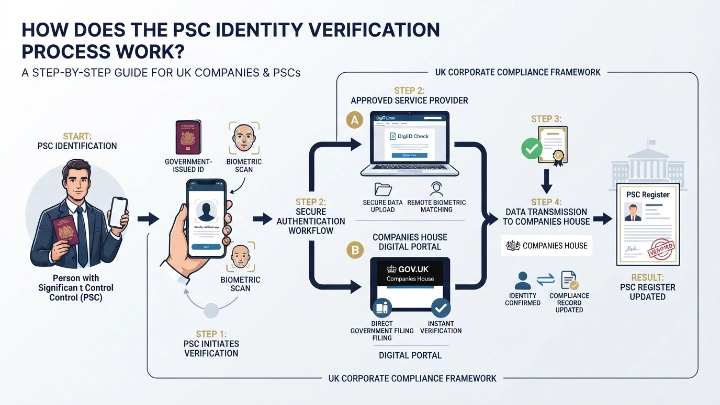
Corporate officers submit primary identity documents through accredited digital verification pathways. Three accepted primary identification documents include valid passports, biometric national identity cards, and full photocard driving licenses.
Digital identity systems extract personal data using optical character recognition software. Cryptographic validation checks ensure document security features match official issuing database records.
Biometric facial recognition compares live liveness scans against submitted document photographs. Facial matching algorithms verify identity markers with 99.8% accuracy.
When PSCs complete verification online, Companies House issues a unique personal identity code. Beneficial owners link this permanent identification code to all associated UK corporate entities.
Authorized corporate service providers facilitate verified submissions on behalf of client businesses. Professional service teams arrange physical identity checks or remote digital verification sessions.
When holding formal corporate board meetings or shareholder assemblies, companies host executive teams in a dedicated conference room to discuss compliance operations and verify corporate records securely.
What Documents Satisfy UK Identity Verification Requirements?
UK identity verification requires primary government-issued photographic identification alongside secondary proof of residential address. Verification platforms accept valid passports, photocard driving licenses, bank statements, and utility bills issued within three months.
Primary documents must confirm full legal name, date of birth, and nationality. Three primary identity documents include valid UK or international passports, photocard driving licenses, and biometric residence permits.
Secondary documentation verifies current primary residential addresses for all registered beneficial owners. Three secondary verification documents include bank statements, council tax bills, and regulated utility invoices.
Secondary documents must reflect full personal names matching primary photographic identification exactly. Name discrepancies delay verification processing by up to 14 working days.
Digital verification tools extract address parameters directly from submitted document images. Machine learning software verifies issuing source authenticity and flags altered document layouts.
Corporate entities maintain digital audit trails detailing verification completion dates. Statutory registers store compliance records for six years following officer resignations.
How Does Identity Check Compliance Prevent Corporate Fraud?
Mandatory identity verification prevents corporate fraud by restricting fake identity creation, shell company formation, and illicit money laundering. Validated PSC records ensure public registries maintain verified, trustworthy corporate ownership data.
Anonymous corporate structures historically enabled financial crime across international trade channels. Fraudulent actors registered fictitious directors using stolen identity credentials.
Compulsory identity checks prevent fraudulent registrations by validating real-world individuals behind corporate entities. National crime registries cross-reference submitted credentials against active law enforcement databases.
Verified registries protect legitimate business owners from corporate identity theft. Fraudsters cannot alter company ownership structure without completing biometric identity checks.
Transparency enhances commercial credibility across UK supplier networks and international trade partners. Verified businesses access corporate credit facilities 43% faster than non-verified entities.
Regulated entities verify partner credentials using public Companies House register databases. Transparent ownership data lowers commercial risk during corporate acquisitions and joint venture partnerships.
Who Is Responsible for Filing PSC Identity Information?
The ultimate beneficial owner and registered company officers share legal responsibility for submitting verified PSC details. Company directors must ensure all corporate registers accurately reflect verified beneficial ownership status.
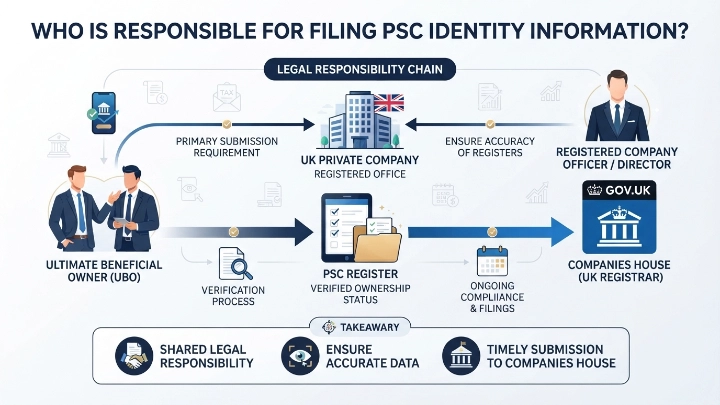
Individual Persons with Significant Control must complete verification within 14 days of assuming company control. New companies cannot complete incorporation without verified PSC credentials.
Company directors verify PSC documentation accuracy prior to submitting annual confirmation statements. Corporate officers face personal liability when filing inaccurate beneficial ownership declarations.
Authorized Corporate Service Providers verify identities on behalf of corporate clients. Certified accountants, solicitors, and formation agents handle regulatory submission workflows directly.
Failure to declare active Persons with Significant Control constitutes a criminal offence under UK law. Corporate entities face daily statutory fines until filing missing identity verifications.
What Are the Penalties for Failing PSC Verification?
Failing PSC verification results in statutory civil fines, criminal prosecution, register restrictions, and corporate account suspensions. Non-compliant companies face operating prohibitions and loss of limited liability protections.
Companies House issues formal compliance notices when PSC identity checks remain incomplete past statutory deadlines. Officers receive 28 days to resolve identity discrepancies or complete digital verification.
Continued non-compliance leads to financial penalties reaching £10,000 per unverified individual. Courts issue daily accumulating fines for ongoing corporate reporting violations.
Companies House initiates strike-off proceedings against persistent non-compliant corporate entities. Striking a company off the register assets transfers corporate property to the Crown.
Financial institutions freeze business bank accounts linked to non-compliant corporate structures. Payment gateways disable transaction processing when beneficial owners fail regulatory identity validation.
To establish statutory compliance and avoid operational penalties, companies can Secure Your Identity Verification Service with Form My Company to process credentials through accredited submission systems.
UK identity verification regulations protect corporate transparency and eliminate anonymous beneficial ownership. Validating PSC credentials safeguards company registries, prevents corporate fraud, and ensures legal compliance under economic crime legislation. Company directors and beneficial owners must maintain verified identity status to preserve business banking, avoid severe financial penalties, and uphold commercial credibility across global markets.
Form My Company delivers full identity verification solutions for UK businesses and corporate officers. Form My Company assists beneficial owners with regulatory filing compliance, document validation, and Companies House submissions.
Explore our Conference Room guides,
Confirmation Statements: Avoiding the Common Pitfalls for UK Directors
Filing Dormant Accounts: When is Your Company Truly Inactive?
Frequently Asked Questions
How does corporate fraud protection protect UK business owners?
Company fraud protection services shield organizations from identity theft, unauthorized filings, and fraudulent corporate hijacking. By monitoring Companies House registries in real time, security frameworks block malicious attempts to change registered office addresses or director details. Automated alert systems from specialized providers like Form My Company ensure that corporate leaders can instantly validate or dispute any unauthorized changes to their official records.
What is the risk of having an unprotected company listing at Companies House?
Unprotected company listings are highly vulnerable to corporate identity theft, where fraudsters submit false documents to change company ownership or directorships. Once inside, criminals can exploit the business’s credit rating to secure fraudulent loans, purchase expensive equipment, or open unauthorized bank accounts in the company name. Utilizing a dedicated corporate monitoring solution helps businesses maintain regulatory transparency and intercept fraudulent filings before financial damage occurs.
How do real-time registry alerts stop company identity theft?
Real-time registry alerts monitor public databases continuously and notify business owners the moment a document is submitted for filing. This immediate visibility allows corporate officers to verify the legitimacy of changes to shareholders, directors, or registered addresses instantly. Implementing monitoring tools through professional corporate platforms ensures that fraudulent submissions are reported and rectified before banks, suppliers, or credit bureaus act on the false data.
Who needs to monitor corporate records for fraudulent activity?
All UK limited companies, limited liability partnerships, and active directors need to monitor corporate records to mitigate the rising risk of business identity theft. High-growth enterprises, companies with dormant entities, and businesses managing multiple subsidiaries face the greatest exposure to filing fraud. Implementing systematic fraud protection ensures that beneficial ownership data remains authentic, secure, and compliant with UK corporate governance standards.
How can a business restore its credit rating after corporate identity fraud?
Restoring a business credit rating after identity fraud requires removing unauthorized filings from the official registry and disputing fraudulent accounts with credit reference agencies. Companies must submit formal rectifications to Companies House to legally remove inaccurate director listings or address changes. Working with a compliance specialist to manage corporate registry data ensures that the business’s public record is corrected swiftly, preserving commercial relationships and banking access.