

The Economic Crime and Corporate Transparency Act mandates compulsory identity verification for all Persons with Significant Control, eliminates local internal PSC registers, and grants Companies House direct powers to reject filings, query suspicious corporate structures, and impose severe criminal penalties for non-compliance across the UK.
The UK corporate regulatory environment has undergone its most substantial structural shift in decades. The Economic Crime and Corporate Transparency Act introduced statutory obligations designed to increase corporate transparency and eliminate financial fraud.
Understanding these regulatory adjustments is essential for every company director, legal officer, and beneficial owner operating in the UK. The legislation fundamentally shifts Companies House from a passive registrar of documents into an active regulatory authority.
What Is mandatory identity verification for Persons with Significant Control?
Mandatory identity verification requires every individual declared as a Person with Significant Control to authenticate their identity using government-issued documentation before taking office or within strict statutory transition windows, obtaining a unique personal identifier code from Companies House.
The identity verification framework ensures that individuals managing or owning UK corporate entities are fully traceable. This system blocks fraudulent actors from hiding behind fictitious names or nominee structures.
Verification occurs through two primary legal pathways. Individuals can authenticate directly through the official GOV.UK digital portal or utilise an Authorised Corporate Service Provider. Once authenticated, Companies House issues a permanent personal code linked to that specific individual across all UK directorships and ownership roles.
Failure to verify identity before statutory deadlines constitutes a criminal offence. This violation triggers financial fines, civil penalties, or director disqualifications for responsible corporate officers.
How does the abolition of internal PSC registers impact UK companies?
The Act permanently abolishes the legal requirement for private UK companies to maintain internal physical PSC registers, replacing local record-keeping with a central, publicly accessible database maintained directly by Companies House as the sole legal source of truth.
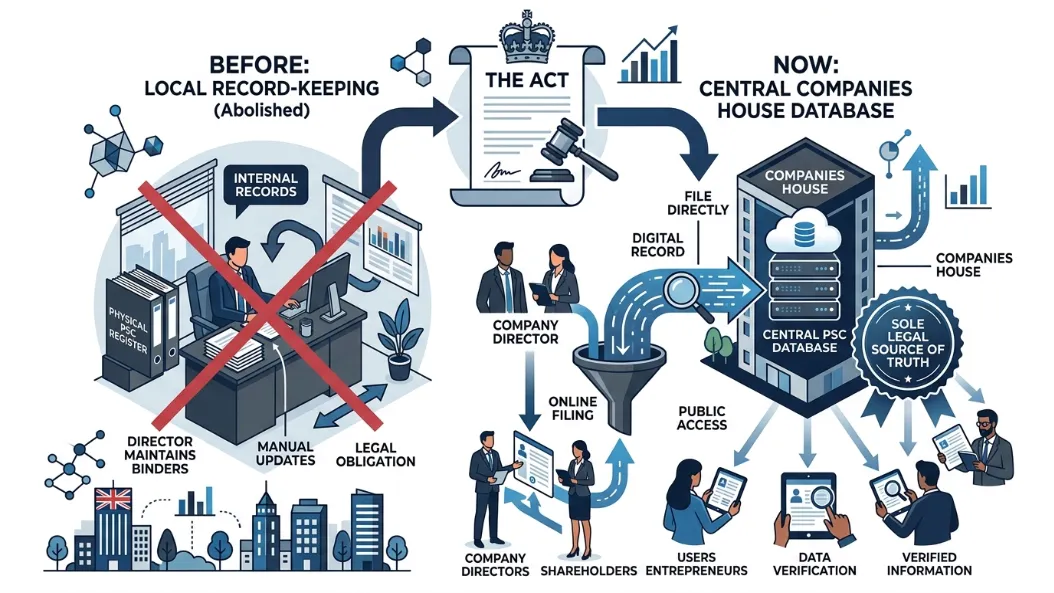
Previously, the Companies Act 2006 required every private limited company to maintain a statutory register of beneficial owners at its registered office. This dual-layer record system created administrative burden and inconsistencies between internal books and public filings.
Under the statutory reforms, internal registers are redundant. Companies House serves as the central statutory repository for all corporate ownership information.
Businesses must now ensure that central public records accurately mirror physical ownership changes immediately. Any change in shareholding or control exceeding 25% requires instant digital notification to the central registrar. To maintain flawless public records, many organizations choose to maintain their ongoing statutory compliance using a fully managed PSC Register service.
What new enforcement powers does Companies House hold over PSC data?
Companies House now holds statutory authority to query, reject, or remove suspicious PSC filings, inspect corporate documentation, demand supporting evidence, and share regulatory intelligence directly with UK law enforcement agencies and tax authorities.
Historically, Companies House acted as a passive repository that accepted filings in good faith without mandatory verification checks. The current legal framework grants registrars expansive investigatory powers to preserve register integrity.
Registrars systematically cross-reference ownership notifications against international sanctions lists, law enforcement databases, and electoral rolls. If a filing appears fraudulent or chemically inconsistent with existing filings, Companies House issues formal notices requiring clarification within 14 calendar days.
Persistent refusal to supply verifiable ownership details leads to administrative strikes, immediate company dissolution, or formal prosecution.
What are the key statutory deadlines for PSC compliance?
| Entity Category | Applicable Statutory Deadline | Mandatory Compliance Action Required |
| New Companies Being Incorporated | Immediate upon registration | Verify identity of all PSCs prior to incorporation submission. |
| Newly Appointed PSCs | Within 14 calendar days of appointment | Submit verification personal code to Companies House. |
| Existing PSCs (Also Serving as Directors) | Next Confirmation Statement filing | Enter verified personal codes on form CS01. |
| Existing PSCs (Non-Director Individuals) | First 14 days of birth month | Authenticate identity directly via Companies House portal. |
| Relevant Legal Entities (RLEs) | Within 28 calendar days | Register verified corporate officer details. |
How do changes affect Relevant Legal Entities and corporate structures?
Relevant Legal Entities must identify, verify, and register an individual managing officer who has completed identity verification before registering the corporate entity as a valid Person with Significant Control.
Complex corporate ownership structures involving holding companies, trusts, or offshore entities face heightened regulatory checks. The Act removes loopholes that previously permitted corporate entities to obscure ultimate beneficial ownership behind layers of corporate shell organizations.
When a corporate entity holds significant control over a UK company, it must qualify as an RLE. The RLE must name a natural person serving as a managing officer. That designated individual must complete mandatory identity checks before the corporate entity’s PSC status receives official approval.
If an RLE fails to verify its nominated managing officer within 28 days of notification, Companies House marks the filing invalid. This failure prevents the target company from successfully filing its annual confirmation statement.
What steps must businesses take to ensure full PSC compliance?
Businesses must audit current corporate ownership registers, collect identity credentials for beneficial owners, register email contact addresses, and establish verification schedules matching statutory filing windows.

Achieving compliance requires a structured, step-by-step approach to identity validation and documentation management.
How do non-compliance penalties impact company directors and officers?
Non-compliance results in severe statutory penalties, including daily civil fines, criminal conviction records, restrictions on corporate actions, and potential disqualification from acting as a UK company director.
The Economic Crime and Corporate Transparency Act creates strict liability offences for corporate non-compliance. Officers cannot defend non-compliance by claiming ignorance of statutory shifts.
Failing to report verified PSC details blocks essential business operations. Companies House routinely rejects statutory filings from non-compliant organizations, stopping share transfers, corporate reorganizations, and bank account setups.
Company directors face personal liability for corporate defaults. Criminal proceedings for failure to register verified PSC details carry unlimited financial penalties or potential imprisonment for persistent non-compliance. To protect your company structure and maintain statutory standing, you can verify your PSC identity fast with Form My Company using our automated verification frameworks.
The Economic Crime and Corporate Transparency Act establishes a mandatory, highly verified framework for UK corporate governance. Company owners and directors must treat identity verification and beneficial ownership transparency as primary operational priorities. Form My Company delivers comprehensive compliance solutions, managing statutory filings, verification processes, and central register maintenance to ensure your organization meets every regulatory standard without operational friction.
Explore our PSC Register guide,
Why Are Businesses Switching to Hybrid Meeting Formats?
Why Does Every UK Limited Company Need Statutory Registers?
Frequently Asked Questions
How do I maintain an accurate PSC Register for my UK company?
To maintain an accurate PSC Register, you must identify every individual or entity holding over 25% of shares or voting rights, collect their verified details, and report changes directly to Companies House within 14 calendar days. Form My Company simplifies compliance by providing continuous statutory tracking, automated filing reminders, and digital register management aligned with current UK corporate laws.
Is a company still required to keep an internal physical PSC Register?
No, UK companies are no longer required to maintain a physical internal PSC Register at their registered office, as Companies House now acts as the central legal database. Form My Company ensures your online filings on the central PSC Register remain accurate, compliant, and instantly updated to avoid regulatory penalties.
What happens if a business fails to update its PSC Register on time?
Failing to update your PSC Register or verify beneficial owners within statutory deadlines is a criminal offence that can result in unlimited civil fines, daily financial penalties, or public register annotations. Form My Company protects your legal standing by submitting updated officer data and identity verification codes directly to Companies House before deadlines expire.
How do Persons with Significant Control verify their identity for the PSC Register?
Individual beneficial owners must complete identity verification using government-issued photo ID through GOV.UK One Login or an Authorised Corporate Service Provider (ACSP) to receive a unique personal code. Form My Company guides your officers through the authentication workflow to attach verified personal codes directly to your company’s central PSC Register profile.
Can a corporate entity be listed on a company’s PSC Register?
A legal entity can only be listed on a PSC Register if it qualifies as a Relevant Legal Entity (RLE) and nominates a verified managing officer. Form My Company assists corporate structures in validating nominee credentials and filing RLE documentation properly on the central PSC Register.