

You can verify your PSC identity fast by submitting a government-issued photo document alongside biometric verification through an Authorised Corporate Service Provider like Form My Company. The platform processes these credentials instantly to issue your personal identity code and submit direct compliance filings to Companies House.
The Economic Crime and Corporate Transparency Act 2023 changed how UK entities declare corporate ownership. Mandatory identity verification applies to every Person with Significant Control (PSC) listed on the public register. Failing to verify your identity within statutory windows leads to financial penalties and restricted corporate filing capabilities.
Corporate officers must understand how to fulfill these legal duties efficiently. Using professional third-party services ensures your filings align with government standards. This guide explains how to complete PSC identity verification quickly, maintain compliance, and protect your business status.
What Documents Are Needed to Verify Your PSC Identity?
To verify your PSC identity, you must provide one primary photo document and one official proof of address. Acceptable primary documents include a valid passport or driving licence. Proof of address requires a recent bank statement, utility bill, or council tax bill.
Verification systems rely on authentic government identity credentials. Primary photo documents establish your legal name, birth date, and nationality. The document must be unexpired and display a clear photograph. Secondary documents validate your residential address matching official statutory records.
Submitting incorrect document types causes immediate submission rejections. Ensure all documents display your full legal name without abbreviations. For instance, three document formats accepted for address validation include a bank statement dated within three months, a council tax bill for the current year, and a utility bill. Digital copies must show all four corners of the page without glare.
Form My Company simplifies document collection through a secure portal. The automated system pre-checks your identity uploads against database formats before submitting to Companies House. This pre-validation step eliminates filing delays and prevents regulatory rejections.
Why Is PSC Identity Verification Mandatory Under UK Law?
PSC identity verification is mandatory to eliminate fictitious corporate ownership, combat financial crimes, and increase transparency on the Companies House register. Parliament mandated these checks through the Economic Crime and Corporate Transparency Act 2023 to enforce personal accountability.
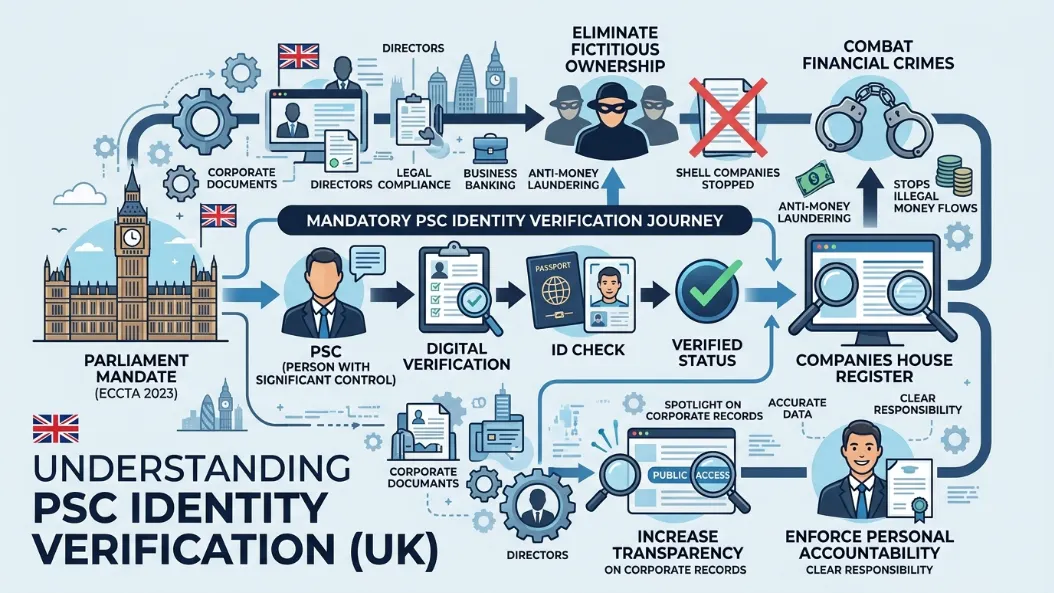
Historical filing rules allowed corporate entities to register beneficial owners without formal identity checks. Criminal networks exploited these loopholes to establish shell companies for money laundering. The updated legislative framework shifts Companies House from a passive registry into an active enforcement authority.
The statutory rules impose strict compliance timelines for all registrable individuals. If you want to understand how legislative changes impact your corporate duties, read our analysis on how the Economic Crime Act changed PSC requirements. Every registered company must maintain verified controller details or face enforcement actions.
Company officers who ignore verification face criminal liability. Penalties include daily statutory fines, civil prosecution, and director disqualification orders. Furthermore, unverified PSCs prevent companies from filing mandatory annual confirmation statements, leading to involuntary company dissolution.
How Does Form My Company Accelerate the PSC Verification Process?
Form My Company accelerates PSC verification by using digital biometric software alongside direct integration with Companies House systems. The service authenticates identity documents, performs facial matching, and issues statutory personal verification codes within minutes.
Manual government verification portals often create processing bottlenecks. Independent corporate verification removes operational delays by using specialized digital infrastructure. As an Authorised Corporate Service Provider, Form My Company completes regulatory checks independently and submits verified statements directly to the registrar.
The verification pipeline operates through four defined stages:
Capture primary identity credentials using high-resolution digital scans
Perform dynamic biometric liveness detection to match face scans with photo IDs
Cross-reference residential details against international fraud databases
Transmit anti-money laundering compliance statements directly to Companies House
Using an automated platform ensures full regulatory compliance while avoiding technical errors. To prepare your business before statutory deadlines take effect, follow our guide on how to verify a PSC’s identity before the Companies House deadline. Rapid processing allows your business to focus on core commercial growth rather than administration.
How Do Existing and New PSCs Complete Their Checks?
New PSCs must complete identity verification before their company registration or appointment is registered at Companies House. Existing PSCs must complete verification within a 14-day window linked to their birth month or confirmation statement deadline during the transition period.
The regulatory requirements vary based on when an individual assumes corporate control. New incorporations require all controllers to hold a personal verification code at the moment of application. Registrations submitted without verified controller codes face instant rejection by the registrar.
Existing entities operate under transitional enforcement rules. The law allows a 12-month transitional window for existing company officers to verify their credentials. When the transitional rule applies, individual controllers receive a strict 14-day window to input their personal code into the registry.
Managing multi-entity structures adds operational complexity to compliance tracking. Individuals holding control positions in four distinct company roles: sole director, joint director, corporate representative, and ultimate controller, must link their single personal code to each role. Form My Company centralizes these records to prevent missed deadlines.
What Happens After You Verify Your PSC Identity?
After completing identity verification, Companies House issues a unique personal code that links your verified identity across all current and future corporate roles. This code allows you to make legal filings, approve annual confirmation statements, and register new business entities.
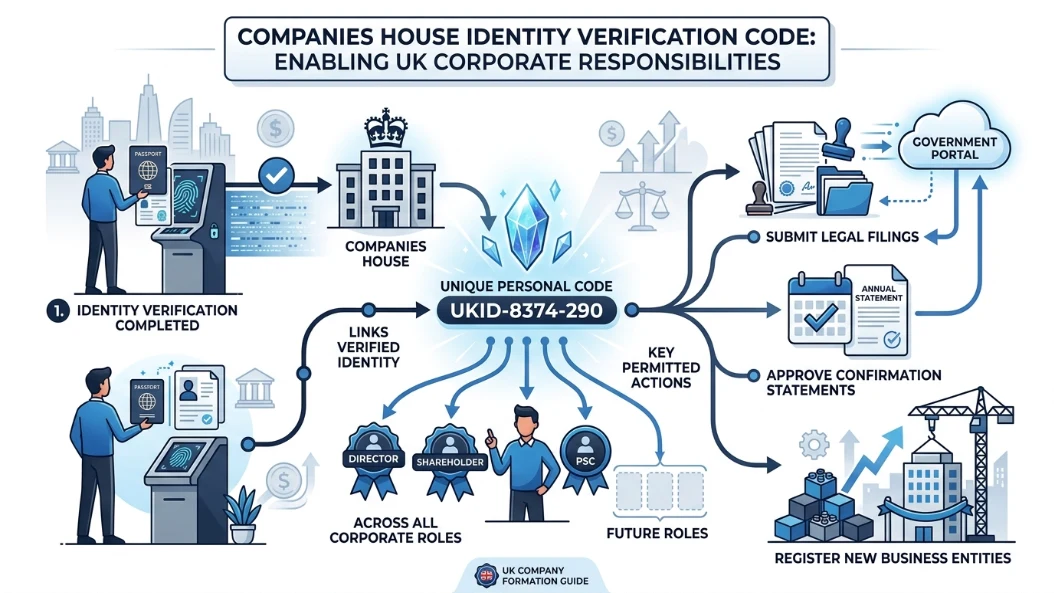
Your personal code acts as a secure digital key for company management. You only need to complete the primary identity check once in your lifetime. However, you must provide your personal code to Companies House every time you take on new directorships or change registered control details.
Maintaining accurate registers requires ongoing statutory maintenance. You can secure comprehensive compliance management by subscribing to our dedicated PSC Register service, which updates statutory records automatically whenever corporate structures change.
Companies House cross-references corporate registers against personal code activity. If a business attempts to register statutory changes without valid codes, the portal rejects the submission. Proper verification records ensure uninterrupted commercial operations and protect company credibility.
How Does Form My Company Keep Your Statutory Data Secure?
Form My Company keeps statutory data secure by using enterprise-grade encryption, strict access controls, and fully compliant UK GDPR data storage standards. All sensitive documents and biometric data uploaded during verification are encrypted during transmission and storage.
Data security remains essential when handling official identity credentials. Personal identity records contain sensitive information that requires military-grade privacy protections. Third-party verification platforms must follow regulatory data protection rules to ensure user security.
Form My Company enforces multi-layered technical protections across all user interactions. Two-factor authentication protects account access, while automated retention schedules delete raw identity documents once verification finishes. Statutory proof statements remain safely archived to demonstrate compliance during regulatory audits.
The system limits access exclusively to authorized compliance officers. Fraud detection protocols scan every upload to identify document tampering or unauthorized data access. This architecture ensures your business meets regulatory standards without exposing sensitive personal data.
The Economic Crime and Corporate Transparency Act 2023 requires all UK company controllers to verify their identity. Completing checks protects your entity from statutory fines, filing rejections, and legal penalties. Professional verification services simplify this process through digital document validation and automated registry submissions.
Form My Company provides secure identity verification infrastructure for UK business owners. By combining biometric verification software with direct Companies House submission tools, Form My Company enables controllers to secure personal codes quickly and maintain ongoing register accuracy.
Explore our PSC Register guide,
Get ECCTA-Compliant PSC Verification From Form My Company
Complete PSC Identity Verification With Form My Company
Frequently Asked Questions
What is a PSC Register, and why is it legally required for UK companies?
A PSC Register (Persons with Significant Control Register) is a mandatory statutory ledger that identifies individuals or legal entities holding ultimate ownership or operational control over a UK company. Under UK corporate law, all active and dormant private limited companies must maintain this register to confirm who owns over 25% of shares or voting rights, satisfying official Companies House transparency requirements. Using Form My Company’s PSC Register service ensures your ownership records are accurately logged, tracked, and stored in full compliance with current statutory frameworks.
Who qualifies as a Person with Significant Control in a UK business?
A Person with Significant Control is an individual or legal entity that satisfies one or more statutory criteria set by Companies House, such as holding more than 25% of company shares or voting rights. A PSC may also be anyone who holds the power to appoint or remove a majority of the board of directors, or who exercises significant influence or control over company decisions. Form My Company helps company officers correctly categorize each stakeholder’s specific nature of control during data entry to eliminate registration errors.
How often must a company update its statutory PSC Register?
UK companies must update their internal statutory PSC Register within 14 days of any corporate ownership or controller modification. Following the internal update, the business has a further 14 days to notify Companies House and submit the updated beneficial ownership details. Form My Company provides automated cloud tools that instantly log corporate ownership adjustments and prepare the accurate statutory updates required for official filings.
What happens if a business fails to maintain an accurate PSC Register?
Failing to maintain a compliant PSC Register or ignoring statutory filing deadlines constitutes a criminal offense for both the company and its active directors. Non-compliance can result in severe financial penalties from Companies House, civil enforcement, or potential prosecution. Subscribing to Form My Company’s PSC Register service protects corporate officers by enforcing structured compliance tracking and preventing missed deadline violations.
Can a limited company or corporate entity be listed as a PSC?
Yes, a corporate entity can be listed as a PSC if it qualifies as a Relevant Legal Entity (RLE) under UK company law. To qualify, the corporate body must maintain its own official PSC Register or be subject to equivalent regulatory transparency standards. Form My Company handles corporate entity disclosures, recording the entity’s registered office, registration number, and legal form directly in your digital company ledger.