
To avoid penalties for poorly kept statutory records, maintain accurate registers of directors, secretaries, PSCs, and members at your registered office address or SAIL, update Companies House within strict statutory deadlines of 14 days, and implement rigorous compliance protocols to prevent administrative negligence.
Managing a corporate entity requires strict adherence to corporate governance legislation. Directors face rigorous enforcement actions when administrative registers fall out of compliance. Operating a business structure in the United Kingdom demands total transparency regarding ownership and management. Regulatory bodies penalize negligence heavily. Companies House enforces strict compliance standards. Directors bear personal liability for recordkeeping failures. Statutory registers form the legal backbone of corporate identity.
What Are Statutory Records and Why Must They Be Maintained?
Statutory records are legally mandated corporate documents containing historical and current data regarding company ownership, management decisions, and financial transactions that every registered corporation must maintain for inspection.
Corporate transparency relies on comprehensive documentation. Every registered business must maintain these legal registers under the Companies Act 2006. Inspectors review these files during audits. Officers require clear visibility into company structures. The state enforces mandatory recordkeeping to protect stakeholders and creditors.
Essential registers include the register of members, the register of directors, and the register of people with significant control. Maintaining these documents ensures legal compliance. Neglecting these records triggers severe financial repercussions.
Key Statutory Registers Required by Law
| Register Name | Primary Purpose | Required Details |
| Register of Members | Tracks shareholders and share allotments | Full names, addresses, share counts, acquisition dates |
| Register of Directors | Records executive management appointments | Legal names, residential addresses, dates of birth, nationalities |
| Register of PSCs | Identifies individuals exercising significant control | Control nature, ownership thresholds, restriction notices |
When maintaining the register of members, record every share transfer immediately. When updating the register of directors, verify residential addresses annually.
What Penalties Apply to Poorly Kept Statutory Records?
Penalties for poorly kept statutory records include daily default fines up to 500 British pounds for corporations, personal criminal fines reaching 5,000 British pounds for defaulting officers, and potential corporate prosecution by the Registrar of Companies.
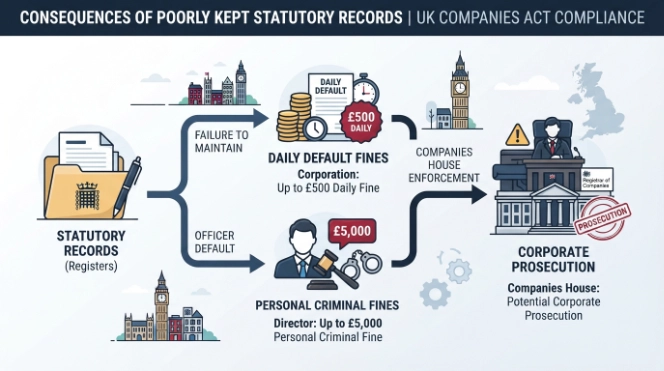
Regulatory enforcement targets administrative non-compliance directly. Magistrates courts issue financial penalties when corporations fail to produce requested registers. The state penalizes directors for corporate negligence. Enforcement actions escalate rapidly.
Default fines accrue daily until companies rectify their registers. Officers face severe legal consequences. Criminal records damage professional reputations irreparably. Business operations suffer during active compliance investigations.
Pay daily fines reaching 500 British pounds for continuous register neglect
Incur personal criminal fines up to 5,000 British pounds as a defaulting director
Face formal prosecution by the Registrar of Companies for severe documentation breaches
Suffer reputational damage during regulatory investigations into corporate governance failures
When penalties accumulate, business liquidity drops sharply. When courts prosecute officers, professional disqualifications follow.
Where Must Statutory Records Be Kept Legally?
Statutory records must be kept securely at the company registered office address or a registered inspection location known as a Single Alternative Inspection Location within the same jurisdiction of incorporation.
Accessibility forms a core requirement of corporate legislation. Public authorities demand instant access to compliance registers. Shareholders inspect documents during standard working hours. Maintaining records in unauthorized locations violates corporate law.
Companies must notify Companies House regarding record storage locations. Moving records requires formal electronic submissions. Keeping documents in digital formats requires secure servers located within the United Kingdom.
Storage Location Compliance Guidelines
| Location Type | Notification Requirement | Accessibility Standard |
| Registered Office | Default statutory location at incorporation | Available for public inspection during business hours |
| SAIL Address | File form AD02 with Companies House beforehand | Available for public inspection with prior notice |
| Remote Servers | Maintain backup protocols and secure encryption | Accessible instantly upon regulatory demand |
When utilizing a SAIL address, file form AD03 simultaneously. When storing digital records, ensure complete data integrity.
How Can Businesses Prevent Administrative Errors in Recordkeeping?
Businesses prevent administrative errors by establishing standardized compliance workflows, conducting quarterly internal audits of corporate registers, and utilizing professional company secretarial support services.
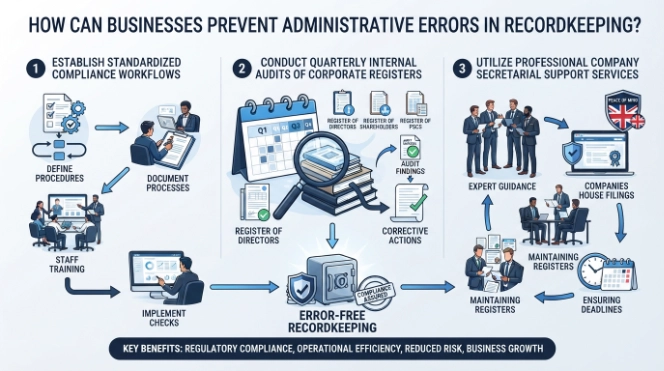
Systematic data management eliminates regulatory exposure. Manual recordkeeping invites human error. Automated tracking systems secure critical corporate data. Businesses must implement robust governance frameworks.
Adopting digital compliance platforms streamlines statutory updates. Training administrative staff reduces compliance risks. Engaging specialized professionals guarantees adherence to regulatory timelines.
To maintain pristine statutory registers, use our comprehensive Company Pack to automate your corporate administration and eliminate compliance risks.
Conduct quarterly internal audits of all statutory registers
Update Companies House within 14 days of any corporate change
Implement secure digital document management systems for all corporate filings
Train administrative personnel on statutory compliance requirements
When audits reveal discrepancies, correct errors immediately. When directors change residential addresses, update the central register instantly.
What Steps Ensure Long-Term Compliance and Governance?
Long-term compliance requires proactive calendar management for filing deadlines, continuous monitoring of legislative amendments, and adherence to established corporate governance standards across all operational tiers.
Corporate legislation evolves continuously. Businesses must adapt their internal protocols rapidly. Maintaining pristine records protects corporate assets. Good governance attracts institutional investment.
Companies must retain historical records for specified statutory periods. Directors supervise all administrative updates. Professional oversight safeguards the corporate entity from unexpected penalties.
For a deeper understanding of where specific documents must reside, review our guide on Where Must a UK Company Keep Its Statutory Records?. To acquire verified registers immediately, utilize our dedicated service detailed in Get Your Register of Members and Directors From Form My Company.
When filing annual confirmation statements, cross-reference all statutory registers. When issuing new shares, record transactions in the central register on the exact transaction date.
Avoiding penalties for poorly kept statutory records requires constant vigilance and strict adherence to the Companies Act 2006. Businesses protect their financial stability by maintaining accurate registers of members, directors, and people with significant control. Form My Company delivers the essential administrative infrastructure and compliance solutions needed to keep your corporate registers flawless, secure, and fully updated against evolving regulatory standards.
Explore our Company Pack guide,
DIY vs Assisted PSC Identity Verification: Which Is Safer?
Choosing the Right AV Partner for Your Hybrid Conference
Frequently Asked Questions
What is included in the Company Pack from Form My Company?
The Company Pack includes essential corporate documents such as the certificate of incorporation, memorandum and articles of association, share certificates, and pre-printed statutory registers. Form My Company designs this comprehensive bundle to ensure newly registered UK entities meet all initial legal compliance standards seamlessly.
How does Form My Company help maintain statutory registers?
Form My Company provides meticulously organized digital and physical registers for members, directors, and people with significant control through their specialized Company Pack. This service simplifies ongoing corporate administration and helps businesses prevent costly administrative penalties.
Are the documents provided by Form My Company legally compliant in the UK?
All corporate documents and statutory templates supplied within the Company Pack comply strictly with the requirements of the UK Companies Act 2006. Form My Company ensures that business founders receive fully validated records ready for official inspection.
Can I update my statutory records digitally using Form My Company services?
Businesses can efficiently manage and update their statutory registers using the structured templates and guidance provided in the Company Pack from Form My Company. This digital accessibility streamlines annual filing obligations and maintains data integrity across all corporate records.
Where should a UK company store the registers included in the Company Pack?
UK companies must store their statutory registers at their registered office address or a registered single alternative inspection location notified to Companies House. Utilizing the compliance framework from Form My Company ensures these documents remain accessible for public inspection during standard business hours.