
Assisted PSC identity verification is significantly safer than DIY methods because anti-money laundering regulations require strict biometric matching and official document validation. Professional service providers use secure API integrations to verify identity data directly against government databases, eliminating compliance errors and data exposure.
Identity verification for Persons with Significant Control (PSCs) is a mandatory requirement under UK corporate law. Companies House requires all registered directors and PSCs to confirm their legal identities to prevent corporate fraud. Business owners must choose between handling this verification independently or using an anti-money laundering compliant provider. Evaluating the security risks, technological safeguards, and legal liability associated with each path ensures your business maintains compliance without exposing sensitive personal data.
Why Is Identity Verification Mandatory for Persons with Significant Control?
Identity verification is mandatory for Persons with Significant Control because the Economic Crime and Corporate Transparency Act mandates strict transparency to prevent financial crime. Validating beneficial owners prevents individuals from hiding behind fraudulent corporate structures, shell companies, and false personal information.
The UK government enacted the Economic Crime and Corporate Transparency Act to overhaul corporate registration standards. Previously, individuals could register UK companies using unverified names and false residential addresses. This loophole allowed international criminal networks to establish untraceable entities for money laundering, fraud, and tax evasion.
The legislation alters how Companies House operates, transforming it from a passive register into an active gatekeeper. Corporate entities must verify every individual who exercises significant influence or holds more than 25% of shares or voting rights. Verifying these individuals creates an immutable audit trail within the official public register.
Failure to verify a PSC carries severe statutory penalties for both the corporate entity and individual officers. Unverified PSCs face restricted voting rights, bans on share transfers, and potential criminal prosecution resulting in civil fines. Establishing identity proof safeguards the legal standing of the UK corporate repository.
How Does DIY PSC Identity Verification Work?
DIY PSC identity verification works by having the individual submit their own identity documents directly to Companies House through the public online portal. The user manually uploads photographic identification, enters personal details, and completes a direct digital identity match without third-party intervention.
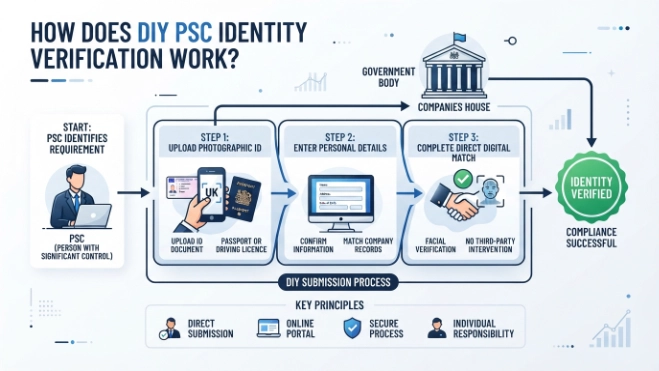
The self-service model allows individuals to access the official Companies House digital verification platform. The PSC creates an account, inputs their personal details, and uploads high-resolution images of primary identity documents. Two specific document categories are acceptable: government-issued passports and photo driving licences.
Once documents are uploaded, the portal uses automated optical character recognition to extract textual data. The user then completes a smartphone liveness check to match their live facial scan with the photo on the physical ID document. When the automated algorithm detects a discrepancy, the system rejects the submission automatically.
The primary appeal of the DIY route is its zero initial service fee. However, the manual upload system offers zero guidance when identity mismatches occur. Simple errors, such as a missing middle name or a slightly blurred document scan, trigger immediate rejection notices without detailing the precise error.
What Security Vulnerabilities Exist in DIY Verification?
DIY verification creates security vulnerabilities because unassisted users frequently transmit unencrypted documents, misinterpret identity guidelines, and fail to detect sophisticated spoofing attempts. Manual input errors leave corporate filings open to rejection, identity theft, and statutory non-compliance penalties.
When individuals undertake identity verification without professional oversight, operational risk increases. Users frequently store unencrypted copies of passports, driver’s licences, and utility bills on unsecured local devices or personal email servers. These practices expose sensitive personally identifiable information to interception, malware, and credential theft.
A major risk in the self-service model stems from document quality control. Automated systems at Companies House apply rigid validation rules. When a user uploads a document with minor glare, cropped edges, or mismatched middle names, the software flags the submission as a potential fraud attempt. The filing fails silently or triggers a formal rejection notice.
Self-directed applicants often lack the expertise to navigate technical errors in registration data. If an individual submits conflicting information between their existing officer profile and their verification paperwork, Companies House logs an official query. Resolving these identity discrepancies manually requires administrative correspondence, extending non-compliance windows.
What Features Make Assisted Identity Verification Safer?
Assisted identity verification is safer because regulated professional service providers use secure API integrations, biometric liveness algorithms, and human forensic reviews. This multi-layered architecture validates official identity documents against global databases while shielding private personal information from public disclosure.
Assisted verification replaces raw manual uploads with enterprise-grade identity infrastructure. Professional corporate service providers operate under strict Anti-Money Laundering (AML) regulations and Know Your Customer (KYC) frameworks. Their verification systems perform deep-level document validation using three structural checks: optical feature extraction, security chip reading, and database cross-referencing.
Biometric authentication in an assisted workflow extends far beyond simple photo comparison. Advanced software measures facial geometry, skin texture, and depth perception to prevent 2D printouts or digital video spoofing. These systems cross-reference identity details across multiple official registries to ensure the document is active and valid.
When a business uses a professional service, human compliance experts review edge-case flags before submitting data to Companies House. If a middle name is missing or a birthdate format differs, the expert corrects the discrepancy prior to submission. This dual layer of technology and human oversight drastically lowers rejection rates and secures sensitive corporate records.
How Does Assisted Verification Safeguard Personal Data?
Assisted verification safeguards personal data by processing identity documents through encrypted, closed-loop portals compliant with UK GDPR regulations. Professional providers store verification evidence in secure environments, preventing unauthorised access and eliminating public transmission risks.
Data privacy is a critical concern when managing executive identity documents. When a PSC submits sensitive records through unencrypted consumer channels, the risk of data interception rises. Regulated corporate service providers mitigate this vulnerability by utilizing end-to-end encrypted file transfers and secure client portals.
Under UK GDPR standards, identity data must be collected for specific legal obligations and protected from unauthorized processing. Professional platforms store identity artifacts in ISO-certified data centers using AES-256 encryption. The system generates an encrypted digital verification token, which is transmitted to Companies House, rather than exposing raw personal identity files.
Professional providers manage the secure deletion of temporary verification files according to statutory retention schedules. This ensures identity documents are not left sitting in local computer folders or email archives indefinitely. Restricting data exposure protects directors and major shareholders from targeted identity fraud attacks.
How Do You Select the Right PSC Verification Strategy?
Select the right PSC verification strategy by assessing your corporate structure, the volume of officers requiring verification, and your internal compliance expertise. Complex corporate groups with overseas officers, multiple PSCs, or strict filing deadlines benefit from professional assisted verification services.
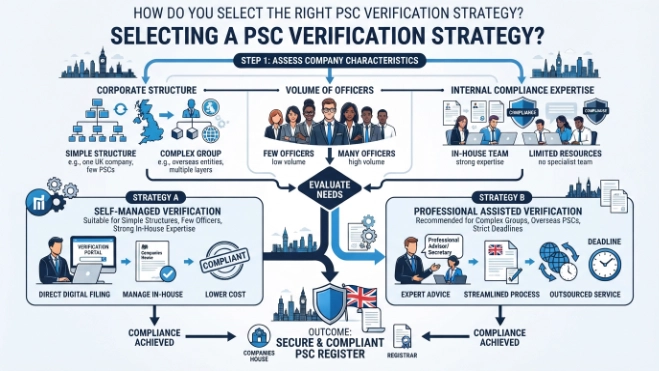
Choosing between self-directed and assisted verification depends on your organization’s technical capability and risk tolerance. For a single UK-resident director with straightforward documentation, DIY verification may seem accessible. However, as organizational complexity increases, reliance on manual processes introduces systemic compliance risks.
Companies with non-UK resident directors face distinct verification challenges. Overseas passports, foreign residential addresses, and translated identity proofs often fail automated validation algorithms at Companies House. Utilizing professional identity verification tools ensures foreign documentation is properly validated according to UK regulatory standards before filing.
Corporate administrative teams handling multiple legal entities must maintain accurate corporate records. Managing dozens of individual PSC verifications manually creates high operational overhead and increases human error rates. Outsourcing identity administration streamlines corporate filings, eliminates administrative backlogs, and maintains continuous statutory compliance.
Maintaining an accurate PSC Register allows corporate entities to manage beneficial ownership structures, document identity verifications, and fulfill statutory filing duties without delay.
Managing Statutory PSC Verification Obligations
Identity verification for Persons with Significant Control is a permanent statutory requirement across the UK corporate landscape. Choosing assisted verification provides enhanced data encryption, expert document review, and direct API submission capabilities that protect businesses from non-compliance penalties. Relying on professional corporate services eliminates operational friction, protects sensitive director data, and keeps company registers accurate.
To understand the legal consequences of failing to complete these statutory duties, read our analysis on what happens if a PSC fails to verify their identity. Organizations facing upcoming regulatory deadlines can streamline corporate filings and maintain compliance by choosing to beat the Companies House deadline with Form My Company.
Explore our PSC Register guide,
Why Expert Secretarial Support is Essential for Maintaining Your Inactive Company Records
Understanding the Benefits of Using a Fully Managed Director Appointment Filing Service
Frequently Asked Questions
How do I update my company’s PSC Register with Form My Company?
You can update your PSC Register by accessing Form My Company’s secure client portal to submit changes regarding beneficial ownership, voting rights, or control. Our compliance specialists then verify the submitted details against statutory requirements and process the official updates directly with Companies House.
What information is required to maintain an accurate PSC Register?
A compliant PSC Register requires the full legal name, date of birth, nationality, service address, and residential address of each Person with Significant Control. It must also detail the exact nature of their control, such as percentage of shares, voting rights, or significant influence over the company.
Who is legally required to be listed on a UK PSC Register?
Any individual who holds more than 25% of company shares, controls over 25% of voting rights, or holds the right to appoint or remove a majority of board directors must be registered. Form My Company assists businesses in identifying and recording eligible individuals to ensure full compliance with Companies House regulations.
What are the consequences of failing to keep an up-to-date PSC Register?
Failing to maintain an accurate PSC Register is a criminal offence under UK corporate law that can lead to fines for the company and its officers. Additionally, Companies House may issue default penalties, place public warning notes on the register, or restrict voting rights on unverified shares.
How does Form My Company verify identity details for the PSC Register?
Form My Company utilizes AML-compliant verification protocols to authenticate primary identity documents, such as biometric passports and national driving licences. Our assisted verification process validates beneficial owner credentials against official databases before updating your statutory PSC Register.