
You can beat the Companies House deadline by using Form My Company to submit accurate PSC Register updates directly to the official UK registrar. This service ensures identity verification, prevents strict financial penalties, and keeps corporate filings fully compliant before statutory cut-off dates.
What Is the Companies House PSC Register Deadline?
The Companies House PSC Register deadline is the strict statutory cut-off date by which UK entities must submit and update their People with Significant Control records. Failure to notify changes within 14 days leads to director prosecution, severe fines, and official register strikes.
Under the Economic Crime and Corporate Transparency Act 2024, Companies House enforces strict regulatory schedules. Every UK company must maintain an accurate record of individuals holding significant influence. Significant control includes holding over 25% of shares, holding over 25% of voting rights, or exercising management authority.
When corporate ownership changes, the legal clock starts immediately. Directors have 14 days to update internal company registers. Directors then have another 14 days to submit updated details to Companies House. Missing these legal deadlines constitutes a criminal offense under statutory UK law.
Penalties for non-compliance are automatic and costly. Companies House issues court summons, daily non-compliance fines, and immediate register annotations. Unresolved filings lead directly to company strike-off proceedings. Securing your business record requires immediate administrative action and accurate identity submission.
Why Do Companies Struggle to Meet PSC Verification Deadlines?
Companies struggle to meet PSC verification deadlines due to complex identity verification workflows, missing documentation, and changing regulatory rules. Unclear beneficial ownership structures, unverified foreign directors, and tedious manual paperwork cause administrative bottlenecks that stall filings.
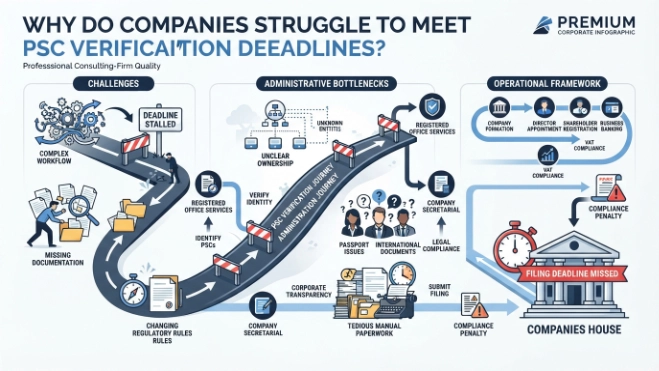
Identity verification mandates create friction for active corporate directors. The statutory process requires matching biometric passports, government photo credentials, and physical proof of address. When corporate officers operate overseas, authenticating documents causes long administrative delays.
Many corporate structures feature layered ownership models. Identifying ultimate beneficial owners across multi-tiered corporate entities requires extensive legal investigation. Directors often miscalculate threshold percentages, leading to rejected filings and wasted time.
Internal administrative errors further slow down filings. Misspelled director names, incorrect residential address histories, and missing dates of birth trigger automated system rejections. Manual submissions magnify these errors, leaving the company exposed to statutory default.
How Does Form My Company Accelerate Your PSC Filing Process?
Form My Company accelerates your PSC filing process by automating identity verification and transmitting verified corporate data directly to Companies House APIs. The platform eliminates manual administrative paperwork, validates officer data instantly, and secures statutory compliance.
Using automated compliance software streamlines identity checks. Modern compliance tools process director identity documents in minutes. Direct integration with official registry databases ensures accurate data formatting before final submission.
Using the specialized PSC Register service ensures that corporate ownership changes process without statutory errors. Professional compliance specialists review complex ownership hierarchies. Specialist review removes filing ambiguities and prevents legal rejection.
Streamlined digital workflows simplify compliance management. Directors complete identity verification through secure digital portals without physical appointments. Automated validation tools eliminate formatting mistakes, ensuring your updates pass registry filters on the first attempt.
What Are the Consequences of Missing the PSC Deadline?
Missing the PSC deadline results in automatic financial penalties, criminal prosecution of corporate officers, and potential company strike-off. Invalid filings disrupt commercial banking operations, void business insurance policies, and halt active corporate transaction workflows.
Financial penalties accumulate rapidly after filing default. Companies House imposes daily fines on directors for continuous non-compliance. These statutory fines fall directly on individual officers, making compliance a serious personal liability.
Criminal prosecution risks affect every non-compliant director. Court summons lead to permanent legal convictions, director disqualification orders, and serious reputational damage. Disqualified officers cannot manage UK entities for up to 15 years.
Commercial disruptions affect immediate business operations. Financial institutions monitor public registry compliance daily. Default status leads to frozen merchant accounts, canceled credit facilities, and rejected loan applications. Investors withdraw capital when registry flags indicate regulatory non-compliance.
If an officer fails to comply with statutory identity mandates, the business risks immediate enforcement action. You can learn more about regulatory enforcement actions by reading what happens if a PSC fails to verify their identity.
How Does DIY Filing Compare to Assisted PSC Verification?
DIY filing requires manual document gathering, unassisted portal submissions, and personal liability for technical compliance errors. Assisted PSC verification provides automated identity checks, expert document validation, and guaranteed registry approval before statutory enforcement deadlines.
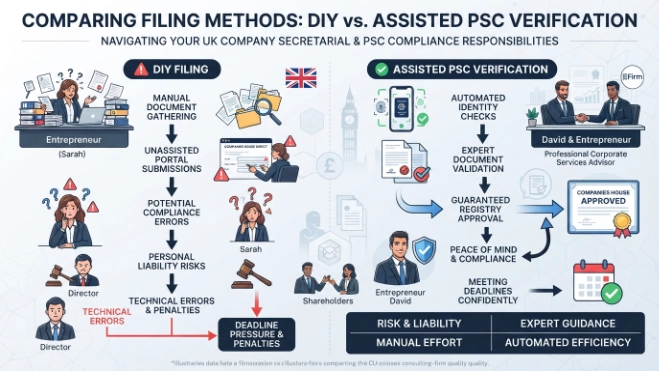
Manual submissions through government portals carry substantial operational risk. DIY users must interpret complex legal definitions without professional assistance. Unintended miscalculations of shareholder percentages result in illegal registry filings.
Self-managed filing processes lack automated validation protections. Minor typographical errors trigger rejection notices days after submission. Repeating filing procedures wastes critical time, often pushing companies past statutory cut-off dates.
Professional assistance removes technical burdens from company directors. Expert compliance strategists verify document authenticity, calculate voting shares correctly, and handle registry communications directly. Choosing professional assistance protects directors from legal liabilities.
Evaluating operational safety models helps determine the best approach for your business. You can review a complete risk assessment by reading about DIY vs assisted PSC identity verification.
How to Complete Your PSC Verification with Form My Company
To complete your PSC verification with Form My Company, input director details into the secure online portal, upload government-issued identification documents, and authorize automated filing. Compliance specialists validate the information and submit approved records directly to Companies House.
Completing corporate compliance requires a structured, step-by-step approach. Following a clear operational process ensures all statutory obligations are met without administrative delay.
Why Is Immediate Action Critical for UK Business Compliance?
Immediate action is critical for UK business compliance because legal penalties begin accruing the day a statutory filing deadline passes. Early verification prevents public compliance red flags, protects director reputations, and maintains uninterrupted commercial trading capabilities.
Proactive compliance management prevents unexpected regulatory action. Registrars act quickly on overdue obligations under modern enforcement mandates. Updating corporate registers well before deadline dates shields companies from administrative notices.
Maintaining clear public registers builds trust with commercial partners. Institutional clients, suppliers, and buyers review corporate filings before signing agreements. Unblemished compliance records facilitate fast, successful business deals.
Form My Company delivers reliable corporate filing services for busy UK directors. Delegating compliance tasks to qualified experts protects your business from expensive registry fines. Fast administrative turnaround ensures your filings complete on time, every time.
Explore our PSC Register guide,
Get a Premium Bound Statutory Register With Form My Company
Hire Video-Enabled Conference Venues From Form My Company
Frequently Asked Questions
What Is a PSC Register and Why Is It Mandatory for UK Companies?
A PSC Register (Persons with Significant Control register) is an official record maintained by UK entities detailing individuals who hold ultimate ownership or control over a business. Form My Company manages these statutory records to ensure compliance with Companies House guidelines and the Economic Crime and Corporate Transparency Act. Keeping this register updated is legally mandatory to maintain public transparency and prevent financial crime penalties.
How Do You Update Your PSC Register With Form My Company?
Updating your PSC Register with Form My Company involves submitting details of any changes in ownership, voting rights, or corporate control through our secure compliance portal. Our team processes your updated beneficial ownership information, verifies director identity details, and transmits the verified filings directly to Companies House. This streamlined service prevents administrative delays and guarantees your corporate record remains legally accurate.
What Are the Key Criteria for Identifying a Person with Significant Control?
An individual is classified as a PSC if they hold more than 25% of company shares, control over 25% of voting rights, or have the authority to appoint or remove a majority of directors. Form My Company assists business owners in evaluating these threshold metrics across direct and indirect ownership structures. Accurately determining control status ensures your statutory disclosures align with UK legal standards.
What Happens If You Fail to Maintain an Accurate PSC Register?
Failing to file accurate PSC disclosures or meet statutory verification cut-off dates constitutes a criminal offense under UK law. Non-compliant entities face daily financial penalties, public register annotations, director disqualifications, or official company strike-off proceedings. Form My Company protects your corporate standing by handling all statutory updates and identity validations before enforcement deadlines occur.
Can Foreign Directors or Overseas Beneficial Owners Be Listed on a UK PSC Register?
Yes, non-UK residents and overseas beneficial owners can be registered as PSCs, provided their identities pass statutory verification standards. Form My Company coordinates international identity verification through compliant biometric and document authentication checks. This ensures international directors and global corporate entities remain fully compliant with UK registration rules.