
Companies House will begin rolling out mandatory identity verification requirements for Persons with Significant Control (PSCs) in spring 2025 under the Economic Crime and Corporate Transparency Act. Full mandatory compliance across all existing PSCs and registered entities will take effect by spring 2026.
What Are the New PSC Identity Verification Requirements?
The new PSC identity verification rules require individuals with significant control over UK companies to confirm their personal identities directly with Companies House or through an Authorised Corporate Service Provider. This process links individual identities to official corporate filings.
The Economic Crime and Corporate Transparency Act 2023 establishes this statutory framework to prevent fraudulent corporate registrations. Under the updated regulations, every PSC must verify their identity to ensure the public register reflects accurate ownership data. Anonymous corporate control is no longer permitted under UK company law.
The identity verification process applies to both individual PSCs and Relevant Legal Entities (RLEs). For individual PSCs, verification requires submitting primary photographic identification documents alongside biometric data. For RLEs, a relevant officer of the corporate body must undergo verification to maintain compliance.
Company directors and PSCs face strict personal obligations to complete this process within designated statutory windows. Failing to meet the verification standards renders filings invalid and prevents official updates to the register. This framework ensures total transparency across all business structures operating in the United Kingdom.
Why Is Companies House Introducing Mandatory Identity Verification?
Companies House is introducing mandatory verification to combat economic crime, prevent identity theft, and eliminate anonymous shell companies from the UK registry. These rules ensure that all corporate entities operate with verified, accountable beneficial owners.
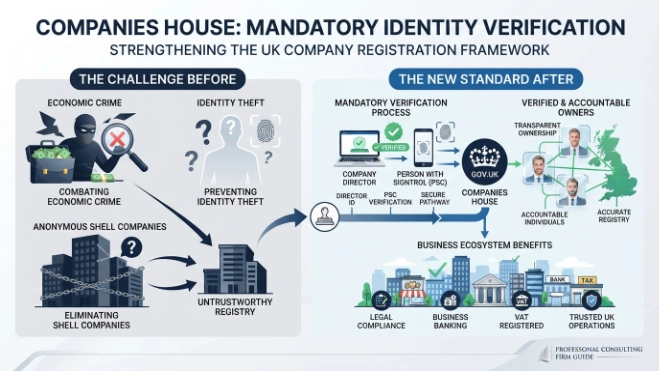
Law enforcement agencies and regulatory bodies require verified corporate data to investigate financial misconduct effectively. In accurate registry records allow bad actors to obscure illegal financial flows through complex corporate structures. Mandatory verification establishes a traceable audit trail directly to the true controllers of every UK firm.
The official reforms target bad actors who use fictitious names or stolen identities to incorporate legal entities. By requiring verified primary credentials, the registry actively blocks illicit formations before illegal trading activity occurs. This statutory barrier significantly reduces corporate fraud across all commercial sectors.
Legitimate businesses benefit directly from a verified corporate environment that increases international trading trust. Suppliers, financial institutions, and investors gain clear visibility when performing standard due diligence procedures. A transparent registry protects honest market participants from fraudulent trading counterparties.
Who Must Complete the PSC Identity Verification Process?
Every individual registered as a Person with Significant Control, newly appointed PSCs, company directors, and nominated officers of Relevant Legal Entities must complete verification. Unverified individuals cannot legally carry out formal statutory duties for UK companies.
Individual PSCs who hold more than 25% of company shares or voting rights must complete verification. This requirement extends to individuals who hold the right to appoint or remove a majority of the board of directors. Every individual exercising significant influence or control over a company must comply with the new rules.
Corporate officers holding multiple appointments across different legal structures must complete the process once. Companies House links a single verified identity account to all relevant director and PSC appointments across the entire public database. This unified system eliminates redundant verification requests for multi-company directors.
For corporate entities acting as PSCs, specific legal representatives must undergo verification on behalf of the organization. Designated corporate officers must validate their credentials to satisfy statutory compliance obligations for the entity. Failure by an officer to verify halts corporate filings for the underlying firm.
What Documents Are Required to Verify a PSC Identity?
Verification requires valid government-issued photographic identification documents, such as biometric passports, photo driving licences, or national identity cards. Individuals must also provide proof of address documents, including utility bills, bank statements, or official tax correspondence.
Identity verification mechanisms rely on official identity documents containing integrated biometric features. Applicants submit high-resolution document scans alongside real-time facial recognition checks using official digital verification platforms. This technology matches live facial imagery against stored biometric chip data instantly.
Three accepted secondary documents validate residential address details:
Present utility bills issued within the last three months
Provide official bank statements showing full current residential address
Submit government tax assessment letters issued within the current tax year
Individuals choosing non-digital verification routes must submit certified hard-copy documentation through authorized professional intermediaries. Authorised Corporate Service Providers verify original physical documents and submit formal statutory declarations to Companies House. Both digital and manual pathways enforce identical verification standards.
How Does the PSC Verification Timeline Roll Out for Existing Companies?
Existing companies receive a 12-month transition period starting from the official implementation date in spring 2025 to verify all registered PSCs. All existing PSCs must complete verification alongside their company’s first confirmation statement filing after implementation.
The phased transition period allows existing businesses to align verification tasks with routine annual compliance filings. Directors must check that every registered PSC completes verification before submitting the confirmation statement. Companies cannot submit their annual confirmation statement if an unverified PSC remains on record.
Newly incorporated entities face immediate compliance obligations from the moment of legal establishment. Individuals designated as PSCs during company formation must complete verification before filing the initial incorporation documents. Companies House rejects incorporation applications containing unverified individual details.
Company officers should audit their current ownership records well before the statutory deadline arrives. Identifying inactive or uncooperative PSCs early prevents administrative bottlenecks during confirmation statement filings. Proactive updates to your internal PSC Register ensure seamless transitions when your confirmation statement deadline occurs.
What Are the Non-Compliance Penalties for Unverified PSCs?
Failing to complete identity verification within statutory deadlines results in civil penalties, administrative sanctions, director disqualifications, and criminal prosecution. Unverified PSCs face daily fines, while non-compliant companies lose the ability to file official records.
Companies House holds both the non-compliant PSC and the defaulting company officers liable for statutory breaches. Criminal penalties include unlimited financial fines assessed against defaulting individuals and corporate entities. Severe cases involving persistent non-compliance can result in imprisonment for responsible officers.
Administrative consequences immediately halt routine corporate operations and official record management activities. Companies House refuses to process key statutory filings submitted by companies with unverified controllers. Blocking changes to official records restricts commercial transactions, bank account operations, and funding rounds.
Three distinct legal consequences apply to unverified corporate officers:
Incur daily default fines for every day the verification remains outstanding
Face formal disqualification proceedings preventing future company directorship appointments
Suffer automatic rejection of all statutory corporate filings submitted to the registrar
How Can Businesses Prepare for the New PSC Identity Rules?
Businesses must audit their internal PSC registers, notify relevant controllers of incoming rules, verify personal details, and establish digital account access. Early preparation prevents filing rejections, operational delays, and statutory fines when compulsory enforcement begins.
Managing internal records effectively ensures your company holds accurate details for all legal controllers. Corporate secretaries must verify that current full names, residential addresses, and service addresses match official identity documents exactly. Correcting discrepancies on the public register now prevents delays during identity checks.
Establishing clear communication lines with external PSCs speeds up verification completion rates significantly. Many PSCs reside overseas or operate through complex corporate structures, requiring extended lead times to gather documents. Early outreach gives foreign investors adequate time to navigate verification requirements.
Implementing structured internal processes ensures ongoing compliance as corporate ownership structures change. Companies should integrate mandatory identity verification checks directly into their standard director onboarding workflows. Establishing clear compliance steps helps businesses learn how to avoid delays with PSC identity verification before statutory confirmation deadlines arise.
What Role Do Authorised Corporate Service Providers Play in PSC Verification?
Authorised Corporate Service Providers (ACSPs) act as official anti-money laundering regulated intermediaries permitted to perform identity verification checks. ACSPs verify client identities directly and submit official verification statements straight to Companies House.
Regulated professionals, including accountants, solicitors, and company formation agents, apply for ACSP status through Companies House. These providers operate under strict anti-money laundering supervision, ensuring robust identity checks. ACSPs offer professional assistance to business owners navigating complex verification procedures.
Using an ACSP simplifies corporate compliance for businesses with complex, foreign, or multi-tiered ownership structures. Intermediaries securely verify international identity credentials without requiring non-UK residents to navigate complex direct filing portals. ACSPs submit digital confirmation notices directly to the registrar upon successfully verifying client documents.
Outsourcing corporate compliance tasks reduces administrative burdens on internal company directors significantly. Professional service providers manage verification workflows, track statutory filing deadlines, and maintain accurate internal registers. Business owners can book assisted PSC identity verification with Form My Company to ensure full regulatory compliance across all entity records.
How Will PSC Verification Impact Foreign Investors and Overseas Controllers?
Overseas PSCs must undergo identical verification standards as UK-based controllers by submitting internationally recognized biometric passports or certified identity documentation. Foreign language credentials require certified translations from accredited verification professionals before formal submission.
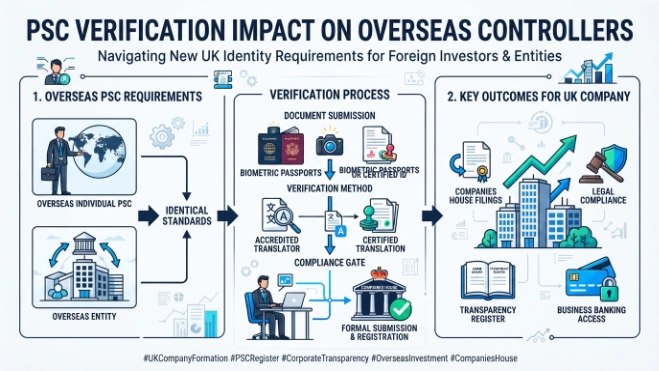
International investors holding significant control in UK entities must obtain compatible digital identification tools promptly. Overseas individuals without UK digital accounts utilize authorized ACSP intermediaries to complete identity checks remotely. Intermediaries validate international credentials under rigorous UK anti-money laundering regulations.
Verification timelines for foreign controllers often take longer due to document legalization and translation requirements. Non-UK citizens must ensure their passport details match public registry filings exactly. Addressing spelling variations across foreign documents prevents administrative rejections at Companies House.
UK companies with foreign parent structures must trace ultimate beneficial ownership back to individual controllers promptly. Corporate structures that fail to verify their overseas PSCs risk immediate statutory restrictions on UK business activities. Maintaining transparent global ownership records protects UK subsidiaries from operational disruption.
Summary of PSC Identity Verification Reforms
The Economic Crime and Corporate Transparency Act introduces fundamental changes to UK corporate governance through mandatory PSC identity verification. These reforms mandate that every corporate controller proves their identity to maintain accurate public registry data. Transition periods begin in spring 2025, with full mandatory enforcement for all existing entities by spring 2026.
Proactive preparation remains essential for every UK director, company secretary, and beneficial owner. Conducting immediate audits of internal records ensures seamless transitions when confirmation statement deadlines arrive. Maintaining clear, updated corporate records protects your business from administrative rejections and statutory penalties. Form My Company assists UK businesses by managing statutory compliance and providing expert corporate register support.
Explore our PSC Register guide,
Why Must Every PSC Now Verify Their Identity at Companies House?
Why Are Businesses Switching to Hybrid Meeting Formats?
Frequently Asked Questions
What is a PSC Register, and why is it legally required for UK companies?
A PSC Register (Person with Significant Control Register) is an official compliance record that details the ultimate beneficial owners and key decision-makers of a UK company. Under the Companies Act 2006 and Economic Crime and Corporate Transparency Act, maintaining and filing accurate ownership data with Companies House is a statutory requirement to prevent corporate fraud and financial crime. The Form My Company PSC Register service helps businesses maintain accurate statutory records, ensure identity verification compliance, and avoid severe legal penalties.
Who qualifies as a Person with Significant Control (PSC)?
An individual or legal entity qualifies as a PSC if they hold more than 25% of a company’s shares, hold over 25% of the voting rights, or have the power to appoint or remove the majority of the board of directors. Individuals who exercise significant influence or control over company decisions through alternative contractual agreements also meet the statutory threshold. Form My Company assists corporate structures in auditing ownership chains and identifying registrable beneficial owners correctly.
How do the new PSC identity verification rules affect existing UK companies?
The new rules require all PSCs and company directors to authenticate their identity using government-issued photo ID through Companies House or an Authorised Corporate Service Provider (ACSP). Existing UK entities must submit a verified unique personal identifier code for every registered PSC alongside their next annual confirmation statement filing. Form My Company streamlines this verification process for business owners to ensure uninterrupted statutory filings and public register compliance.
What happens if a company fails to maintain an accurate PSC Register?
Failing to maintain a verified PSC Register or failing to submit accurate beneficial ownership updates to Companies House is a criminal offense. Responsible officers face civil penalties, daily default fines, director disqualifications, and potential prosecution. Additionally, Companies House will reject routine filings, freezing corporate record updates until full statutory compliance is restored.
How does Form My Company assist businesses with PSC Register compliance?
Form My Company provides end-to-end statutory maintenance for your company’s PSC Register, handling everything from initial controller identification to identity document verification. Their team ensures all entries are updated within statutory deadlines and properly submitted to Companies House. Using the Form My Company PSC Register service eliminates administrative errors, protects directors from non-compliance penalties, and maintains transparent legal standing.