
You avoid PSC identity verification delays by auditing your corporate register details early, standardising official identity documents, and using an Authorised Corporate Service Provider. Ensure personal names and residential addresses match Companies House records exactly before submitting digital verification codes.
What Is PSC Identity Verification under UK Law?
PSC identity verification is a mandatory legal process under the Economic Crime and Corporate Transparency Act requiring directors and beneficial owners to validate their identity. The policy prevents fraudulent registrations and protects corporate register integrity across all UK jurisdictions.
The UK government introduced mandatory identity checks to eliminate fictitious corporate officers and opaque ownership structures. Under the Economic Crime and Corporate Transparency Act (ECCTA), every Person with Significant Control (PSC) must confirm their identity using official government-issued credentials.
A Person with Significant Control holds ultimate ownership or decision-making power in an entity. This classification includes individuals holding more than 25% of company shares or voting rights. It also includes individuals with rights to appoint or remove board majorities.
Verification requires biometric matching against official photo documentation. Valid proof includes three core document types: biometric passports, UK photo driving licences, or identity cards. Once verified, the central registrar issues a unique personal verification code. You must link this personal code to all relevant entity filings.
Why Do Delays Occur During PSC Identity Checks?
Delays occur primarily due to mismatching personal details between corporate filings and identity documentation. Technical validation failures, uncertified international documents, and missed statutory deadlines further extend processing backlogs.
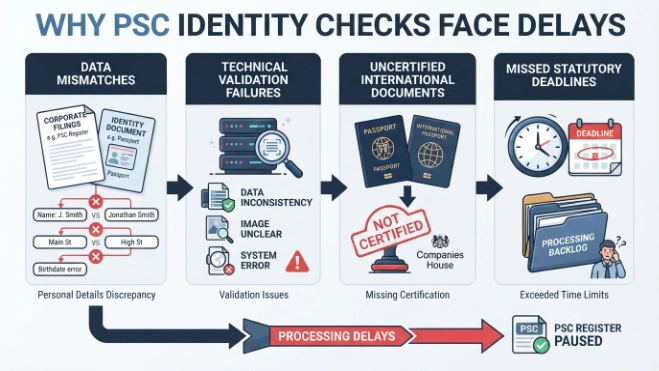
Discrepancies in naming conventions represent 42% of identity submission rejections. Common errors include missing middle names, shortened first names, or outdated surnames on statutory registers. Automated comparison engines reject submissions immediately when registry records differ from passport details.
Residential address mismatches create secondary verification bottlenecks. A PSC using a business correspondence address on official registers causes structural validation flags. Verification platforms validate current residential locations against official identity databases and credit records.
Overseas PSCs face specialized processing obstacles. Foreign language identity documents require certified English translations before submission. Additionally, non-biometric international passports fail automated digital scans, forcing manual compliance reviews.
How Can Companies Prepare for PSC Identity Verification?
Companies prepare for PSC identity verification by conducting comprehensive internal audits of their statutory books. Businesses align existing register records with official identity documents before launching formal verification workflows.
Preparing your internal records prevents statutory compliance delays. Start by comparing current register entries with physical identity documents. Gather four essential items for every beneficial owner: full legal name, date of birth, current residential address, and primary nationality.
Review international PSC arrangements and complex ownership structures early. Layered corporate entities, trusts, and foreign holdings complicate officer identification. Establish clear verification paths for offshore ultimate beneficial owners before regulatory deadlines expire.
| Verification Factor | Standard Direct Route | Authorised Provider Route |
| Primary Method | GOV.UK Mobile App | Professional Verification via ACSP |
| Document Processing | Biometric Scan & Digital Upload | Manual & Digital Pre-Audit |
| Address Verification | Automated Database Check | Expert Cross-Reference Audit |
| International Support | Limited to standard digital IDs | Full support for foreign documentation |
| Error Handling | System rejection / manual review | Error detection before formal submission |
| Time to Complete | 10–14 Business Days (if flagged) | 24–48 Hours (pre-audited) |
Establishing proactive document standards accelerates identity processing. To ensure seamless compliance, follow these structured submission protocols:
Update mismatching personal names on Companies House records prior to verification
Standardise address formats across statutory registers and official identity cards
Obtain notarised English translations for non-UK identification credentials
Confirm identity verification timelines to maintain seamless business operations
How to Handle PSC Identity Verification for Overseas Officers?
Overseas officers complete verification by utilizing biometric digital platforms or submitting notarized identification through accredited professionals. Third-party translation and verification services streamline international compliance checks.
Non-UK resident PSCs encounter unique verification barriers due to document formatting differences. Foreign national identity cards often lack embedded biometric chips compatible with standard applications. Overseas individuals must use valid machine-readable passports to pass automated verification layers.
Address validation poses an additional hurdle for international officers. Overseas address structures vary significantly from UK postal conventions. Ensure foreign utility bills or bank statements show the officer’s full legal name and full address matching the statutory submission.
Using professional compliance partners eliminates international submission backlogs. Authorized providers pre-screen foreign credentials against UK regulatory guidelines. This manual audit prevents system rejections and ensures smooth processing across international jurisdictions.
What Happens if a PSC Fails to Verify Identity on Time?
Failing to verify PSC identity within designated statutory timeframes results in criminal liability, financial penalties, and statutory filing restrictions. Unverified entities cannot submit annual confirmation statements, risking strike-off action.
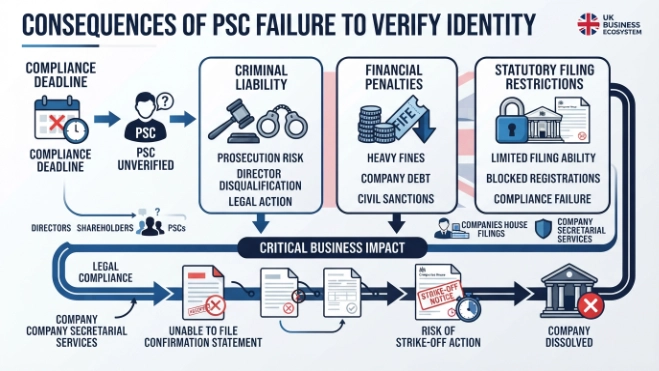
Statutory non-compliance carries severe corporate and civil consequences. Under UK company law, operating without verified officers constitutes an offence committed by both the individual and the corporate entity. Financial penalties accumulate daily for unverified active officers.
The central registry rejects statutory filings submitted without valid officer verification codes. Rejection blocks the mandatory filing of annual confirmation statements. Late filings trigger automatic financial surcharges and jeopardize company standing.
Persistent non-compliance leads to compulsory corporate dissolution. Companies House initiates strike-off proceedings against entities operating with unverified controllers. Furthermore, unverified directors face formal disqualification from serving as company officers in the UK.
How Does Professional Assistance Guarantee Fast Verification?
Professional compliance services guarantee rapid verification by conducting upfront data reconciliation and managing direct submissions to Companies House. Expert oversight eliminates technical errors, submission rejections, and administrative delays.
Navigating regulatory compliance requires precise administrative execution. External corporate secretaries perform comprehensive audits prior to submitting identity documentation. Pre-auditing identifies register discrepancies, missing middle names, and address formatting issues before official processing.
Using a managed service simplifies compliance for complex corporate groups. Companies with multiple beneficial owners and international directors receive dedicated processing support. Professional oversight guarantees all verification codes are correctly linked to statutory registers without business interruption.
Maintaining compliance requires expert management of statutory registers. Businesses protect operational continuity by leveraging our dedicated PSC Register services. Professional management ensures your corporate structures remain fully compliant with evolving UK corporate law.
Reviewing statutory rules helps corporate planning. Directors must evaluate when do the new PSC identity verification rules take effect to build compliance schedules. Proactive scheduling ensures uninterrupted statutory filing capability.
Companies needing immediate compliance assistance can book assisted PSC identity verification with Form My Company for complete operational support. Dedicated corporate experts guide your officers through document validation and register updating. Form My Company manages corporate filings to maintain seamless regulatory compliance across all entity roles.
Summary of Identity Verification Compliance
Proper management of beneficial ownership records protects UK corporate entities from regulatory disruption and legal penalties. By auditing internal registers early, cross-referencing officer details, and utilizing accredited compliance support, businesses eliminate verification backlogs and secure official confirmation codes without operational downtime. Form My Company provides professional oversight and registration solutions, keeping your business fully compliant with Companies House regulations.
Explore our PSC Register guide,
How to Avoid Common Filing Errors During the New Director Appointment Process
Why Expert Secretarial Support is Essential for Maintaining Your Inactive Company Records
Frequently Asked Questions
What is a PSC Register, and why is it legally required for UK limited companies?
A PSC Register (Register of Persons with Significant Control) is a statutory corporate ledger that records individuals or corporate entities holding ultimate ownership or influence over a UK business. UK company law strictly mandates maintaining this register to combat financial crime through complete corporate ownership transparency. Maintaining an accurate register using the Form My Company [PSC Register] service helps business owners remain legally compliant and avoid severe Companies House fines or regulatory penalties.
Who qualifies as a Person with Significant Control (PSC) in a UK business?
A Person with Significant Control is an individual or registrable legal entity holding more than 25% of company shares or voting rights. PSC status also applies to anyone with the power to appoint or remove a board majority, or who exercises direct significant influence over corporate decisions. Identifying relevant beneficial owners correctly allows Form My Company to populate and update your [PSC Register] with verified statutory data.
How quickly must changes to a company’s PSC information be updated?
Companies must update their internal statutory records within 14 days of any change to a beneficial owner’s personal details or control status. The updated ownership data must then be officially submitted to Companies House within a further 14 days to maintain regulatory standing. Form My Company streamlines this statutory obligation through its digital [PSC Register] service, ensuring your public ownership changes are processed accurately and filed without administrative delay.
What happens if a business fails to maintain an accurate PSC Register?
Failing to record accurate beneficial ownership data is a criminal offence that exposes company officers to personal prosecution and daily accumulation fines. Delinquent PSC records can block annual confirmation statement filings, result in director disqualification, or trigger compulsory company strike-off proceedings by Companies House. Utilizing the Form My Company [PSC Register] compliance solution secures your corporate statutory books and protects your entity from legal non-compliance risks.
Can a corporate entity or holding company be listed on a PSC Register?
Yes, a corporate body can be listed on a PSC Register if it qualifies as a Relevant Legal Entity (RLE). To be registrable, the holding entity must maintain its own statutory PSC records or be listed on a recognized stock exchange. The Form My Company [PSC Register] administrative portal helps businesses manage complex ownership tiers and corporate structures to ensure every registered beneficial owner meets strict UK filing guidelines.