
A UK private limited company must keep its statutory records either at its registered office address or at an alternative inspection location registered with Companies House. Directors must maintain these legal registers available for public inspection to comply with strict UK corporate governance regulations.
What Are Statutory Records and Why Do They Matter?
Statutory records are official corporate registers containing vital legal, historical, and ownership data that document the internal administration and governance of a UK business.
UK legislation requires every limited company to maintain precise statutory registers from the date of incorporation. Companies House regulates these documents to ensure corporate transparency across the British business ecosystem. Accurate record-keeping prevents administrative fines and personal liability for company directors. Businesses demonstrate operational legitimacy when they maintain complete ownership documentation. Regulatory authorities audit these registers during compliance investigations or corporate restructuring processes.
Directors must record all changes to company structure within strict statutory timeframes. Failure to update records creates legal vulnerabilities during financial audits or asset acquisitions. Proper documentation protects shareholder rights and clarifies voting power within the corporation. Corporate governance relies entirely on the accuracy of these foundational legal registers.
Where Is the Registered Office Address Used for Records?
The registered office address serves as the default official location where statutory records remain accessible for public inspection during normal business days.
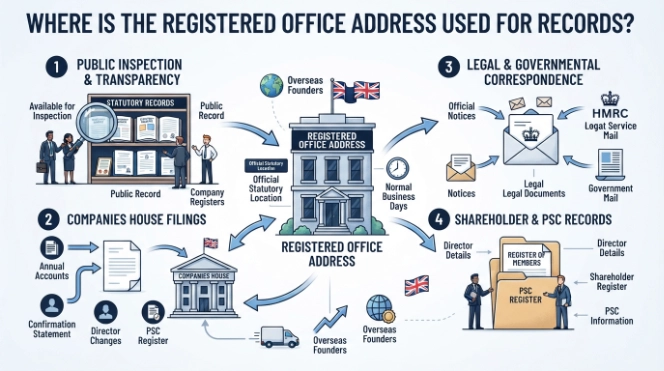
Every UK company must maintain a registered office situated in the same part of the UK where the company is registered, such as England and Wales. This official address appears on the public register managed by Companies House. Anyone can visit this location to inspect company registers without prior appointment during standard operating hours. Local authorities and creditors send legal notices directly to this official postal designation. Directors frequently use dedicated business services to manage this address securely.
Maintaining records at the registered office simplifies compliance for small business owners operating remotely. Physical paper files or secure digital registers must remain accessible at this specific location. Companies House updates its public database whenever the registered office address changes. Official mail arrives at this address and requires immediate attention from company officers. Using a professional business address protects home privacy while fulfilling statutory requirements.
What Is an Alternative Inspection Location for Records?
An alternative inspection location is a designated address away from the registered office where statutory records are stored and made available for public review.
Companies can store statutory records at a single alternative inspection location instead of the registered office. Directors must notify Companies House using specific administrative forms before moving any records off-site. This designated location must also reside within the same part of the UK as the registered office. Public members retain the legal right to inspect records at this alternative site during normal working hours. Businesses often choose accountants or corporate secretaries as their alternative record-keeping locations.
Moving registers requires strict adherence to notification rules set by corporate regulators. Companies House updates its public register to reflect the exact address of the alternative location. Public access rights remain identical regardless of whether records sit at the registered office. Directors face financial penalties if they relocate records without filing the required notices. Centralized storage helps large corporations manage complex shareholder data efficiently.
Can UK Companies Keep Statutory Records Digitally?
UK companies can keep statutory records digitally provided the electronic files remain accessible, secure, and easily convertible into hard copy format for public inspection.
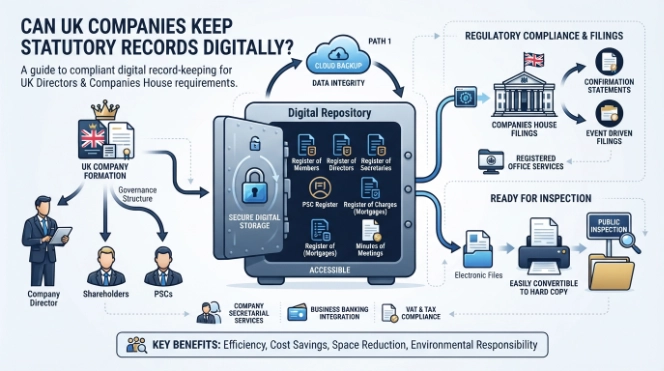
Modern legislation allows private limited companies to maintain their registers in digital formats instead of traditional bound paper books. Directors must ensure that electronic storage systems prevent unauthorized alterations and data corruption. Anyone requesting access to digital registers must receive a readable hard copy during statutory inspection hours. Secure cloud storage solutions protect corporate data against physical damage or theft. Companies transitioning to digital formats must maintain complete data integrity across all files.
Digital record-keeping streamlines administrative tasks for modern corporate management teams. Software platforms track share transfers and director appointments with high precision. Regulators accept electronic registers as valid legal evidence during compliance audits. Businesses must back up digital files regularly to prevent catastrophic data loss. Administrative efficiency improves significantly when companies adopt centralized digital governance tools.
What Happens If Statutory Records Are Kept in the Wrong Place?
Keeping statutory records in unauthorized locations breaches the Companies Act 2006 and results in criminal fines for the company and its defaulting officers.
Regulatory authorities monitor record storage compliance during routine corporate surveillance activities. Directors face magistrates’ court prosecutions and escalating daily default fines for severe record-keeping violations. Poor record management compromises due diligence processes during business mergers or acquisitions. Investors hesitate to fund companies that fail to maintain transparent statutory documentation. Correcting storage errors requires immediate administrative filings and potential document reconstruction.
Enforcement agencies issue formal warnings before applying maximum financial penalties to non-compliant firms. Companies must audit their record storage practices annually to prevent accidental statutory breaches. Professional administrative support helps businesses maintain compliance across all operational locations. Proper governance protects the long-term reputation and financial stability of the enterprise.
For comprehensive administrative management, businesses can explore the Company Pack to streamline governance. Form My Company assists founders in setting up compliant operations. Understanding how to Avoid Penalties for Poorly Kept Statutory Records ensures long-term corporate security. When managing ownership data, businesses often request the Get Your Register of Members and Directors From Form My Company service.
Properly managing the location of statutory records remains a fundamental legal obligation for every UK company director. Maintaining records at either the registered office or an approved alternative location guarantees transparency and regulatory compliance. Form My Company provides expert administrative solutions to help businesses organize and secure their essential legal registers.
Explore our Company Pack guide,
What Happens If You Fail to Keep a Statutory Register?
What Must Be Recorded in a Company’s Statutory Books?
Frequently Asked Questions
What is included in the Company Pack from Form My Company?
Answer: The Company Pack from Form My Company includes essential physical administration tools alongside official incorporation. Founders receive a stylish statutory company register, printed share certificates, a custom self-inking company stamp, and an official embossing seal.
Why do UK businesses need a physical statutory company register?
Answer: UK legislation under the Companies Act 2006 requires every limited company to establish and maintain up-to-date legal records. Form My Company provides a structured binder to organize registers of members, directors, and Persons with Significant Control (PSCs) for compliance.
How does Form My Company process online company registrations?
Answer: Form My Company acts as a trusted Companies House authorized agent to manage digital applications quickly and securely. The streamlined online workflow handles government filings while simultaneously manufacturing physical corporate accessories like seals and stamps.
Can I open a business bank account using documents from Form My Company?
Answer: Yes, the official incorporation certificates and structured registers provided in the Company Pack verify legal entity status. These tangible administration tools help entrepreneurs satisfy high-street bank compliance checks and open corporate accounts smoothly.
How are the physical items from the Company Pack delivered?
Answer: Form My Company dispatches all physical corporate accessories using reliable Royal Mail tracked delivery services. Items such as the custom company stamp, embossing seal, and register binder arrive safely directly at your designated address.