

Failing to keep a statutory register results in direct criminal prosecution, unlimited financial fines for the company and officers, potential director disqualification for up to 15 years, and severe legal complications during corporate audits, funding rounds, or share transfers under UK company law.
What Is a Statutory Register and Who Is Required to Maintain It?
A statutory register is an official set of legal records that every UK private and public limited company must maintain by law. Company directors hold the ultimate legal responsibility to update and store these compliance records accurately.
The Companies Act 2006 mandates that every registered company in the UK keeps an updated set of statutory books. These records track the administrative, financial, and ownership history of the legal entity. You must store these registers at your company’s registered office address or a Single Alternative Inspection Location (SAIL address).
Failure to establish these books upon incorporation creates an immediate breach of statutory duty. The law requires six primary records within your statutory books. These registers ensure complete corporate transparency for Companies House, HMRC, law enforcement, and the public.
Maintain the Register of Members detailing past and present shareholders.
Update the Register of Directors listing full legal names and service addresses.
Record the Register of Directors’ Residential Addresses keeping private location data secure.
Log the Register of Secretaries detailing appointed corporate officers.
File the Register of Persons with Significant Control (PSC) tracking ultimate beneficial ownership.
Document the Register of Charges tracking secured company debts and mortgages.
Companies must make these records available for public inspection upon request. If a member of the public requests access, you must comply within five working days or provide a court order refusing access.
What Are the Immediate Legal Consequences of Failing to Keep Statutory Books?
Failing to keep statutory books constitutes a direct criminal offence under UK law. The statutory breach exposes the company, active directors, and appointed secretaries to criminal prosecution, formal police records, and unlimited financial penalties.
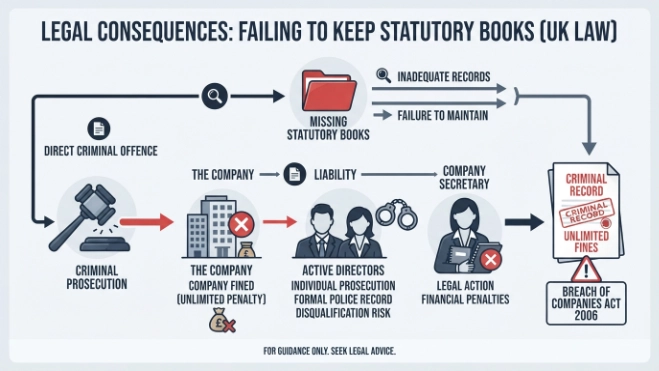
The Companies Act 2006 classifies non-compliance as an offence of continuous default. When a company fails to maintain its records, Companies House issues formal warning notices. Continued failure triggers legal proceedings through the Magistrates’ Court system.
Individual directors face personal liability for non-compliance. You cannot hide behind the corporate veil to avoid personal criminal liability. Courts impose daily default fines for every single day the register remains unupdated.
Pay court-mandated fines reaching unlimited statutory amounts.
Settle daily default penalties accumulating until full compliance occurs.
Absorb permanent criminal records assigned to named company officers.
Surrender executive authority through mandatory court-ordered director removals.
Criminal convictions severely damage a director’s professional standing. Law enforcement agencies utilize non-compliance records to identify fraudulent corporate shells. Maintaining accurate records protects executives from severe regulatory scrutiny and court action.
Can Directors Be Disqualified for Failing to Maintain Statutory Registers?
Yes, company directors face personal disqualification for up to 15 years for failing to maintain statutory registers. The Insolvency Service initiates disqualification proceedings when non-compliance demonstrates unfit corporate management or fraudulent administrative intent.
Under the Company Directors Disqualification Act 1986, regulatory authorities evaluate executive conduct through administrative compliance history. Persistent neglect of statutory registers proves a failure of basic fiduciary duty. Disqualification deprives individuals of the right to manage, launch, or direct any UK company.
Disqualification proceedings frequently arise during company insolvency or formal corporate audits. If liquidators discover missing or altered statutory registers, they report directors for serious misconduct. Courts view missing records as deliberate attempts to obscure illegal financial activities or hidden beneficial ownership structures.
Investigate director conduct following insolvency or public complaint.
Identify missing, inaccurate, or falsified statutory compliance books.
Issue formal letters of intent to pursue director disqualification.
Enforce court disqualification orders ranging from 2 to 15 years.
Publish disqualified director names on the public government register.
A disqualified director loses active professional positions immediately. Breaching a disqualification order results in imprisonment for up to two years. Protecting your directorship requires establishing error-free statutory record structures from day one.
How Does Non-Compliance Impact Business Operations and Transactions?
Non-compliance halts key business operations by invalidating share transfers, blocking commercial equity investments, preventing bank account approvals, and completely stalling corporate mergers or acquisitions during mandatory legal due diligence.
Corporate buyers and institutional investors conduct rigorous due diligence before committing capital. Lawyers verify your statutory books to confirm who actually owns the company. If your Register of Members is incomplete, your share issuances remain legally invalid. Companies House filings do not constitute legal proof of ownership; the statutory register itself serves as the ultimate legal evidence.
Inaccurate registers prevent companies from securing debt financing or commercial mortgages. Financial institutions decline lending applications when beneficial ownership remains unclear or unverified. Corporate transactions fail because solicitors cannot issue clean legal opinions without verified statutory registers.
| Operational Area | Impact of Inaccurate Registers | Legal & Commercial Result |
| Share Transfers | Invalidates share ownership claims | Buyers walk away from transactions |
| Equity Investment | Fails legal due diligence checks | Venture funding is withheld |
| Debt Financing | Blocks bank compliance approvals | Loans and overdrafts are rejected |
| Property Purchases | Prevents execution of charges | Real estate transactions collapse |
When legal disputes arise between business partners, missing registers escalate litigation costs. Courts rely on physical and digital statutory books to resolve shareholder claims. Failing to produce accurate books leaves your firm completely unprotected in corporate litigation.
What Are the Mandatory Records You Must Include in Your Registers?
Your statutory registers must contain detailed legal entries including shareholder personal data, director residential details, PSC ownership percentages, secretarial appointments, and recorded corporate charges under the strict provisions of UK company law.
Maintaining incomplete records exposes your enterprise to the same prosecution as keeping no registers at all. Every entry requires specific data fields dictated by statutory compliance frameworks. To understand the exact data points required for your corporate files, review this guide on what to include in your register of members, directors and PSCs.
Accuracy is essential when recording changes in corporate structure. When a shareholder transfers equity, you must update the Register of Members immediately. Storing vague or outdated information breaches privacy regulations and statutory rules simultaneously.
Record full legal names, service addresses, and equity classes for members.
Document director nationality, birth dates, business occupations, and appointment dates.
Log PSC voting percentages, board control rights, and identity verification markers.
Register secure debt details, charge creation dates, and mortgage satisfaction receipts.
Updating these fields demands consistent administrative oversight. When corporate officers resign, you must record exact termination dates within 14 days. Prompt updates protect the enterprise against regulatory enforcement action.
How Do You Rectify Missing or Inaccurate Statutory Registers?
You rectify missing or inaccurate statutory registers by conducting a comprehensive corporate administrative audit, reconstructing historical transaction entries, passing formal board resolutions, and applying for court orders when share registers contain critical errors.
When a company discovers missing registers, executives must initiate immediate administrative reconstruction. Reconstructing records involves cross-referencing historical board minutes, stock transfer forms, Companies House submissions, and bank payment receipts. This painstaking process restores the legal lineage of your corporate ownership structure.
If your Register of Members contains fundamental errors or missing share allocations, simple edits are insufficient. Section 125 of the Companies Act 2006 requires companies to apply for a formal court order to rectify the Register of Members. The court reviews supporting evidence before ordering legal corrections to official corporate records.
Audit existing corporate files to identify missing or incomplete registers.
Gather historical incorporation documents, stock transfer forms, and board minutes.
Reconstruct chronological entries for directors, secretaries, PSCs, and shareholders.
Pass formal board resolutions approving the adoption of reconstructed statutory registers.
Apply to the court under Section 125 if shareholder ownership rectifications require formal judicial authorization.
Completing this process restores your company’s clean standing with enforcement bodies. Professional corporate service providers streamline this complex administrative process using verified compliance software.
How Can Professional Solutions Help Maintain Your Statutory Books?
Professional corporate services eliminate compliance risks by automating statutory register maintenance, providing digital storage environments, managing Companies House updates, and delivering professionally structured legal documentation for your enterprise.
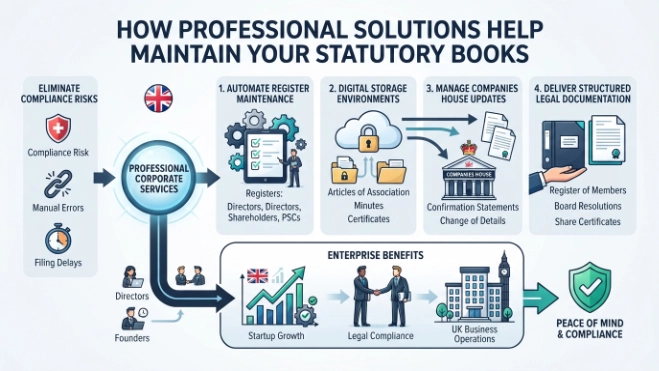
Managing compliance internally diverts valuable focus away from core commercial activities. Manual tracking methods often lead to missed deadlines, lost records, and inadvertent legal breaches. Professional corporate service packages supply structured digital tools designed to maintain compliant statutory registers effortlessly.
When you order an all-inclusive corporate management kit, expert compliance officers handle your ongoing statutory obligations. Implementing professional systems guarantees that every share issuance, officer appointment, and PSC amendment is recorded correctly. You can easily secure your statutory books with Form My Company to safeguard your business against prosecution and operational disruption.
Digital maintenance solutions store your compliance files securely in cloud environments. These platforms generate instant audit trails, automate annual confirmation statement preparation, and facilitate seamless public inspections. Outsourcing administrative burdens ensures your business remains permanently investment-ready.
Working with dedicated compliance professionals prevents administrative oversight before legal vulnerabilities emerge. To establish a reliable record-keeping framework, explore the full Company Pack solution to maintain compliant corporate infrastructure from inception.
Ensuring Long-Term Statutory Compliance
Maintaining accurate statutory registers is a continuous legal obligation under UK company law. Neglecting these records leads to severe penalties, including criminal charges, heavy fines, director disqualifications, and ruined business deals. Business success relies on administrative integrity as much as commercial revenue.
Companies protect their operations by adopting automated, professional compliance frameworks. Form My Company provides comprehensive corporate services that keep your statutory books accurate, updated, and legal. Establishing robust compliance procedures shields your business from regulatory liabilities and secures long-term enterprise value.
Explore our Company Pack guide,
UK Company Formation from Bangladesh: Taxes & Risks (2026)
Can You Open a UK Company from Cape Verde?
Frequently Asked Questions
What is included in a UK Company Pack?
A standard UK Company Pack provides the official legal documentation required to operate a limited company compliant with the Companies Act 2006. Form My Company supplies digital and printed certificates of incorporation, articles of association, shareholder certificates, and structured statutory registers. These documents verify legal entity creation for bank accounts, HMRC registrations, and corporate governance.
Why does a business need a statutory registers kit?
Maintaining statutory registers is a mandatory legal obligation for all UK private limited companies to log directors, members, and Persons with Significant Control (PSCs). Using a professional Company Pack from Form My Company ensures statutory books remain accurately structured and compliant with legal inspection rules. Failing to keep updated statutory registers can lead to criminal fines, director disqualification, and invalid corporate transactions.
How do statutory books differ from Companies House filings?
Public filings on Companies House offer a public overview, whereas statutory books serve as the legal evidence of company ownership and internal structure. The statutory registers included in the Form My Company Company Pack record official shareholder legal titles, residential addresses, and private charge logs. Courts and legal solicitors evaluate statutory registers rather than public registry filings during due diligence and equity transfers.
Can statutory registers be kept electronically in the UK?
UK company law permits statutory books to be maintained in either physical or digital electronic formats, provided access and audit controls are preserved. Form My Company delivers digital statutory registers within its Company Pack services to streamline compliance updates and administrative record-keeping. Digital record management allows corporate officers to update shareholder and director records immediately following corporate changes.
How often should company statutory records be updated?
Company statutory records must be updated within 14 days of any administrative or structural change, such as director appointments, shareholder transfers, or PSC modifications. Utilizing a Company Pack from Form My Company establishes a standardized system to record changes promptly across all statutory registers. Timely record management prevents statutory default penalties and ensures seamless financial and legal audits.