
UK companies must record specific legal details of shareholders, directors, and Persons with Significant Control (PSCs) in their statutory registers. These records require full names, addresses, dates of birth, nationality, appointment dates, share classes, and voting rights to maintain legal compliance.
What Information Must Be Recorded in the Register of Members?
The Register of Members must record the name, official service address, share class, quantity of shares held, and amount paid per share for every shareholder. It also requires the exact date each person was registered or ceased being a member.
UK company law mandates that every private limited company maintains an accurate record of its ownership structure. The legal ownership of shares transfers when an entry appears in this statutory register, rather than when a share certificate issues. Section 113 of the Companies Act 2006 governs these specific recording requirements.
Companies must record the full corporate or personal name of every shareholder without exception. Individual shareholders must provide a contact or service address for legal notices. Corporate members must state their registered name, company registration number, and official registered office address.
Share allocation details require absolute numerical precision within the record. You must list the exact number of shares held, their nominal value, and the specific currency of denomination. The register must document three financial status fields: total amount paid, amount remaining unpaid, and voting rights attached to each share class.
Dates form a critical legal component of the membership record. The register must state the exact day, month, and year a shareholder enters the register. When a shareholder transfers or surrenders their equity, you must record the exact termination date. Companies with more than 50 members must maintain a searchable index of shareholder names.
When updating ownership structures during corporate restructuring, business owners often use a dedicated Company Pack to generate compliant statutory registers and update share certificates accurately.
What Details Are Required in the Register of Directors?
The Register of Directors requires the full name, former names, service address, country of residence, nationality, business occupation, and date of birth for each appointed individual. Corporate directors require their official company name, registered office address, and legal registration identifier.
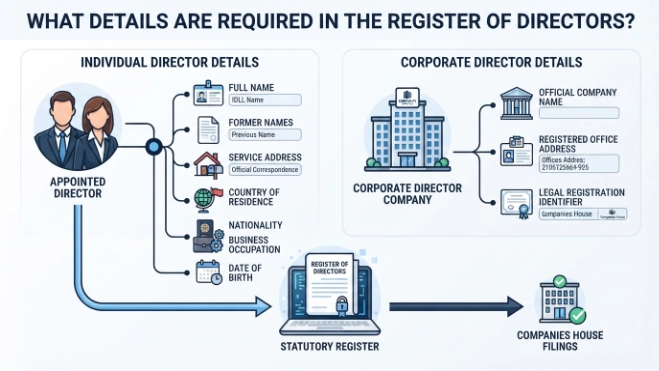
Section 162 of the Companies Act 2006 mandates that every UK company keeps a formal Register of Directors at its registered address. This record provides transparency regarding the operational leadership and legal officers of the business. You must update this register within 14 days of any administrative change or new appointment.
Individual directors must provide comprehensive personal identification metrics. The register must list their full legal name, including middle names and any former names used for business purposes within the last 20 years. The director’s date of birth requires full entry in the statutory book, though only the month and year appear on the public registry at Companies House.
Address records for directors split into two distinct legal categories. Every director must supply a service address for official correspondence and a private residential address. The service address appears on public records, while the residential address remains protected under data protection protocols.
Corporate directors—where another legal entity acts as a director—require specialized entity identification data. The register must record three corporate metrics: full corporate title, legal form of the entity, and official corporate registration number. If registered outside the UK, you must record the governing law and foreign register location.
Former directors remain part of the statutory history of the firm. You must retain the complete record of a resigned director, including their exact date of termination, for at least 10 years after their departure.
What Must Be Included in the Register of Persons with Significant Control (PSC)?
The PSC Register must contain the full name, date of birth, nationality, service address, residential address, date of becoming a PSC, and specific nature of control for every individual holding over 25% of shares or voting rights.
The Small Business, Enterprise and Employment Act 2015 introduced the requirement for a PSC Register to increase corporate transparency. A Person with Significant Control holds ultimate beneficial ownership or operational authority over a corporate entity. Companies must identify, verify, and record all PSC details without delay.
Control metrics determine whether an individual or legal entity qualifies as a PSC. The register must document five conditions of control: holding over 25% of shares, holding over 25% of voting rights, holding rights to appoint or remove majority board members, exercising significant influence or control, or holding equivalent control through a trust arrangement.
Individual PSC entries require specific legal descriptors. The entry must display the individual’s full legal name, service address, residential address, country of residence, nationality, and full date of birth. You must also record the exact date the person achieved the threshold of significant control.
When a legal entity qualifies as a PSC—known as a Relevant Legal Entity (RLE)—different recording criteria apply. The register must list the corporate name, registered office address, legal form, governing legislation, register name, and registration number. The RLE must meet specific criteria regarding corporate transparency to qualify for entry.
If a company takes reasonable steps to identify PSCs but receives no response, the register must record an official statutory state statement. You must insert specific statutory phrases explaining that inquiries are active, notices are issued, or information verification remains pending.
How Do You Maintain and Update These Statutory Books Correctly?
Companies maintain statutory books by recording changes within 14 days, making registers available for public inspection, and filing annual confirmation statements with Companies House. Updates require formal board resolutions, accurate date stamping, and secure physical or digital storage.
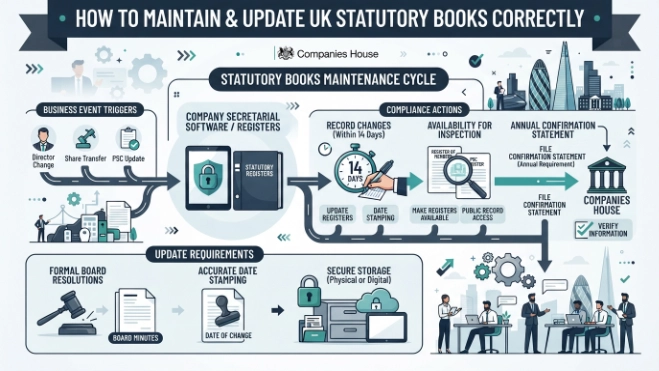
Maintaining statutory registers requires strict administrative processes. Companies must store their registers at their registered office address or a Single Alternative Inspection Location (SAIL). You must notify Companies House immediately if you shift the physical storage location of your legal registers.
Time limits for statutory updates carry legal enforcement consequences. You must update the Register of Directors within 14 days of a change in officers or personal details. Changes to the PSC Register require two distinct timelines: update your internal register within 14 days of confirming details, and submit updates to Companies House within a further 14 days.
Digital register management provides enhanced compliance tracking compared to physical paper books. Software systems automatically log changes, create audit trails, and ensure correct data structuring. Whether utilizing paper or electronic records, registers must remain available for public inspection for at least two hours daily during business hours.
Failing to maintain these internal books leads directly to statutory penalties and administrative defaults. Company officers interested in understanding the legal consequences of poor recordkeeping can review our comprehensive guide on What Happens If You Fail to Keep a Statutory Register? to evaluate their corporate compliance exposure.
Correcting errors within statutory records demands formal procedures rather than simple deletions. If an incorrect entry occurs, the board must pass a resolution authorising the rectification. For complex shareholder disputes or historic errors in the Register of Members, a court order under Section 125 of the Companies Act 2006 may be necessary to amend the record legally.
What Are the Key Differences Between Internal Registers and Companies House Records?
Internal statutory registers serve as the primary legal proof of ownership and control, whereas Companies House filings serve as a public secondary reflection. Ownership transfers occur immediately upon entry into internal registers, prior to any public notification.
Many business executives incorrectly treat public filings at Companies House as the definitive legal record of their firm. Under UK corporate law, the internal statutory registers held by the company represent the sole legally binding source of corporate ownership and officer status.
The legal point of share ownership highlights this critical distinction. A newly issued share or transferred equity holding does not legally belong to the recipient when Companies House processes an annual confirmation statement. Legal title vests when the company secretary or director enters the details into the physical or digital Register of Members.
Public transparency levels differ significantly between internal books and public filings. Internal registers hold unredacted information, including full dates of birth and private residential addresses for directors and PSCs. Public files at Companies House display redacted datasets, showing only the month and year of birth alongside official service addresses.
Submission timelines reflect different operational functions. Internal registers require updates immediately after corporate events occur. Public updates occur via immediate event-driven filings (such as filing a Form AP01 for new directors) or through the annual confirmation statement submission.
When establishing new corporate structures or rectifying outdated records, directors can rely on Secure Your Statutory Books With Form My Company to configure accurate, legal statutory records that satisfy all UK governance requirements.
Explore our Company Pack guide,
Launch Your UK Company from Chile with Form My Company
What Chinese Residents Must Navigate When Setting Up a UK Company Legally
Frequently Asked Questions
What Is Included in a Company Pack for UK Statutory Registers?
The Company Pack from Form My Company includes a bound statutory register, official certificates of incorporation, customized share certificates, and initial board minutes. It provides a complete legal compliance toolkit containing formatted registers for members, directors, and Persons with Significant Control (PSCs).
What Is the Difference Between Internal Statutory Registers and Companies House Records?
Internal statutory registers serve as the primary legal evidence of ownership and directorship under the Companies Act 2006. Companies House public records serve as a secondary public record and display redacted datasets, whereas internal registers contain complete, unredacted corporate records.
How Quickly Must Statutory Books Be Updated After Corporate Changes?
Under UK company law, changes to the Register of Directors or PSC Register must be updated internally within 14 days of the change occurring. Utilizing the Company Pack by Form My Company helps business owners accurately maintain records and avoid statutory fines up to £5,000 for non-compliance.
Where Must Statutory Books and Company Registers Be Kept?
Statutory registers must be stored at the company’s registered office address or a Single Alternative Inspection Location (SAIL) notified to Companies House. They must remain accessible for public inspection during normal business hours to fulfill UK statutory transparency rules.
Is a Hardbound Physical Statutory Register Mandatory for UK Companies?
While statutory registers can be maintained digitally or physically, hardbound physical registers provide a permanent, tamper-proof record preferred by auditors, banks, and legal advisors during due diligence. Form My Company manufactures premium hardbound leatherette statutory registers to simplify statutory recordkeeping and inspection compliance.