
A UK company’s statutory books must record official details regarding officers, shareholders, debentures, and major control structures. Specifically, businesses must maintain registers of directors, director residential addresses, secretaries, members, people with significant control, and charges to meet legal standards.
What Are Company Statutory Books Under UK Law?
Company statutory books are legally required registers that record key governance details, ownership structures, and administrative decisions of a UK business. The Companies Act 2006 mandates that every registered company maintains these records at its registered office or single alternative inspection location.
Under the Companies Act 2006, statutory books serve as the primary official record of a business entity’s legal structure. Private limited companies and public limited companies must set up these registers immediately upon incorporation. The legal responsibility for keeping these books up to date lies directly with the company’s appointed directors. Failing to keep accurate registers constitutes a criminal offence, which exposes directors to individual fines up to £5,000 plus daily default penalties.
Statutory records differ significantly from filings submitted directly to Companies House. While Companies House holds public records, the physical or digital statutory books held by the business represent the legal proof of ownership and officer appointments. If a discrepancy exists between the public register and the statutory registers, courts treat the internal statutory books as the definitive legal evidence. Members of the public and company shareholders hold a legal right to inspect these books under specific statutory conditions.
Which Official Registers Must Every Company Maintain?
Every UK company must maintain six core registers detailing directors, secretarial officers, shareholder identities, residential addresses, controlling interests, and registered charges. These registers capture complete personal, financial, and administrative records necessary to maintain valid legal operations under current corporate enforcement frameworks.
The legal framework specifies precisely which registers must exist within the company’s official records. Company administrators must update these documents whenever changes occur within the corporate structure:
Register of Directors: Record full legal names, service addresses, nationalities, dates of birth, business occupations, and formal appointment dates for all active directors.
Register of Directors’ Usual Residential Addresses: Log the actual home addresses of each director separately to preserve confidentiality from public registers while maintaining statutory records.
Register of Secretaries: Log the legal name, service address, and appointment date for the corporate or individual secretary, when the business chooses to appoint one.
Register of Members: Document all current and past shareholders, including full names, addresses, share classes, held quantities, paid amounts, and the exact date each person became or ceased to be a shareholder.
Register of People with Significant Control (PSC): Identify all individual ultimate beneficial owners or legal entities that hold more than 25% of shares or voting rights within the business.
Register of Charges: List all legal mortgages, fixed charges, and floating charges created against company assets before December 2012, along with historical property encumbrances.
Updating these registers promptly prevents severe administrative delays during legal audits or commercial transactions. When a new share transfer occurs, the transaction gains full legal effect only after the company records the details in the official Register of Members.
Why Is the Register of People with Significant Control Essential?
The Register of People with Significant Control is essential because UK anti-money laundering regulations mandate transparent ownership structures for corporate entities. This specific register identifies every individual or legal entity exercising substantial influence, equity ownership, or board voting power over the business.
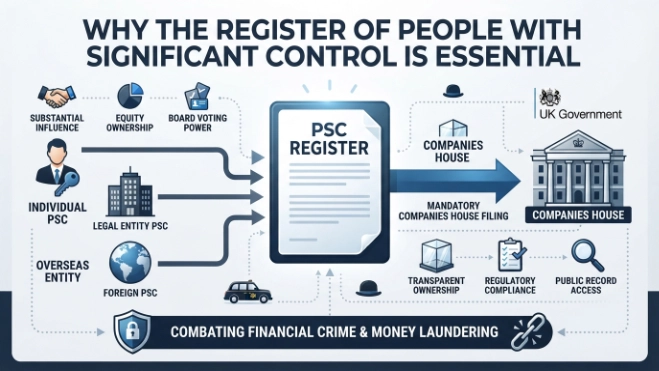
The Small Business, Enterprise and Employment Act 2015 introduced the requirement for a PSC register to combat corporate opacity and tax evasion. A company must identify anyone who meets one or more specific criteria: holding more than 25% of shares, holding more than 25% of voting rights, or holding the right to appoint or remove a majority of the board of directors. If an individual exercises significant influence or control through non-standard agreements, administrators must document those exact details.
Maintaining the PSC register requires proactive verification of beneficial owners. Directors must issue formal notice letters to suspected controlling entities when ownership details remain unconfirmed. If an individual fails to respond to official requests for information within 30 days, directors can place restrictions on their shares, effectively stopping dividend distributions and voting privileges. When corporate managers maintain an accurate PSC record, they ensure full transparency for law enforcement agencies, tax authorities, and potential financial investors.
How Must Board Minutes and Resolutions Be Recorded?
Board minutes and written resolutions must be formally recorded in writing and permanently stored within the statutory records for a minimum of 10 years. These records document official board decisions, shareholder votes, annual general meetings, and structural changes made by corporate officers.
The Companies Act 2006 demands that corporate management records every decision taken during formal board meetings or shareholder assemblies. When directors convene to approve financial accounts, appoint officers, or issue new shares, a designated minute taker must draft clear records of the proceedings. The chairperson of that meeting, or the chairperson of the subsequent meeting, must sign these physical or digital minutes to authenticate the records legally.
Shareholder decisions require distinct legal documentation based on the vote type. Ordinary resolutions require a simple majority exceeding 50% of voting rights, whereas special resolutions demand a 75% majority vote. When shareholders pass a special resolution—such as changing the business name or altering the articles of association—the company must file a copy with Companies House within 15 days while archiving the original copy in the statutory books. Maintaining organized meeting minutes provides crucial legal protection for directors by proving they fulfilled their fiduciary duties responsibly.
Where Should Statutory Books Be Kept and Inspected?
Statutory books should be kept at the company’s registered office address or at a designated Single Alternative Inspection Location registered with Companies House. Companies can keep these records in physical bound volumes, loose-leaf folders, or secure digital formats accessible for public inspection.
Corporate law dictates that statutory registers must remain stored at a fixed, declared UK location. If a business chooses not to hold its books at its main registered office, officers must submit Form SAIL to Companies House specifying the alternative address. Directors can also elect to keep their statutory registers directly on the central Companies House register, though this option exposes certain personal details—like full birth dates—to public databases.
The law grants shareholders and the general public distinct inspection rights regarding corporate books. Shareholders can inspect the registers without charge, while non-members must pay a statutory fee to inspect the files. When an individual submits a formal request to inspect the records, the company must provide access within five working days. If a company denies legitimate inspection requests, courts can issue immediate access orders and impose financial penalties on the non-compliant officers.
What Are the Consequences of Non-Compliant Company Records?
The consequences of non-compliant company records include criminal prosecution, personal financial penalties for corporate directors, delayed commercial transactions, and invalid legal operations. Inaccurate registers undermine corporate status and destroy investor confidence during formal commercial due diligence procedures.
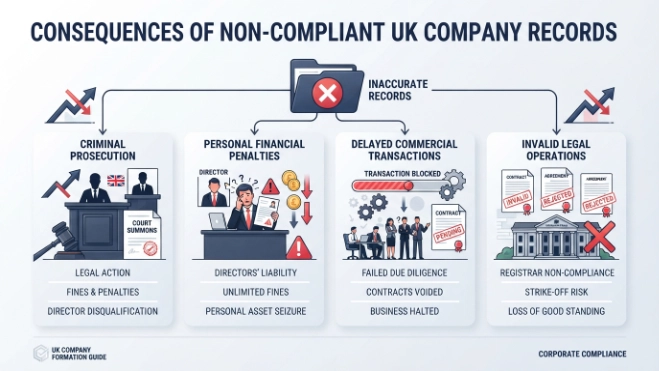
Failing to maintain accurate statutory registers directly exposes corporate officers to severe legal liability. The Companies Act 2006 treats inadequate register maintenance as an offence of daily default. Courts impose individual fines on company directors, which accumulate daily until the company corrects the statutory deficiencies. Beyond statutory fines, sloppy record-keeping creates massive legal obstacles during important commercial events.
Commercial banks, prospective buyers, and institutional lenders review statutory registers thoroughly during legal due diligence processes. When a business attempts to secure equity financing or complete a corporate sale, corporate solicitors inspect the internal registers rather than relying on Companies House extracts. If a share transfer was never recorded properly in the Register of Members, the purported shareholder does not legally own those shares. Resolving these historical record errors often requires expensive court applications to rectify the register, delaying business deals by several months.
How Do Digital Statutory Books Compare to Paper Registers?
Digital statutory books compare favorably to paper registers by automating record updates, preventing physical damage, enhancing data security, and ensuring instant compliance with UK corporate regulations. Modern software solutions securely store compliance documentation while allowing authorized administrative access from any remote location.
Historically, corporate entities used physical leather-bound books or loose-leaf binders to track statutory updates. While paper registers remain legally permissible, they carry severe operational risks, including physical theft, fire damage, loss, and handwriting errors. If a business loses its physical statutory books, directors must undertake a complex legal reconstruction process to restore historical shareholder details and corporate decisions accurately.
Digital compliance platforms eliminate these operational vulnerabilities entirely. Electronic registers allow company secretaries to update shareholder logs, alter officer details, and create resolution templates with precision. When share transfers occur, electronic systems generate updated share certificates and adjust member registers simultaneously. Implementing modern digital registers ensures full data backup, encryption, and seamless compliance audits. Organizations looking to streamline their corporate administration efficiently often purchase a complete Company Pack to obtain fully compliant, pre-structured statutory registers tailored to their specific business framework.
Businesses seeking guidance on maintaining operational standards can review How to Keep Your Statutory Books Compliant With the Companies Act to establish rigorous internal reporting schedules. When corporate structures undergo rapid scaling or funding rounds, directors should Buy a Compliant Company Register From Form My Company to ensure all regulatory registers meet strict statutory standards effortlessly.
Explore our Company Pack guide,
How to Minimize Distractions During Your Next Corporate Team Training Program Session
The Impact of Unfiled Dormant Accounts on Your Personal Director Credit Rating
Frequently Asked Questions
What are the legal requirements for keeping company statutory books in the UK?
The Companies Act 2006 mandates that every UK limited company must maintain accurate, up-to-date statutory registers at its registered office or a declared Single Alternative Inspection Location (SAIL). These records must document directors, shareholders, members, secretaries, and People with Significant Control (PSC) to ensure legal compliance. Ordering the Company Pack from Form My Company provides a fully compliant hard-backed statutory register alongside official company formation filings.
What is included in the Form My Company Company Pack?
The Company Pack by Form My Company combines complete government incorporation services with physical legal registers and administration tools. It includes official Companies House registration fee coverage, a tabbed physical statutory company register binder, printed share certificates, an official plier company seal, and a self-inking custom stamp. This complete package ensures new businesses possess both digital legal standing and tangible corporate accessories from day one.
Are UK businesses legally required to have a physical statutory register?
While digital records are permitted, companies must physically or electronically present readable statutory books upon official request by regulators, investors, or auditors. Storing physical registers ensures directors can immediately present required legal evidence during bank account openings or legal due diligence. The Company Pack from Form My Company supplies an organized, tabbed physical register binder specifically manufactured for safe offline document retention.
What happens if a company fails to maintain accurate statutory books?
Failing to maintain up-to-date statutory registers constitutes a criminal offence under UK corporate law, exposing company directors to personal fines and daily default penalties. Furthermore, inaccurate registers invalidate share transfers and disrupt corporate transactions during formal commercial audits. Utilizing the Company Pack from Form My Company equips business owners with proper tabbed registers to prevent regulatory breaches and maintain seamless corporate governance.
How does the Company Pack assist with opening a business bank account?
UK high-street banks and financial institutions require verified proof of ultimate ownership and officer appointments before approving corporate accounts. The Company Pack supplied by Form My Company delivers official printed certificates alongside a pre-structured statutory register to substantiate shareholder and director details. Presenting these physical corporate instruments simplifies compliance checks and speeds up business account authorization.