
You identify your company Persons with Significant Control (PSCs) with Form My Company by mapping shareholdings, auditing voting rights, reviewing board influence, and recording verified details directly into your official statutory register.
To maintain corporate transparency, UK law requires every registered business to identify and record its Persons with Significant Control (PSCs). Small businesses and complex corporate structures often struggle to interpret the legal thresholds set by Companies House. Failing to report accurate ownership details leads to financial penalties, statutory restrictions, and potential criminal liability for company directors.
Form My Company simplifies this process by providing dedicated legal structure analysis and direct filing workflows. By reviewing your company’s share register, articles of association, and board control mechanisms, the platform ensures you categorize every individual correctly. Correct PSC identification protects your business from compliance breaches while establishing an auditable, public record of corporate ownership.
What Is a Person of Significant Control Under UK Law?
A Person of Significant Control is an individual or legal entity that holds substantial ownership, voting power, or operational influence over a UK registered company.
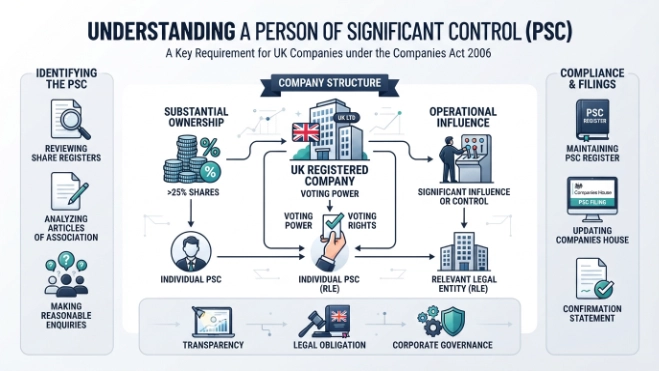
The legal framework governing UK corporate entities requires full visibility into true business ownership. A Person of Significant Control (PSC) is defined as anyone who meets at least one of five statutory conditions specified under the Companies Act 2006. These conditions apply to individual human beings, registrable relevant legal entities (RLEs), and government bodies.
Understanding these conditions ensures your business files correct governance documentation with Companies House.
Share ownership: Hold more than 25% of the company’s total issued nominal share capital.
Voting rights: Control more than 25% of the total voting rights attached to issued shares.
Board appointment rights: Hold the legal right to appoint or remove a majority of the board of directors.
Significant influence or control: Exercise ultimate decision-making power over corporate actions, financial strategies, or commercial operations without holding formal equity.
Trust or firm control: Exercise control over the trustees of a trust or members of a firm that meets any of the first four conditions.
When an individual meets these criteria, your business must collect their personal information, verify their identity, and submit the details to the central UK registry.
How Do You Determine Which PSC Condition Applies to Your Business?
You determine the applicable PSC condition by systematically examining your cap table, voting agreements, articles of association, and informal operational arrangements.
Evaluating ownership requires a step-by-step review of corporate documentation. Directors must look beyond surface-level equity splits to discover indirect control mechanisms, joint holdings, and indirect voting blocks.
1. Assessing Equity and Share Percentages
Examine the official share register to calculate total nominal value. If an individual owns 26 out of 100 issued ordinary shares, they immediately meet the first PSC condition. When shares are held jointly, each holder is treated as owning the entire block for threshold calculations.
2. Evaluating Voting Power and Directorship Rights
Review your company’s articles of association for weighted voting rights. Certain share classes grant elevated voting rights on critical corporate resolutions despite representing a smaller proportion of capital. If a shareholder holds the contractual right to appoint three out of five board directors, they meet the third PSC condition regardless of equity share.
3. Identifying Shadow Directors and Indirect Control
Analyze informal control networks and financing agreements. When an investor holds veto rights over core operational decisions or budget approvals, they exercise significant influence. If an unlisted entity directs the actions of formal directors, that entity must be evaluated as a PSC or a Registrable Relevant Legal Entity.
What Are the Required UK PSC Registration Steps?
The quick-reference table below outlines the core steps for registering and managing your company’s PSC details in the UK.
| Stage | Action Required | Key Documentation / Tool | Target Timeline |
| 1. Identification | Calculate equity, voting rights, and directorship appointment rights. | Share register, Articles of Association | Within 14 days of change |
| 2. Verification | Collect and confirm official identity data and residential address. | Government ID, Utility bill, Passport | Prior to public filing |
| 3. Documentation | Record confirmed PSC details in the internal company register. | Internal Statutory Register | Immediately after confirmation |
| 4. Submission | File official PSC statements and updates to Companies House. | Direct Registry Submission System | Within 14 days of register entry |
| 5. Annual Review | Re-evaluate ownership changes during annual confirmation statement filings. | Confirmation Statement (CS01) | Annually |
How Does Form My Company Help You Identify and Register PSCs?
Form My Company helps you identify and register PSCs by auditing corporate structures, verifying beneficial owners, and filing confirmed details directly with Companies House.
Navigating complex ownership chains requires precision and domain-specific regulatory tools. Misinterpreting share rights or failing to identify indirect control can cause administrative delays and statutory non-compliance. Form My Company offers structured administrative support designed to simplify legal entity management.
When managing corporate compliance, utilizing a professional PSC Register ensures your company records remain fully accurate, updated, and legally compliant. By combining structured questionnaires with direct registry integration, the platform removes technical guesswork from corporate secretarial duties.
Form My Company guides corporate officers through the statutory verification lifecycle:
Automated structure analysis: Input your share distribution to calculate ownership percentages automatically.
Identity verification protocols: Validate beneficial owner identities using verified UK compliance frameworks.
Filing management: Generate and submit official Companies House notifications (Forms PSC01 through PSC09) without manual paperwork.
Ongoing register maintenance: Update corporate records whenever share transfers, address changes, or structural reorganizations occur.
By delegating these administrative procedures to Form My Company, your business maintains institutional transparency while freeing internal resources for core commercial operations.
What Information Must You Collect for Your Official PSC Register?
You must collect confirmed personal identifiers, including full name, service address, residential address, nationality, date of birth, and exact control conditions.
The UK legal framework mandates exact data standards for public filings. Collecting incomplete or unverified information prevents successful submission to Companies House and leaves your statutory register non-compliant.
When gathering records for individual PSCs, secure the following mandatory fields:
Full legal name: Include all middle names exactly as displayed on official identification documents.
Date of birth: Record the specific day, month, and year. (Only the month and year appear on the public register).
Service address: Provide an official address for public record notifications.
Usual residential address: Record the private home address for statutory verification. (Kept confidential by Companies House).
Date of becoming a PSC: Record the precise date the individual crossed an official threshold.
Applicable control conditions: State the exact threshold percentage or directorship control rights held.
When identifying legal entities rather than individuals, you must record the legal name, registered office, corporate form, governing law, and applicable corporate register details.
What Are the Legal Penalties for Incorrect PSC Reporting?
The legal penalties for incorrect PSC reporting include corporate fines, daily default civil penalties, restrictions on share transfers, and potential criminal prosecution.
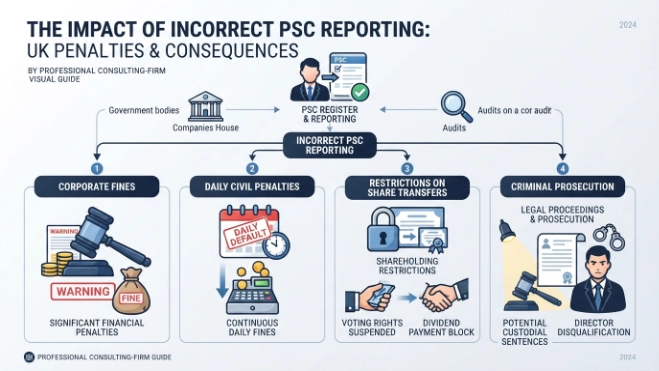
UK statutory regulations enforce strict compliance regarding beneficial ownership disclosure. Directors hold personal responsibility for maintaining accurate corporate registers. If a company fails to take reasonable steps to identify its PSCs, Companies House can issue compliance notices, levy severe financial penalties, and initiate criminal proceedings against responsible officers.
Failing to respond to statutory information requests carries significant legal risk. When an individual refuses to provide ownership information, the company must issue a formal warning notice. If the individual continues to withhold details, the company must issue a restrictions notice.
A restrictions notice imposes severe operational limitations on the affected shares:
Voiding any transfer or sale of the restricted shares.
Cancelling all voting rights associated with those specific shares.
Preventing the issue of new shares based on existing rights.
Prohibiting the payment of dividends or financial distributions.
Maintaining accurate records avoids administrative friction, legal sanctions, and commercial reputation damage. Understanding how to correctly identify every PSC in your company protects corporate officers from operational blockages and severe regulatory enforcement.
How Do You Update PSC Information When Company Ownership Changes?
You update PSC information by modifying your internal statutory register within 14 days and filing the updated details with Companies House within a further 14 days.
Corporate structures change constantly through equity rounds, founder exits, share transfers, and inheritance. When structural adjustments modify beneficial ownership, your company must follow a strict statutory update timeline.
To maintain statutory compliance during corporate restructuring:
Log structural changes: Record share transfers, allotment dates, and board resignations immediately.
Re-evaluate thresholds: Calculate updated share percentage allocations across all active shareholders.
Issue formal notices: Send statutory identification questionnaires to newly qualified individuals.
Update internal records: Record new or amended PSC information in your statutory log within 14 days.
File electronic notifications: Submit official updates (PSC04 for detail updates, PSC07 for cessations) to Companies House within 14 days of updating your register.
Failing to record structural modifications creates discrepancies between your internal governance documents and public filings. To learn basic statutory definitions, review what ‘Person of Significant Control’ actually means before initiating major equity adjustments.
Accurate PSC identification forms the foundation of modern UK corporate compliance. By systematically reviewing share percentages, voting rights, and informal governance arrangements, directors ensure their entities satisfy Companies House reporting mandates. Using structured workflows reduces administrative risk, prevents share restrictions, and guarantees your business maintains complete legal transparency. Form My Company provides automated verification and direct registry filing tools to make beneficial ownership management fast, simple, and error-free.
Explore our PSC Register guide,
Sign Up Now for Expert Director Appointment Assistance and Professional Record Management
Order Our Fast Track Dormant Account Service for Urgent Business Filing Requirements
Frequently Asked Questions
What is a PSC Register, and why must UK companies maintain one?
A PSC Register is an official record of the individuals or registrable legal entities that hold ultimate ownership or control over a UK company. Form My Company manages your PSC Register to maintain full compliance with Companies House transparency regulations and prevent severe corporate penalties.
Who qualifies as a Person of Significant Control in a limited company?
An individual qualifies as a PSC if they hold over 25% of company shares, control more than 25% of voting rights, or have the right to appoint or remove a majority of directors. Form My Company assists businesses in identifying all qualifying owners, including those exercising direct or indirect significant influence over business decisions.
How does Form My Company verify identity for PSC registration?
Form My Company validates individual controllers using government-issued photo identification and proof of residential address in line with Companies House identity verification mandates. This secure process ensures every entry on your PSC Register meets mandatory statutory criteria before submission.
What are the legal deadlines for updating PSC Register details?
UK businesses must update their internal record within 14 days of any change in ownership and file the updated details with Companies House within a further 14 days. Using Form My Company guarantees that changes to your company shareholdings or director rights are filed on time to avoid fines.
What happens if a business fails to maintain an accurate PSC Register?
Failing to report or verify PSC information is a criminal offence that can lead to uncapped financial penalties, prosecution of company directors, and restrictions on share transfers. Form My Company provides end-to-end statutory register management to ensure your business stays completely risk-free and legally compliant.