
UK companies keep statutory books compliant by updating company registers immediately after corporate changes occur, maintaining them at a registered location or via Companies House, making them available for public inspection, and cross-referencing all recorded entries against official filings required under the Companies Act 2006.
Maintaining statutory books is a strict legal requirement under the Companies Act 2006 for every company registered in England, Wales, Scotland, and Northern Ireland. Every private limited company must establish and preserve an accurate set of statutory records from the exact date of incorporation. Company directors bear ultimate legal responsibility for keeping these registers accurate, up to date, and available for public inspection. Failure to maintain statutory records constitutes a criminal offence, exposing company officers to severe personal fines and potential prosecution.
Statutory registers serve as the official, definitive legal record of a company’s ownership, management structure, and governance history. While many business owners confuse Companies House filings with statutory registers, the physical or electronic statutory books held by the company represent the primary legal evidence of ownership. Updating Companies House updates the public record, but updating your internal statutory books fulfills the actual statutory duty. Modern business practices allow companies to hold these registers in hard-copy loose-leaf binders or via secure, encrypted electronic register systems.
What Statutory Registers Must Every UK Company Maintain?
Every UK company must legally maintain seven core statutory registers covering directors, director residential addresses, company secretaries, shareholders, persons with significant control, allotments of shares, and transfers of shares under the Companies Act 2006 guidelines.
The Companies Act 2006 mandates the exact records a business must construct and preserve. The primary register is the Register of Directors, which documents the full legally recognised name, former names, service address, country of residence, nationality, business occupation, and date of birth for every appointed director. Alongside this, companies must maintain a separate Register of Directors’ Residential Addresses, which remains strictly confidential and off the public record to protect director privacy and security.
The Register of Members lists every shareholder, their full physical address, the class of shares held, the currency denomination, the nominal value, and the exact date their name entered the register. The Register of Persons with Significant Control details any individual or legal entity holding more than 25% of company shares or voting rights. The Register of Share Allotments tracks every newly issued share, while the Register of Share Transfers logs all secondary sales or reallocations between outgoing and incoming shareholders.
When Must You Update Your Statutory Books to Remain Compliant?
Companies must update their statutory books within fourteen days of any corporate event, officer change, share issuance, address alteration, or shareholder transfer occurring within the business structure.
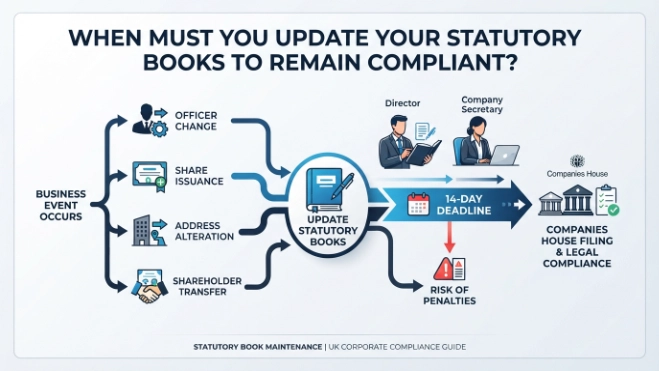
Timeliness is the core legal pillar of statutory compliance. When a company appoints a new director or resigns an existing board member, the legal change takes full legal effect immediately, but the internal Register of Directors must record the event within 14 days. If a corporate officer changes their residential or service address, the company secretary or director must amend the internal records immediately to reflect correct contact details.
Share transactions follow strict statutory timelines. When existing shareholders sell, gift, or transfer shares to new investors, the transaction is not legally complete until the company registers the executed stock transfer form. The legal ownership of shares changes when the director enters the new owner’s name into the Register of Members, not when the parties sign the agreement. Updating records late creates discrepancies between internal registers and external regulatory databases, exposing directors to regulatory enforcement actions.
How Do You Maintain Statutory Records Electronically or in Hard Copy?
Companies maintain statutory records by keeping bound physical registers at their registered office address or using compliant digital registers that provide immutable audit logs, strict security controls, and rapid public accessibility.
Traditionally, UK businesses preserved their corporate history using leather-bound registers or structured loose-leaf legal folders stored securely at their primary office. While hard-copy binders remain legally valid, they are susceptible to physical damage, misplacement, fire, or unauthorized tampering. If a physical register is lost, the company must undergo a costly, complex court-assisted reconstruction process to re-establish legal share ownership and corporate history.
Modern companies increasingly rely on secure digital statutory register platforms. These systems encrypt sensitive corporate data, track historical changes with immutable time-stamps, and simplify statutory reporting. A digital corporate setup simplifies governance by centralizing corporate history within a single, secure environment. A comprehensive [Company Pack] simplifies corporate administration by providing all required statutory registers, share certificates, and bound presentation books in one complete package.
Where Must a Company Store Its Statutory Registers for Public Inspection?
A company must store its statutory registers at its official registered office address or at a Single Alternative Inspection Location registered with Companies House via Form AD01.
The Companies Act 2006 gives shareholders, regulatory authorities, and members of the general public explicit legal rights to inspect statutory registers. If a company chooses not to keep its books at its main registered office address, it must officially notify Companies House using Form AD01 to declare a Single Alternative Inspection Location. Both the primary registered office and any secondary inspection location must reside within the exact same UK jurisdiction where the company was originally incorporated.
Companies must keep their statutory records open for inspection for a minimum of two hours every business day between 9:00 AM and 3:00 PM. Anyone requesting an inspection must provide written notice containing their full name, address, and the specific purpose of the request. If a member or third party requests physical or electronic copies of statutory registers, the company must provide the requested records within ten calendar days, provided the request serves a legitimate, lawful purpose.
What Are the Penalties for Failing to Keep Statutory Books Compliant?
Failing to keep compliant statutory books results in fine penalties up to £1,000 per unrecorded event, daily default fines, personal director liability, and severe deal delays during corporate due diligence.
Non-compliance with statutory record-keeping rules carries significant criminal and commercial penalties. The Companies Act 2006 classifies statutory record failures as summary offences. When a company fails to maintain an accurate Register of Members or PSC Register, the company and every defaulting director face court fines up to level 3 or level 5 on the standard scale, alongside ongoing daily fines for every day the default continues.
Beyond statutory fines, unmaintained statutory books severely damage commercial growth and enterprise value. During business acquisitions, equity investment rounds, or bank loan applications, commercial solicitors execute comprehensive legal due diligence. If corporate lawyers uncover missing, inaccurate, or incomplete statutory registers, investors routinely pause transactions, demand indemnities, or decrease business valuations. Business owners must audit records before completing a transaction, and purchasing a compliant company register ensures all historical documentation satisfies strict regulatory standards.
How Do You Audit and Reconstruct Damaged or Lost Statutory Registers?
Companies audit and reconstruct lost statutory registers by cross-referencing Companies House filings, historical board minutes, signed share transfer forms, tax returns, and bank records to rebuild a verified legal timeline.
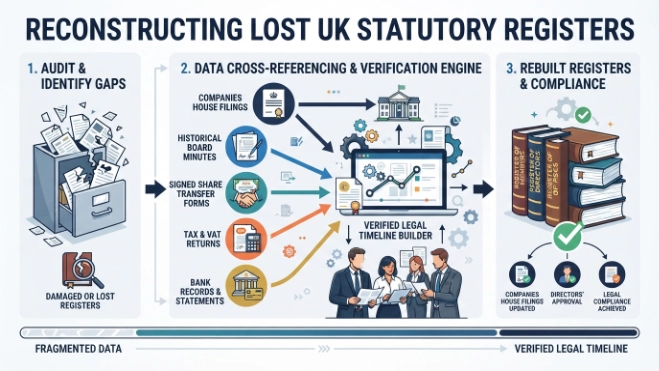
When statutory registers are misplaced, damaged, or neglected for several years, directors must execute a structured reconstruction process. The audit begins by pulling all historical public records filed at Companies House since incorporation, including annual returns, confirmation statements, incorporation documents, and officer appointment filings. Directors analyze these public records alongside internal documentation to construct an accurate chronological sequence of corporate events.
Reconstruction requires verifying every historical share movement. Directors must gather historic stock transfer forms, dividend vouchers, board minutes, and bank statements showing equity capital payments. Once the factual timeline is re-established, the board must pass a formal resolution adopting the reconstructed registers as the official statutory books. Maintaining clear corporate administration prevents record loss, and reviewing what must be recorded in a company’s statutory books helps business owners verify that every essential data field is captured correctly.
How Does Form My Company Ensure Total Corporate Compliance?
Form My Company delivers fully compliant statutory register structures, automated digital record management, professionally bound physical corporate registers, and continuous compliance oversight for UK limited companies.
Navigating complex UK corporate governance requires expertise, accuracy, and absolute precision. Form My Company eliminates legal administrative burdens by providing comprehensive corporate management tools tailored specifically to modern businesses. Whether your business requires fully bound physical books or secure electronic registers, expert corporate support ensures your company remains compliant with every mandate set by the Companies Act 2006.
By partnering with experienced corporate administrative specialists, directors protect their business from personal liability, regulatory fines, and operational disruptions. Form My Company structures your internal registers, validates historical entries, manages ongoing Companies House filings, and maintains accurate books ready for public or investor inspection at any time.
Explore our Company Pack guide,
Understanding the Benefits of Using a Specialist Dormant Company Filing Assistance Service
How to Quickly Resolve Past Due Dormant Account Filings with Professional Help
Frequently Asked Questions
What is included in the Form My Company [Company Pack]?
The [Company Pack] from Form My Company provides a complete set of physical and digital administrative assets designed for UK limited companies. It includes a hard-backed statutory company register, a bespoke self-inking company stamp, a heavy-duty embossing seal, official share certificates, and printed incorporation documents.
Why does a business need a physical statutory company register?
Under the Companies Act 2006, every UK business must maintain official corporate records, including registers of directors, shareholders, and Persons with Significant Control (PSCs). The physical register provided in the Form My Company [Company Pack] helps business owners easily keep hard-copy records organized for statutory inspection and bank account verification.
What is the purpose of the custom company seal and stamp in the [Company Pack]?
The official embossing seal and custom self-inking stamp are traditional tools used to validate high-value contracts, share certificates, and official company correspondence. Included in the Form My Company [Company Pack], these tools add a professional level of authenticity and security to physical corporate paperwork.
Can I order the [Company Pack] if my company is already registered?
Yes, business owners can purchase the Form My Company [Company Pack] as a standalone service to upgrade, replace, or organize their existing legal documentation. The service fulfills physical corporate governance requirements regardless of when your UK limited company was initially incorporated.
How long does delivery take for the physical [Company Pack] items?
Once your order details are confirmed, Form My Company manufactures your custom seal and stamp immediately before sending all items via Royal Mail Tracked Delivery. Physical items in the [Company Pack] typically arrive at your specified UK delivery address within a few working days.