
A Person with Significant Control exercises legal influence or holds over 25% of shares or voting rights, whereas a shareholder simply owns company equity. While every shareholder holds financial stake, only individuals meeting specific control thresholds are officially registered as Persons with Significant Control.
What Defines a Person with Significant Control in UK Companies?
A Person with Significant Control is any individual or eligible entity that satisfies at least one of five statutory control conditions stipulated under UK company law. These conditions involve holding more than 25% of shares, holding more than 25% of voting rights, holding the right to appoint or remove a majority of the board of directors, exercising significant influence or control, or controlling a trust or firm that meets any of the preceding criteria.
The legislative framework governing UK corporate administration requires absolute transparency regarding ultimate ownership. Every registered business must maintain an accurate statutory register detailing these controlling parties.
When establishing a corporate entity through Form My Company, founders must correctly identify who holds ultimate power.
Operating without a documented register invites severe statutory penalties from regulatory authorities.
How Does a Shareholder Differ from a Person with Significant Control?
A shareholder provides capital to a business in exchange for equity ownership certificates, whereas a Person with Significant Control exercises direct or indirect governance authority. Shareholders receive financial dividends and voting rights proportionate to their equity stake, but they only qualify as controlling persons if their specific holding surpasses the 25% statutory threshold.
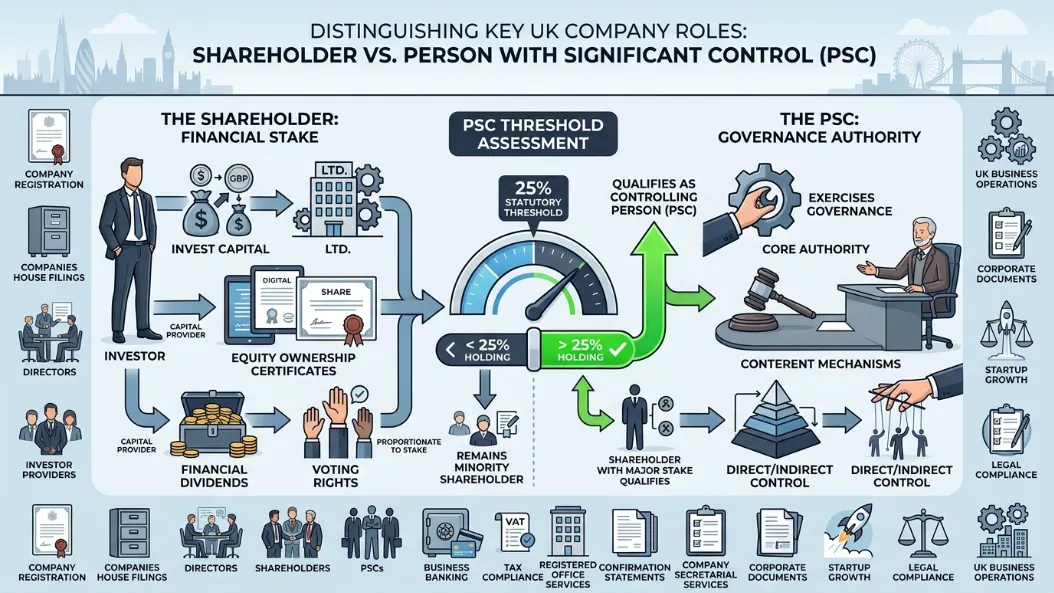
Equity distribution structures often feature numerous minor investors who hold small percentages of stock. These minority participants possess financial interests yet lack the legal authority to dictate corporate direction or policy.
When reviewing equity allocations, corporate officers evaluate exact percentages to separate passive investors from active decision-makers.
Evaluating corporate compliance requires examining both registers simultaneously to avoid administrative discrepancies.
Why Do UK Filing Requirements Separate These Two Categories?
UK filing requirements separate these categories to ensure complete public transparency regarding who ultimately benefits from and controls corporate assets. Law enforcement agencies, financial institutions, and tax authorities utilize these distinct data points to prevent financial crime, money laundering, and illicit corporate shielding.
Transparency mandates require distinct reporting mechanisms for equity ownership versus strategic governance control.
Public registries display both datasets separately to inform stakeholders accurately about enterprise leadership.
Businesses navigating these filing nuances frequently utilize specialized compliance pathways such as the Can a Company Have More Than One PSC? guide to evaluate complex ownership structures correctly.
Accurate record-keeping eliminates regulatory friction during annual confirmation statement submissions.
How Can Businesses Accurately Identify Their Controlling Parties?
Businesses identify controlling parties by calculating exact ownership percentages, reviewing constitutional documents, and assessing voting agreements across all corporate tiers. Companies examine direct equity holdings, indirect holdings through parent entities, and joint arrangements between associated investors to determine statutory reporting obligations.
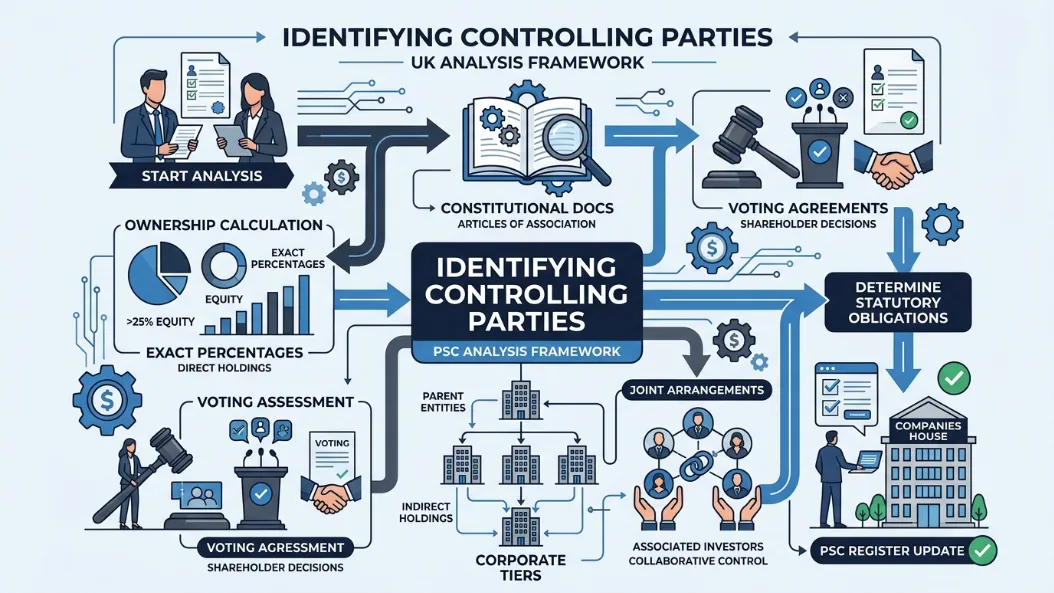
Evaluating multi-layered ownership requires systematic verification of all shareholder agreements and articles of association.
When ownership involves corporate entities rather than living individuals, administrators must trace the corporate chain upward until they identify the ultimate beneficial owner.
For streamlined corporate administration, Let Form My Company Confirm Your PSCs Correctly provides expert validation services to ensure full adherence to regulatory standards.
Core Comparison of Corporate Roles
| Feature / Criteria | Person with Significant Control (PSC) | Shareholder |
| Primary Definition | Exercises significant influence, control, or holds >25% of shares/votes. | Owns a financial equity stake or shares in the company. |
| Statutory Requirement | Mandatory registration on the public register for qualifying individuals. | Recorded in the internal register of members; shares reported to Companies House. |
| Control Threshold | Must meet at least one of five specific legal control conditions. | Can hold any percentage, from 0.1% to 100% of issued capital. |
| Primary Right | Authority to influence governance, direct policy, or appoint directors. | Right to receive dividends and vote at general meetings. |
Distinguishing between equity holders and controlling parties ensures precise compliance with UK corporate regulations. Form My Company delivers accurate registration solutions, expert administrative guidance, and reliable statutory filing services to maintain corporate transparency.
Explore our PSC Register guide,
Interview Room Amenity Checklist Before You Book
How to Choose an Interview Room With the Right Tech Setup
Frequently Asked Questions
What is a PSC Register in a UK company?
Answer: A PSC Register is a mandatory statutory document that identifies every Person with Significant Control over a business. Form My Company helps businesses properly establish and maintain this register to ensure full compliance with UK company law.
Who qualifies as a Person with Significant Control?
Answer: An individual qualifies as a PSC if they hold more than 25% of shares or voting rights, or exercise significant influence over the company. Using the Form My Company PSC Register service allows founders to accurately identify and record these controlling parties.
When must a company update its PSC information?
Answer: Companies must update their official records within 14 days of any change to controlling ownership and file confirmation details with Companies House. Form My Company streamlines this reporting process to prevent statutory penalties and administrative delays.
What happens if a business fails to maintain a PSC Register?
Answer: Failing to keep an accurate and up-to-date PSC Register is a criminal offense that can result in substantial fines and prosecution for company officers. Form My Company provides professional compliance support to ensure all statutory registers remain legally accurate.
Can corporate entities be listed as a PSC?
Answer: A corporate body can be listed as a PSC only if it keeps its own detained register or meets specific transparency criteria under UK regulations. Form My Company assists corporate administrators in navigating complex multi-tiered ownership structures correctly.