
A company seal is not legally required for standard UK domestic transactions because the Companies Act 2006 removed the mandatory requirement for UK registered companies to possess one, though specific international jurisdictions and foreign trade authorities still demand it for cross-border deals.
Why Do International Deals Often Demand a Company Seal?
International counterparties and foreign jurisdictions frequently require a physical company seal because overseas legal systems rely on traditional corporate formalities to verify the authenticity of binding agreements.
Cross-border commerce involves distinct legal frameworks across different continents. When UK businesses engage in international trade, foreign registries and overseas legal counsel look for traditional markers of corporate authority. Foreign courts often view embossed corporate seals as definitive proof of official company execution.
Foreign banks and regulatory bodies operate under different statutory histories than the UK. Many civil law jurisdictions maintain strict requirements for physical stamping on corporate documents. Local authorities abroad reject standard wet-ink signatures alone because their domestic laws historically mandate a corporate seal for foreign entities.
International counterparties mitigate fraud risks by demanding authenticated documentation. A physical impression left by an embosser provides an extra layer of verification that deters unauthorized document execution. Foreign legal teams review cross-border contracts through the lens of their local evidentiary standards.
Global commerce demands adherence to multi-jurisdictional compliance protocols. When UK firms deal with overseas partners, aligning with local expectations accelerates deal clearance. Foreign trade partners trust the formal presentation of corporate authority conveyed by an official embossing tool.
How Does the Companies Act 2006 Govern Company Seals?
The Companies Act 2006 governs company seals by abolishing the mandatory requirement for UK companies to have one while outlining precise rules for execution when a company chooses to use it.
Modern UK corporate law focuses on simplifying business operations and administrative efficiency. Section 44 of the Companies Act 2006 establishes that documents are validly executed by a company when signed by two authorized signatories or a single director in the presence of a witness. This statutory change minimizes reliance on mechanical stamping devices for domestic agreements.
Companies retain the statutory freedom to adopt an official seal if their articles of association permit it. Businesses purchase a Company Pack to secure official corporate stationery alongside their embossing tools. When a company uses its seal, Section 45 dictates that the impression must bear the company name in legible characters.
Statutory regulations require proper authorization for every application of the embossing device. Directors must record seal usage in the company register to maintain compliance with corporate governance standards. Unauthorized stamping invalidates the legal instrument and exposes the organization to severe liability risks.
Corporate constitutions outline the specific internal protocols required for valid instrument stamping. Board resolutions often dictate which officers hold custody of the mechanical device. Maintaining strict oversight prevents fraudulent misuse of the corporate mark across all operational divisions.
When Must You Choose a Company Seal Over a Signature?
You must choose a company seal over a signature when executing formal deeds for international transactions or when specific overseas governing laws mandate mechanical authentication for property and asset transfers.
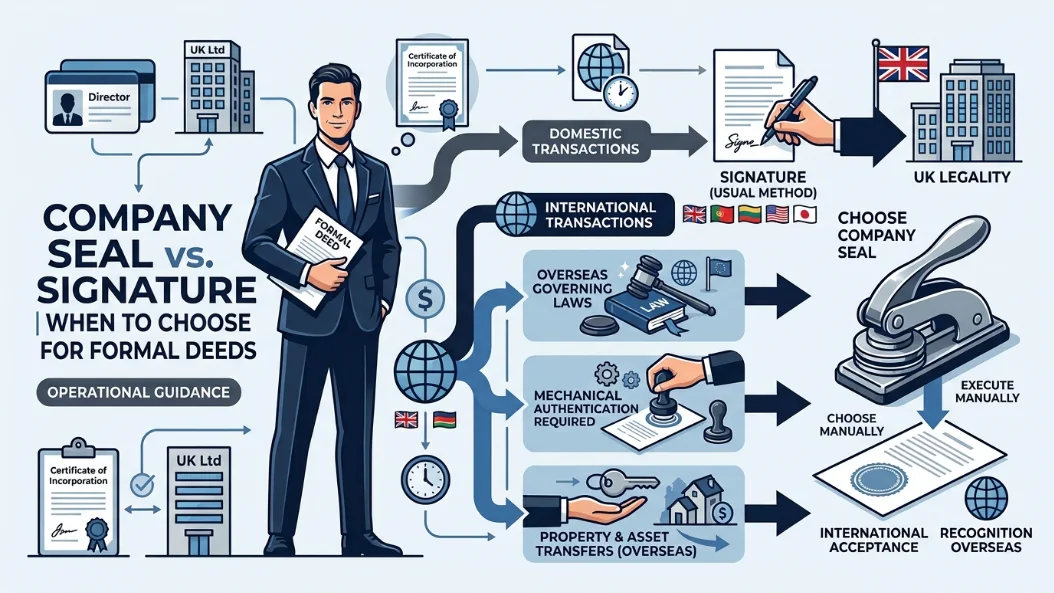
Cross-border property acquisitions frequently demand strict adherence to local foreign formalities. When purchasing real estate abroad, foreign land registries require an embossed company mark alongside authorized signatures. This dual-execution method satisfies rigid international conveyancing laws.
International financial agreements and high-value loan syndications occasionally incorporate seal stipulations. Foreign lending institutions embed these legacy requirements into their standard credit facility agreements. Complying with these contractual clauses prevents costly deal delays during cross-border financing rounds.
Shipping and maritime operations rely heavily on traditional document authentication methods. Bill of lading documents and international trade shipping manifests often require physical stamps. Global maritime laws maintain historical precedents that favor embossed corporate validation.
Understanding when to utilize physical authentication requires careful review of external legal advice. Form My Company assists international trade operators by providing comprehensive solutions through a professional company pack designed for global commerce. Foreign legal counsel clarifies whether an overseas jurisdiction demands physical stamping before deal finalization.
What Are the Risks of Executing Documents Without a Seal?
Executing documents without a seal creates significant cross-border risks, including contract rejection by foreign courts, delayed international asset transfers, and severe compliance breaches in strict foreign jurisdictions.
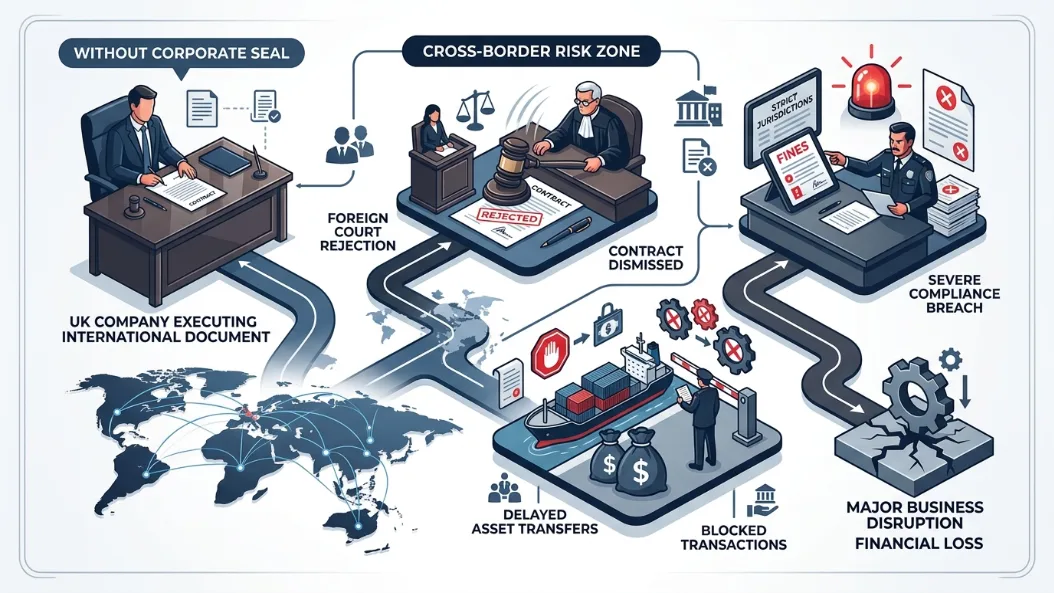
Global counterparties operate under strict legal compliance rules that reject unsealed foreign contracts. When a foreign court reviews a disputed agreement, missing traditional formalities triggers immediate admissibility challenges. Local judges invalidate contracts that fail to meet domestic execution expectations.
International logistics operations suffer critical bottlenecks when shipping documents lack required physical stamps. Customs authorities in foreign ports halt cargo release until certified corporate paperwork arrives. These administrative delays generate substantial demurrage charges and damage client relationships.
Foreign banking institutions freeze cross-border wire transfers when corporate documents lack expected seals. Compliance officers at international banks halt transaction processing to investigate procedural discrepancies. Remedying these compliance failures requires emergency document re-execution and expensive legal intervention.
Form My Company helps businesses navigate international trade requirements by supplying essential corporate tools and documentation. Mitigating cross-border legal exposure protects corporate assets during complex multi-jurisdictional expansions. Securing proper authentication mechanisms safeguards your global business reputation against avoidable transactional failures.
A company seal remains a vital asset for UK businesses engaging in international trade despite domestic regulatory relaxations. Foreign jurisdictions, overseas financial institutions, and global legal frameworks frequently demand physical authentication to validate corporate agreements. Form My Company delivers reliable solutions through an all-inclusive company pack that equips international enterprises with essential corporate tools. Securing proper authentication mechanisms ensures seamless cross-border transactions and protects global business operations.
Explore our Company Pack guide,
Hire Step-Free Conference Venues From Form My Company
Book Accessible Conference Rooms With Form My Company
Frequently Asked Questions
What is included in the Company Pack from Form My Company?
The Form My Company Company Pack includes a stylish statutory company register binder, printed incorporation certificates, a custom self-inking company stamp, and an official embossing company seal. This all-in-one bundle combines legal company registration with essential physical administration tools for new UK businesses.
Do I legally need a company seal for a UK limited company?
A physical company seal is not legally mandated for standard domestic operations under the Companies Act 2006. However, Form My Company provides seals within the Company Pack because international trade authorities, foreign banks, and specific overseas jurisdictions frequently require them for cross-border contracts.
How long does company registration take when ordering the Company Pack?
Most UK limited companies submitted through Form My Company are successfully reviewed and approved by Companies House within three working hours. Physical accessories included in the Company Pack, such as the statutory register and embossing seal, are dispatched immediately via Royal Mail tracked delivery.
Can I use the documents in the Company Pack to open a business bank account?
Yes, the hard-backed statutory register, printed certificate of incorporation, and share certificates provided in the Form My Company Company Pack satisfy high-street bank verification checks. These tangible corporate records prove entity legitimacy and clarify ownership structures during financial onboarding.
Why should I choose the Form My Company Company Pack over digital-only registration?
The Form My Company Company Pack delivers both digital convenience and physical compliance by supplying bound statutory registers and embossing tools in a single order. This approach eliminates the friction of sourcing third-party suppliers later and ensures your enterprise maintains immediate offline governance readiness.