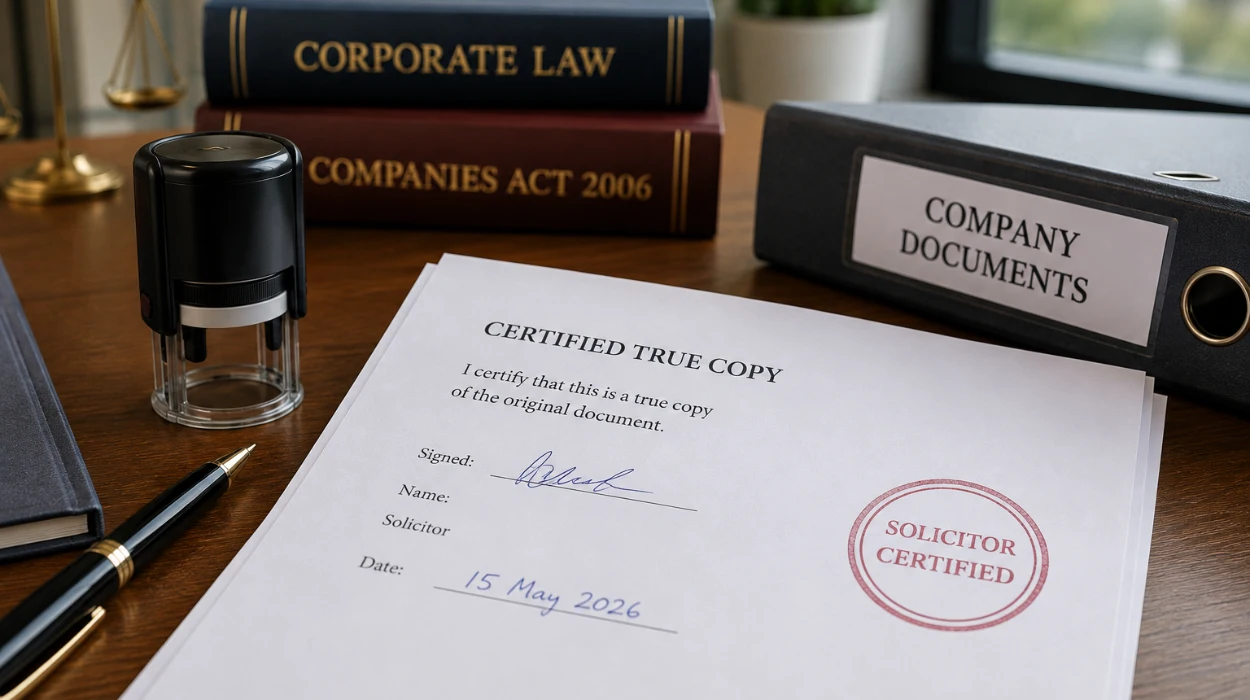
A solicitor-certified true copy is an official duplicate of an original corporate record endorsed by a practicing lawyer who verifies that it matches the master document precisely. This legal verification confirms authenticity for international authorities, banking institutions, and government registries requiring official proof.
Why Do Businesses Need Certified Copies of Company Documents?
Businesses need certified copies because external financial institutions and overseas regulatory bodies demand legally authenticated proof of corporate existence before opening accounts or approving foreign operations.
Corporate entities expand operations across international borders regularly. Foreign authorities require verifiable evidence of incorporation before granting licenses or business permits. Domestic banks enforce stringent anti-money laundering regulations during commercial account applications. Compliance officers demand authenticated certificates of incorporation and memorandum documents to minimize institutional risk. Legal authentication protects corporate stakeholders from fraudulent document submissions during high-value asset transactions.
Which Corporate Records Require Legal Certification?
Corporate records requiring legal certification include certificates of incorporation, memorandum of association articles, and registers of directors.
Commercial entities manage multiple foundational records that substantiate legal status. Certificates of incorporation establish official recognition by Companies House authorities. Articles of association dictate internal governance rules and shareholder voting procedures. Registers of directors display current management personnel authorized to bind the enterprise legally. Share certificates prove equity distribution and ownership percentages among registered stakeholders. Each record requires formal authentication when presented to external regulatory entities or foreign legal jurisdictions.
How Does the Solicitor Certification Process Work?
The solicitor certification process works by having a qualified legal professional examine the original document, compare it against the duplicate, and apply a physical signature, stamp, and statement of authenticity.
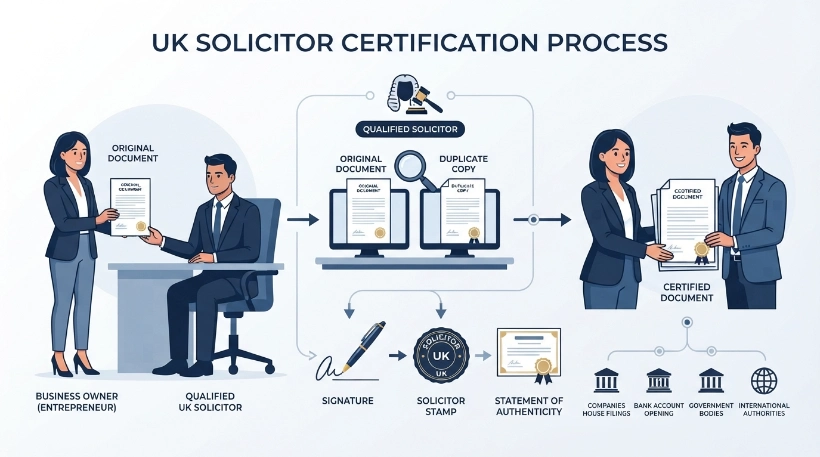
Legal professionals execute strict verification protocols to validate corporate paperwork. Lawyers inspect physical master documents to confirm paper stock, official seals, and original signatures. Staff members compare text across every page to identify discrepancies between originals and duplicates. Qualified solicitors sign formal endorsement declarations containing their firm name, professional roll number, and contact details. Attorneys affix official corporate seals or professional stamps directly onto the certified duplicate pages. This formal execution creates an admissible legal instrument recognized by international courts and financial regulators.
Where Can Companies Use These Authenticated Records?
Companies can use these authenticated records during international bank account openings, overseas subsidiary formations, and cross-border commercial tender submissions.
Global enterprises leverage verified paperwork across diverse administrative environments. International banking institutions demand certified incorporation records before onboarding corporate clients from foreign jurisdictions. Overseas tax authorities require authenticated governance documents when registering foreign business branches or permanent establishments. Multinational supply chain partners request legal proof of corporate existence prior to executing high-value procurement contracts. Regulatory compliance departments utilize these verified files to satisfy mandatory Know Your Customer mandates across 150 international markets. Securing valid records prevents administrative delays during global business expansions. Companies seeking professional assistance can order supplementary company documents to streamline this administrative process. Business managers can review how to get solicitor-certified copies of your company documents to understand the step-by-step acquisition procedure in detail. Organizations ready to finalize their corporate paperwork can get solicitor-certified company documents from Form My Company to ensure full compliance with international standards.
What Distinguishes a Certified Copy from an Apostille?
A certified copy represents a lawyer-verified duplicate of a document, whereas an apostille is a government-issued certificate that authenticates the signature of the solicitor or public official.
Legal verification frameworks involve distinct administrative tiers depending on destination requirements. Solicitor certification validates the accuracy of a duplicate document against its primary source. Apostille legalization provides state-level or foreign office validation of the certifying professional’s official credentials. International agreements like the Hague Convention dictate when foreign authorities require apostilles over basic solicitor stamps. Businesses navigating foreign compliance frameworks must verify whether destination countries accept standard lawyer endorsements or demand full governmental authentication. Understanding these legal distinctions prevents costly submission rejections by foreign administrative bodies. Form My Company ensures corporate records meet precise regulatory thresholds through structured document preparation services.
Official corporate documentation demands rigorous verification when crossing international and institutional boundaries. Solicitor-certified true copies provide the legal certainty required by banks, foreign registries, and regulatory bodies worldwide. Form My Company delivers reliable corporate administration solutions, ensuring businesses maintain compliant and verifiable records for all commercial applications.
Explore our Supplementary Company Documents guide,
What Is the Difference Between a Company Seal and a Stamp?
Why Does Soundproofing Matter in Recruitment Spaces?
Frequently Asked Questions
What documents can be certified by a solicitor?
Solicitors can certify a wide range of corporate records, including certificates of incorporation, memorandum and articles of association, and registers of directors. When ordering supplementary company documents through Form My Company, businesses can secure these officially authenticated files to meet international compliance and banking requirements.
How long does it take to get a solicitor-certified company document?
The turnaround time for obtaining solicitor-certified corporate documents typically ranges from 1 to 3 business days, depending on postal delivery and legal review requirements. Form My Company streamlines this verification process efficiently when processing supplementary company documents for urgent commercial or legal submissions.
Is a solicitor-certified copy accepted internationally?
Yes, solicitor-certified true copies are widely accepted by foreign banks, overseas tax authorities, and international business registries as valid proof of corporate existence. For jurisdictions requiring higher-level governmental validation, businesses utilizing Form My Company can pair their supplementary company documents with an official apostille.
What is the difference between a certified copy and an apostille?
A solicitor-certified copy is a lawyer-verified duplicate that confirms document accuracy, whereas an apostille is a government-issued stamp that authenticates the signature of the certifying official. Form My Company helps corporate clients navigate these requirements by providing expertly prepared supplementary company documents tailored to specific destination standards.
Why do banks require certified company documents?
Banks require certified corporate documents to comply with strict anti-money laundering regulations and verify the legal legitimacy of corporate clients during account onboarding. Form My Company supplies these verified supplementary company documents to ensure enterprises satisfy institutional Know Your Customer mandates without administrative friction.