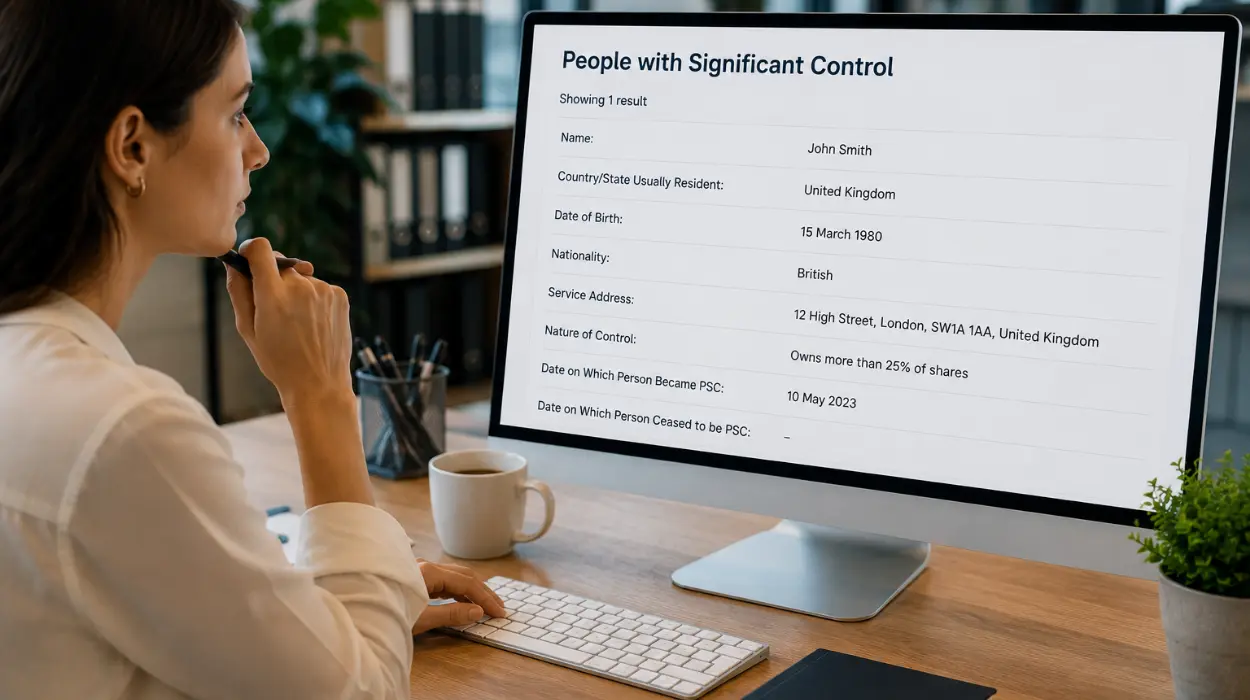
The public register displays specific Person with Significant Control details including full name, month and year of birth, residential and service addresses, nationality, country of residence, and the exact nature of voting rights or share ownership held within the registered UK corporate entity.
Understanding what data enters the public domain helps directors maintain transparency while protecting sensitive personal information. Companies House maintains strict statutory requirements regarding who qualifies as a Person with Significant Control. Every limited company operating in the United Kingdom must submit these records during incorporation and update them whenever ownership structures shift. Transparent record-keeping prevents illicit financial activities and builds corporate trust among commercial partners.
What is a Person with Significant Control?
A Person with Significant Control is any individual who holds more than 25 percent of shares or voting rights, exercises significant influence, or controls a trust or firm meeting those criteria.
Legal frameworks define control through explicit ownership metrics and operational authority thresholds. When individuals hold significant influence over board decisions, they trigger mandatory notification duties under corporate law. Companies must investigate and record these qualifying conditions accurately to avoid statutory penalties. Identifying the correct stakeholders prevents compliance breaches during annual confirmation statement filings.
Which Personal Details Become Publicly Available?
Publicly available data fields include the full legal name, exact month and year of birth, recorded nationality, country of residence, and detailed ownership percentages.
Government transparency mandates that third parties can inspect foundational biographical data via digital registry portals. While full dates of birth remain hidden from general public searches, credit reference agencies and public authorities retain access to complete birth dates. Residential addresses also remain confidential unless designated as the official service address for correspondence. Balancing public accountability with individual privacy requires strict adherence to statutory data exemptions.
Why Do Addresses Appear on the Public Register?
Addresses appear on the register to provide a transparent point of contact for legal notices, regulatory correspondence, and public accountability inquiries.
Every registered officer must supply a service address that appears on public databases for official communication purposes. When residential locations double as service addresses, private homes become visible to any interested commercial entity or private citizen. Companies mitigate this exposure by utilizing designated corporate correspondence addresses instead of domestic properties. Proper address management satisfies legal transparency rules without compromising personal security.
How Do Ownership Percentages Affect Public Records?
Ownership percentages determine registration thresholds by categorizing equity stakes into precise bands ranging from 25 percent to over 50 percent of total company shares.
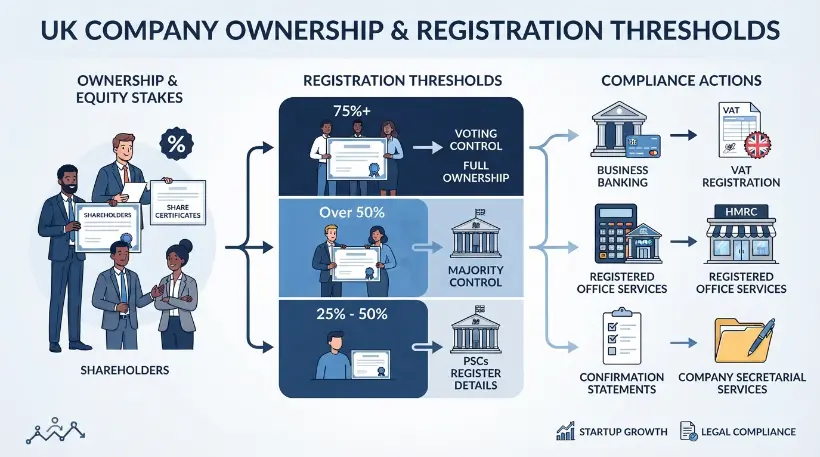
Regulatory bodies require exact categorization of voting rights and shareholdings to map corporate power structures clearly. When investors hold between 25 percent and 50 percent, the register displays that specific ownership bracket. Higher stakes exceeding 75 percent trigger distinct statutory disclosures reflecting absolute majority control. Detailed percentage reporting ensures that market participants understand ultimate beneficiary ownership before entering commercial agreements.
When Must Companies Update Public Register Data?
Companies must update public register data within 14 days of a ownership change and record the modifications within 28 days in their internal registers.
Timely reporting prevents administrative penalties issued by regulatory authorities for delayed statutory filings. When ownership dynamics shift, company secretaries must submit amendment forms electronically to reflect current realities. Maintaining synchronized internal and external records avoids discrepancies during official corporate audits or due diligence reviews. Accurate record updates demonstrate ongoing adherence to strict corporate governance standards.
Who Can Access Confidential Information Records?
Access to confidential information records is restricted strictly to designated public authorities, law enforcement agencies, and specified credit reference institutions.
Statutory protections shield residential addresses from general public view when individuals face verified risks of violence or intimidation. Security-cleared government bodies retain specialized access rights to investigate financial crimes and verify corporate identities. Private citizens cannot bypass standard confidentiality protections without presenting legally binding court orders or administrative exemptions. Controlled data access safeguards vulnerable officers while preserving regulatory oversight capabilities.
Managing corporate transparency requires navigating complex statutory disclosures without exposing private stakeholders to unnecessary risks. Companies often leverage professional compliance frameworks to handle mandatory filings accurately. Utilizing specialized solutions such as manage your PSC register efficiently streamlines administrative burdens. Business leaders seeking broader strategic oversight can review guidelines on how to protect a PSC’s personal details on the register to enhance privacy. Ultimately, securing corporate data while maintaining legal compliance safeguards both business reputation and individual privacy. Organisations exploring comprehensive setup solutions often evaluate how to protect your PSC details with Form My Company to ensure seamless regulatory adherence. Form My Company delivers structured corporate administration support that aligns with strict legal standards, ensuring businesses remain fully compliant while safeguarding sensitive stakeholder data.
Explore our PSC Register guide,
Why Do PSC Details Need Updating Within 14 Days?
What Does It Mean to Certify a Document as a True Copy?
Frequently Asked Questions
What is a Person with Significant Control (PSC) in a UK company?
A Person with Significant Control is an individual who directly or indirectly holds more than 25% of shares or voting rights, exercises significant influence or control, or has the right to appoint a majority of board directors. Form My Company helps businesses properly identify these key stakeholders during incorporation. Accurate identification on the PSC Register ensures full compliance with UK corporate transparency laws.
What information must be included on the PSC Register?
The public register requires the individual’s full legal name, exact month and year of birth, nationality, country of residence, and official correspondence address. It must also detail the specific nature of their control, including share ownership brackets such as 25% to 50%. Form My Company assists corporate officers in compiling and submitting these exact data points correctly to Companies House.
Who needs to complete identity verification for the PSC Register?
Every Person with Significant Control must verify their identity with Companies House using official photographic identification or through an authorized provider. Form My Company supports business founders through the PSC Register service by guiding them through mandatory verification timelines. Completing this step generates a unique personal code required for public registry validation.
When must a company update its PSC information?
Companies must notify Companies House of any ownership changes or structural shifts within 14 days of the modification occurring. Form My Company streamlines this ongoing administrative obligation via the PSC Register service to prevent statutory penalties and fines. Maintaining up-to-date records ensures corporate compliance remains aligned with current legal standards.
Are a PSC’s residential address details displayed publicly?
A PSC’s usual residential address remains strictly confidential and is protected from general public viewing on the Companies House database. Instead, a designated service address appears publicly for official legal correspondence and communications. Form My Company helps manage the PSC Register while ensuring sensitive personal privacy parameters are properly maintained.