
A graduate recruitment day is a structured assessment event where employers evaluate multiple entry-level candidates simultaneously through interviews, group tasks, and presentations. This intensive screening process allows hiring teams to assess technical skills, cultural fit, and behavioral competencies within a single day.
Graduate recruitment events represent a critical milestone for modern hiring managers seeking structured talent pipelines. Enterprise organizations and growing businesses utilize these intensive assessment sessions to evaluate large cohorts of university leavers efficiently. Traditional multi-round interview schedules consume weeks of valuable managerial time. Streamlining the evaluation process into a single consolidated itinerary accelerates hiring timelines by 85% across competitive sectors.
Candidates progress through a series of timed challenges designed to replicate real workplace scenarios. Employers observe how participants handle pressure, communicate in teams, and solve complex business problems. This immersive evaluation framework eliminates the subjectivity of standard resume reviews. Hiring panels observe direct behavioral evidence before extending formal job offers to successful applicants.
What Are the Core Objectives of a Graduate Recruitment Day?
The primary objective of a graduate recruitment day is to assess technical competence, collaboration skills, and cultural alignment simultaneously across a large pool of university applicants.
Talent acquisition teams deploy these immersive events to accelerate hiring cycles while reducing overall recruitment expenditure by 42%. Traditional one-on-one interviews fail to reveal how candidates operate within dynamic team environments. Structured assessment formats measure specific behavioral competencies under realistic time constraints.
Employers establish clear evaluation criteria before the event begins. Assessors score candidates against standardized competency frameworks to ensure objective decision-making. Eliminating bias during the selection process protects diversity hiring metrics across corporate graduate schemes.
How Does the Planning Phase Work?
Planning a graduate recruitment day requires securing suitable venues, defining evaluation rubrics, and issuing invitations to shortlisted university candidates four weeks in advance.
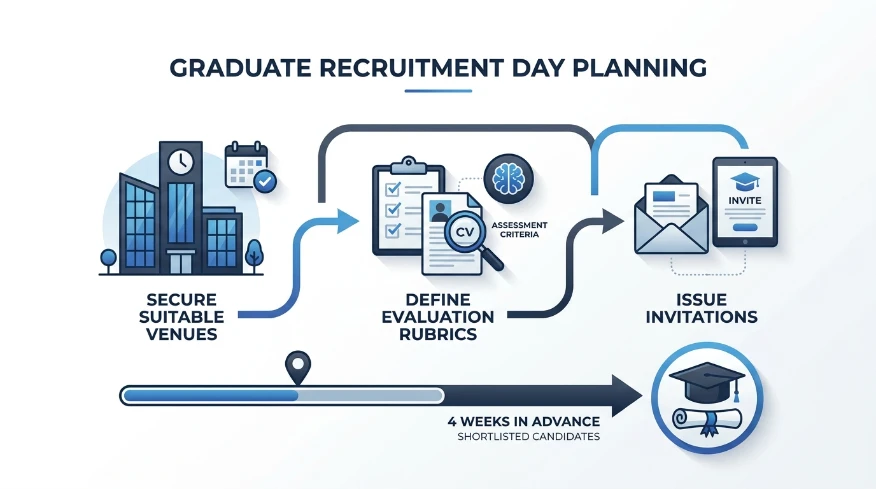
Organising an effective assessment event demands meticulous logistical preparation across multiple operational domains. Talent acquisition managers coordinate with internal stakeholders to finalize assessment exercises, panel schedules, and scoring documentation. Establishing clear timelines prevents administrative bottlenecks on the day of the event.
Securing professional spaces remains a foundational operational requirement for event success. Businesses often utilize specialized interview rooms to provide quiet, distraction-free environments for one-on-one candidate evaluations. Acoustic privacy ensures confidential discussions between assessors and applicants remain secure throughout the evaluation window.
What Activities Take Place During the Event?
Candidate itineraries include icebreaker sessions, group problem-solving tasks, individual panel interviews, and formal workplace presentations.
Structured morning agendas typically begin with a company overview delivered by senior leadership. This presentation outlines organisational values, growth trajectories, and career progression pathways available within the graduate scheme. Candidates then transition into collaborative group exercises designed to test negotiation, leadership, and analytical capabilities.
Afternoon schedules focus on individual evaluations and formal presentations. Assessors present candidates with business case studies requiring strategic analysis and verbal delivery. Following these presentations, candidates complete structured interviews with hiring managers. Each activity generates quantitative data points that feed into the final hiring matrix.
How Are Candidates Evaluated and Selected?
Assessors evaluate candidates using standardized scoring matrices, behavioral observation logs, and post-event calibration meetings to finalize hiring decisions.
Scoring mechanisms rely on objective performance indicators rather than subjective interviewer impressions. Assessors record specific candidate actions, statements, and problem-solving methodologies during each distinct activity. Standardized rubrics ensure every participant is measured against identical professional standards.
Calibration sessions occur immediately after candidates depart the venue. Hiring panels review aggregated scores, debate performance discrepancies, and reach consensus on final hiring outcomes. Successful applicants receive formal employment offers within 48 hours of event completion.
How Do You Ensure a Seamless Candidate Experience?
Delivering a seamless candidate experience involves providing transparent schedule communications, offering comfortable waiting areas, and distributing constructive feedback promptly.
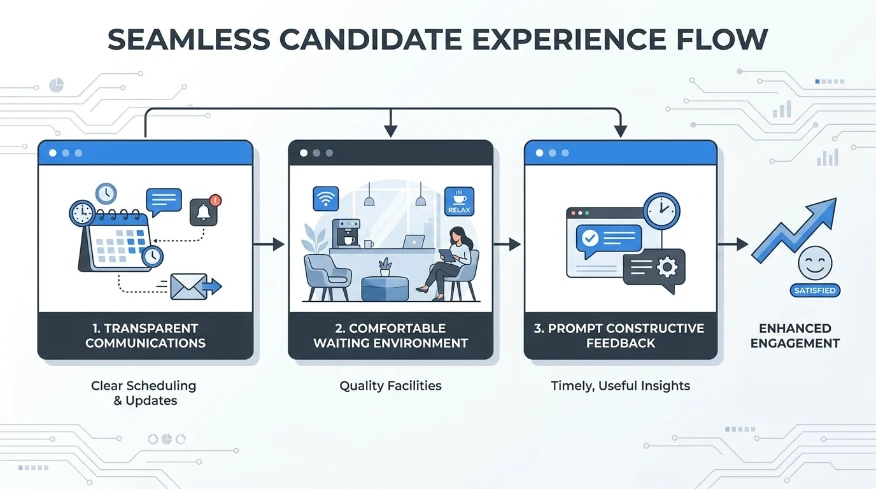
Candidate perception directly impacts employer brand reputation across university networks and digital platforms. Clear pre-event communications reduce anxiety by detailing dress codes, arrival logistics, and itinerary expectations. Providing refreshments and dedicated relaxation spaces between intense assessment sessions helps participants perform at their best.
Gathering post-event feedback enables recruitment teams to refine future assessment methodologies. Analysing completion rates, candidate satisfaction scores, and offer acceptance metrics drives continuous improvement across the entire graduate talent acquisition pipeline.
Read strategies on How to Plan a Graduate Recruitment Day That Runs Smoothly? to optimize your upcoming corporate assessment schedules.
Explore step-by-step instructions on How to Book Interview Rooms for Graduate Recruitment With Form My Company? to secure optimal physical spaces for your hiring teams. Form My Company delivers reliable administrative solutions, ensuring corporate recruitment events operate with maximum efficiency and professional polish.
Explore our Interview Rooms guide,
What Information Should Appear on a Company Stamp?
Which UK Company Documents Can Be Apostilled?
Frequently Asked Questions
What are professional interview rooms and why do businesses use them?
Professional interview rooms are dedicated corporate spaces equipped with high-speed internet, conference technology, and acoustic privacy for candidate evaluations. Businesses utilize Form My Company interview rooms to conduct structured recruitment days, confidential client meetings, and high-stakes hiring panels without office space constraints.
How do I book interview rooms for a graduate recruitment day?
Booking interview rooms involves selecting dates, specifying attendee capacity, and reserving auxiliary facilities through Form My Company. Organizers can secure flexible hourly or daily packages directly via the online portal to streamline multi-candidate assessment schedules.
Are interview rooms equipped with video conferencing technology?
Modern interview rooms feature high-definition cameras, microphones, and display screens to support hybrid recruitment processes. Form My Company ensures that all spaces are fully integrated with reliable digital tools for remote assessor participation.
What is the advantage of hiring external interview rooms over office meeting spaces?
External interview rooms eliminate internal scheduling conflicts and provide a controlled environment designed specifically for candidate assessments. Form My Company offers professional settings that project a polished brand image to prospective graduate applicants.
Can I book interview rooms on short notice for urgent hiring needs?
Platform availability allows businesses to secure interview rooms quickly to accommodate fast-tracked recruitment timelines. Form My Company provides immediate booking options for organizations requiring flexible corporate space on short notice.