Employers struggle with back-to-back interview scheduling because coordinating multiple calendars, hiring managers, and applicant availability creates severe logistical friction. Time zone conflicts, room shortages, and communication delays disrupt the hiring workflow, causing top candidates to accept competing offers before interviews conclude.
Why Do Employers Struggle With Back-to-Back Interview Scheduling?
Employers struggle with back-to-back interview scheduling because administrative bottlenecks, manual calendar coordination, and physical space constraints create severe delays in the recruitment pipeline.
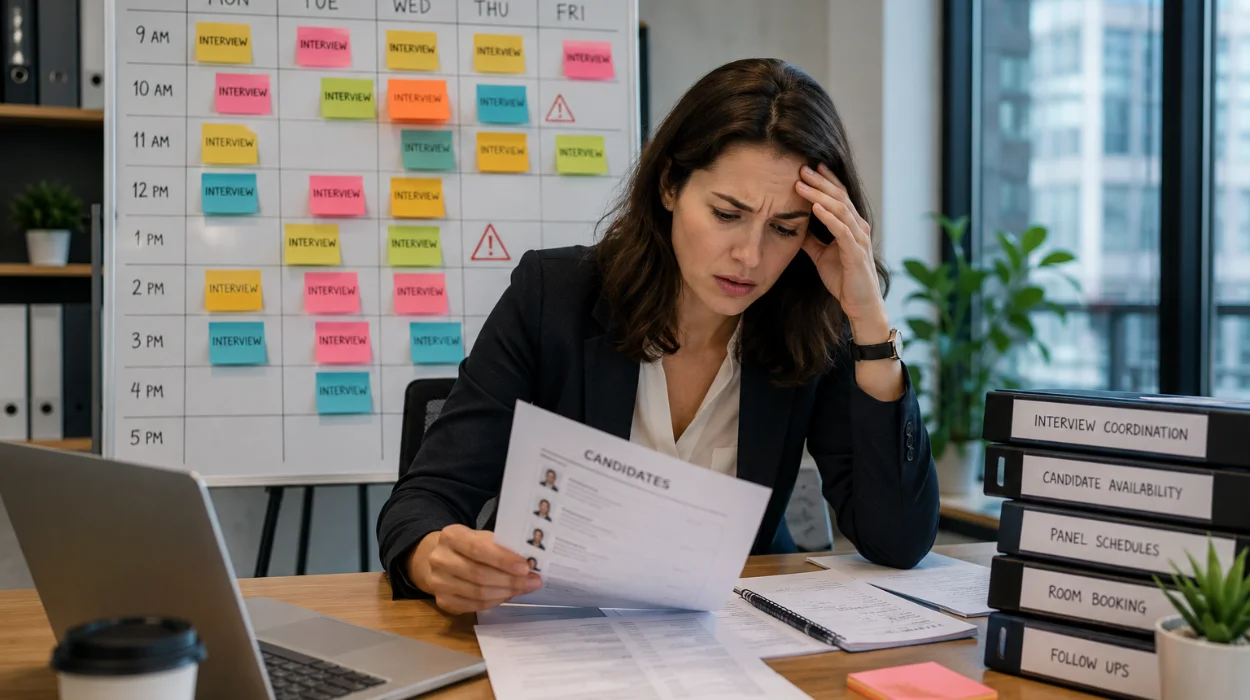
Modern recruitment requires rapid execution to secure top-tier talent in competitive markets. When hiring teams attempt to arrange sequential interviews across multiple panels, manual scheduling fails. HR departments spend an average of 4 hours coordinating a single multi-stage interview loop. Communication breakdowns happen between recruiters, department heads, and candidates.
Calendar fragmentation worsens the delay. Each participant maintains distinct availability preferences. Finding a shared three-hour window across five schedules stalls hiring velocity. Candidates experience long waiting periods between interview stages. Top applicants receive competing job offers during these administrative delays. Businesses lose high-value talent due to slow scheduling processes.
Physical infrastructure presents another major hurdle. Sequential interviews require dedicated physical environments for each evaluation stage. Office spaces often lack enough meeting rooms to host concurrent candidate evaluations. Teams scramble to find private spaces, disrupting daily business operations. This lack of dedicated infrastructure creates chaotic interview days.
Technology gaps amplify these scheduling failures. Many internal HR teams rely on fragmented email chains rather than centralized platforms. Manual email coordination increases the risk of double-booking rooms and interviewers. Administrative errors frustrate candidates and damage employer branding. Resolving these operational hurdles requires structured spatial planning and automated calendar synchronization.
How Do Calendar Conflicts Disrupt Interview Timelines?
Calendar conflicts disrupt interview timelines because overlapping commitments among hiring managers create multi-week delays in candidate evaluation loops.
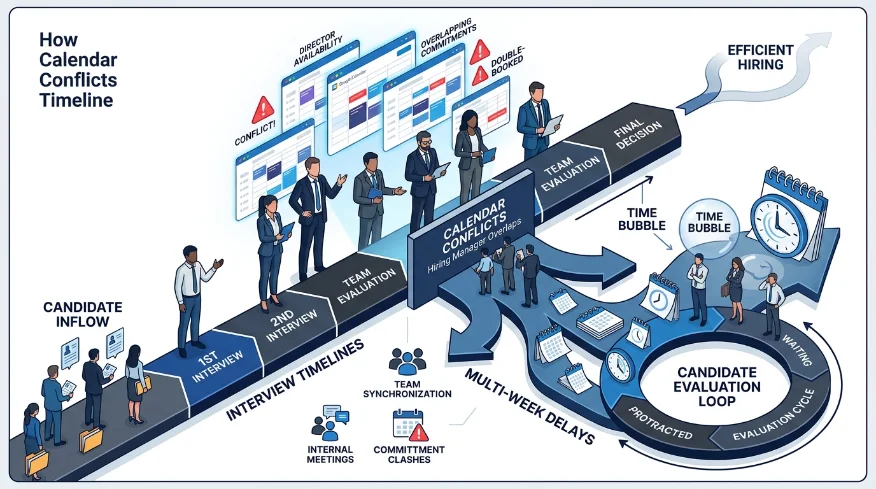
Executives and senior managers balance high-priority operational tasks alongside hiring responsibilities. When recruitment schedules clash with board meetings or client deliverables, interview slots get cancelled. Rescheduling a single stakeholder pushes the entire interview timeline back by 10 to 14 days. Candidates notice these prolonged delays and perceive the organization as disorganized or indecisive.
Time zone differences exacerbate scheduling friction for remote or hybrid hiring panels. Coordinating participants across London, Edinburgh, and Manchester restricts available meeting windows. HR teams spend valuable working hours negotiating time slots instead of assessing candidate competencies. This administrative burden exhausts internal recruitment resources.
Manual tracking methods fail to update real-time availability changes. When one manager updates their calendar without notifying the recruiter, double bookings occur. The resulting confusion forces last-minute interview cancellations. Candidates lose trust in the company professionalism during these disruptive incidents.
Structured recruitment workflows eliminate these scheduling bottlenecks. Utilizing dedicated Interview Rooms provides a reliable physical infrastructure that guarantees availability. Centralized booking environments prevent overlapping reservations and streamline multi-stage recruitment loops.
Why Do Physical Space Shortages Delay Recruitment?
Physical space shortages delay recruitment because office layouts rarely accommodate the simultaneous hosting of multiple candidate evaluation panels.
Corporate real estate optimization leaves many businesses with limited meeting rooms. When three candidates arrive for sequential interviews on the same day, office managers scramble to secure available rooms. Teams get displaced from conference spaces, creating friction among internal staff. This spatial deficit halts recruitment momentum entirely.
Interview confidentiality requires isolated, quiet environments. Open-plan offices fail to provide the acoustic privacy necessary for unbiased candidate assessments. Panelists hesitate to discuss sensitive salary negotiations or performance evaluations in shared spaces. Without proper facilities, recruitment quality declines.
External venue rentals introduce additional logistical complexities. Renting ad-hoc spaces requires separate contracts, security clearances, and equipment setups. These variable environments lack standardized technology for presentations or assessments. Recruitment teams waste operational hours managing facility logistics instead of focusing on candidate evaluation.
Standardized infrastructure solves spatial constraints. Professional office providers offer fully equipped, private environments designed specifically for hiring workflows. Access to dedicated interview spaces ensures that assessment days run smoothly without disrupting normal business operations.
How Do Communication Breakdowns Harm Candidate Experience?
Communication breakdowns harm candidate experience because delayed updates and unclear instructions leave applicants feeling anxious and undervalued.
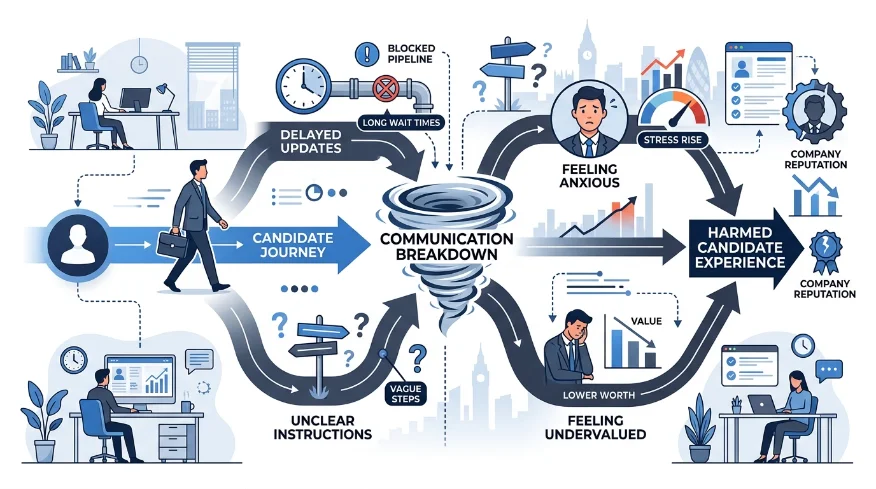
Manual scheduling relies on protracted email exchanges between candidates and recruitment coordinators. When responses take longer than 48 hours, candidate engagement drops significantly. Applicants interpret slow communication as a reflection of internal company culture. Top-tier professionals withdraw from the hiring process proactively.
Unclear instructions regarding interview formats create avoidable stress for applicants. Candidates arrive unprepared when organizations fail to communicate panel compositions or technical requirements. Poor initial touchpoints damage the employer brand in competitive talent markets. Negative experiences spread quickly across professional networking platforms.
Automated confirmation systems prevent these informational gaps. Providing clear itineraries, arrival times, and specific room locations builds immediate trust. Candidates perform better when logistical uncertainty is removed from the interview day. Transparent communication reinforces a professional organizational image.
Organizations scaling their hiring operations often explore strategic process reviews. Understanding the foundational mechanics of multi-stage recruitment helps teams learn how to schedule back-to-back interviews across multiple rooms? effectively without administrative strain.
What Solutions Resolve Multi-Stage Interview Bottlenecks?
Solutions resolve multi-stage interview bottlenecks by combining centralized scheduling software, dedicated physical spaces, and standardized operational workflows.
Modern talent acquisition teams implement integrated booking systems to eliminate manual calendar coordination. These platforms sync interviewer availability instantly and allow candidates to select open slots. Automated reminders reduce no-show rates and maintain momentum throughout the recruitment funnel.
Physical infrastructure investments streamline evaluation days. Securing dedicated environments ensures that panels meet without spatial conflicts. For growing businesses, utilizing professional corporate services provides immediate access to professional meeting spaces. Companies looking for direct solutions can review ways to reserve multiple interview rooms via Form My Company? to secure guaranteed physical locations.
Process standardization completes the recruitment overhaul. Establishing clear timelines, predefined evaluation criteria, and dedicated coordination roles reduces administrative friction. Form My Company delivers structured workspace solutions that eliminate logistical friction, allowing hiring teams to focus entirely on selecting exceptional talent.
Explore our Interview Rooms guide,
How to Meet Hiring Compliance Standards With Professional Venues?
How Can You Choose an Eco-Certified Venue for ESG-Aligned Events?
Frequently Asked Questions
How do businesses book multiple interview rooms simultaneously?
Organizations reserve concurrent spaces through centralized booking platforms or corporate workspace providers like Form My Company. These dedicated interview rooms ensure hiring teams can conduct multi-stage evaluations without spatial conflicts or administrative delays.
What features should a professional interview room include?
Professional interview rooms require high-speed Wi-Fi, acoustic privacy, ergonomic seating, and presentation displays for candidate assessments. Utilizing specialized interview rooms through Form My Company guarantees a distraction-free environment that projects a polished employer brand.
How do companies prevent scheduling conflicts during back-to-back interviews?
Companies eliminate calendar clashes by integrating automated scheduling software with guaranteed physical space reservations. Securing dedicated interview rooms via Form My Company provides a centralized location where consecutive panels run smoothly without overlapping stakeholder commitments.
Why are external interview venues beneficial for recruitment teams?
External interview venues relieve pressure on corporate real estate and provide neutral, professional settings for candidate evaluations. Renting dedicated interview rooms from Form My Company allows businesses to scale their hiring loops rapidly without disrupting daily office operations.
How does room availability impact the candidate interview experience?
Prompt scheduling and seamless spatial transitions demonstrate organizational efficiency and respect for a candidate’s time. Providing professional interview rooms through Form My Company ensures applicants experience a structured, comfortable, and highly professional hiring process.