
What if your home address became public property the moment you launched your dream business? You’ve likely spent weeks refining your business plan, yet the final hurdle of official paperwork feels like a minefield of legal jargon and hidden privacy risks. It’s understandable to feel anxious about choosing the wrong structure or missing a critical compliance step, especially with the 2026 introduction of mandatory digital identity verification for directors. The process of uk company registration should be a milestone to celebrate, not a source of administrative dread.
This guide will show you how to secure a professional registration in under 24 hours whilst keeping your personal data strictly private. You’ll discover the most efficient ways to launch your venture without getting bogged down in complex statutory requirements. We’ll compare the best formation paths for 2026, explain the new £90,000 VAT threshold, and help you decide whether a Limited Company, LLP, or PLC structure provides the best foundation for your entrepreneurial journey. By the end, you’ll have a clear, actionable roadmap to get your business off the ground with total confidence and professional credibility.
Key Takeaways
- Navigate the latest 2026 Companies House requirements to complete your uk company registration in under 24 hours.
- Compare Limited Company, LLP, and PLC structures to find the perfect balance between liability protection and tax efficiency for your venture.
- Discover how to protect your personal privacy by keeping your home address off public records using professional Registered Office services.
- Evaluate tiered formation packages, including the Entrepreneurs Choice and Fully Inclusive options, to find the best value for your specific business goals.
- Gain a clear understanding of essential statutory obligations, including the updated VAT registration thresholds and mandatory director identity checks.
The Essentials of UK Company Registration in 2026
UK company registration is the official process of incorporating your business as a legal entity. This formal act takes place at Companies House, the United Kingdom’s registrar of companies. Once complete, your business exists independently of its owners. This separation provides the limited liability protection that makes the UK such an attractive place for entrepreneurs. It’s the moment your idea becomes a recognised corporate body.
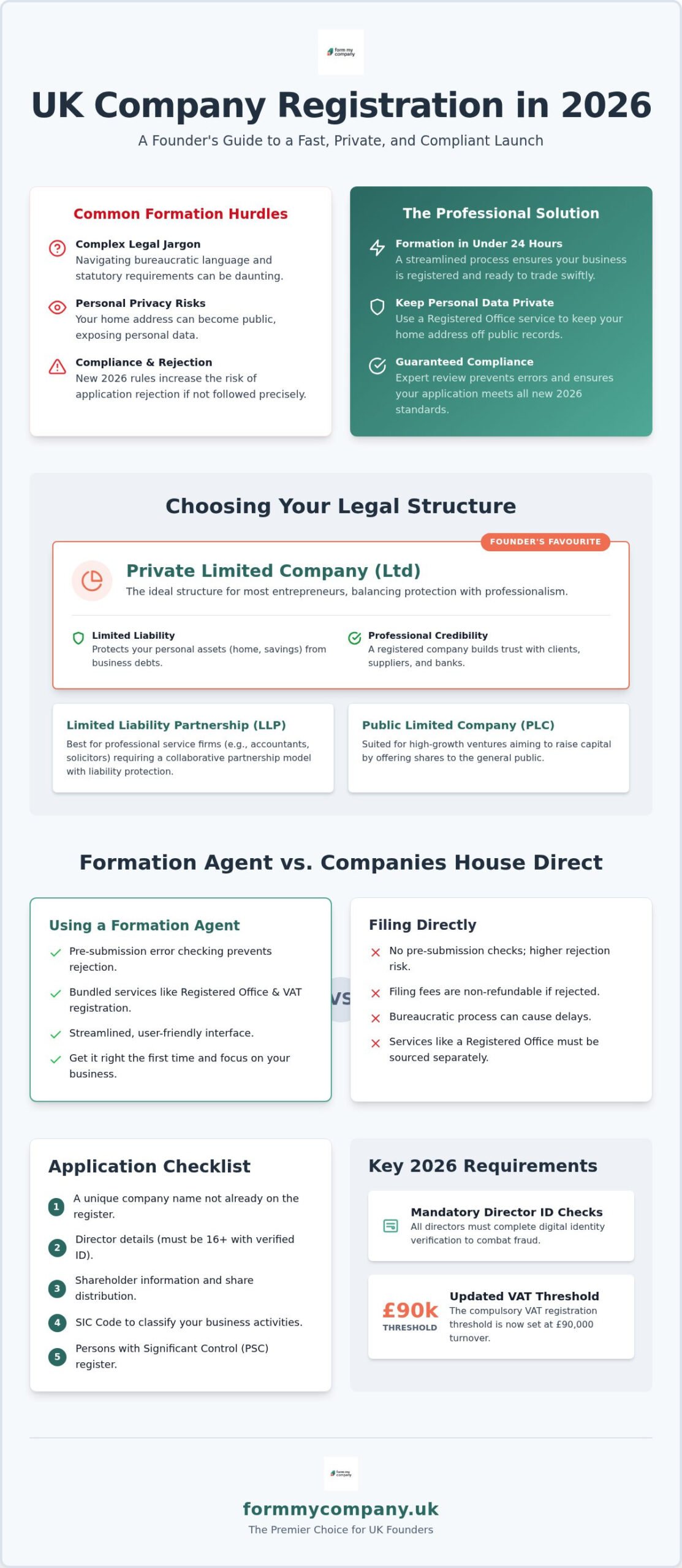
Upon successful filing, you’ll receive a Company Registration Number (CRN). Think of this as your firm’s permanent DNA; it never changes, even if you rename the business later. You’ll need this number for everything from opening a business bank account to filing tax returns. In 2026, the landscape has shifted toward tighter scrutiny. New identity verification requirements for directors mean that accuracy is no longer optional. Whilst digital incorporation is faster than ever, the risk of rejection has increased for those who don’t follow the new protocols exactly. Using a professional facilitator ensures these technical hurdles don’t slow your momentum.
Why Use a Formation Agent vs Companies House Directly?
Choosing an agent over a direct government filing is a strategic move for serious founders. Agents provide a critical layer of pre-submission error checking that government portals simply don’t offer. This software-driven oversight prevents the frustration of a rejected application and the loss of non-refundable filing fees. It ensures your uk company registration is handled with precision from the start.
Beyond simple filing, agents offer bundled value that streamlines your entire setup. You can integrate a Registered Office Address Service or a VAT Registration Service directly into your initial application. The user interface is designed for speed and clarity, stripping away the bureaucratic friction of traditional portals. It’s about getting it right the first time so you can focus on trading. This methodical approach gives you a professional edge from day one.
Essential Information Required for Your Application
Preparation is the key to a 24-hour turnaround. You’ll need several core components ready before you begin the application process:
- Unique Company Name: Your name must not be “too like” an existing one on the register.
- Director Details: You need at least one director who is 16 or older. 2026 rules require verified identity documents for all officers.
- Shareholder Information: Details of who owns the company and how the shares are distributed amongst the founders.
- SIC Code: This code classifies your business activities so the government can track industry trends and tax obligations.
You must also maintain a Persons with Significant Control (PSC) register to identify individuals who hold more than 25% of shares or voting rights; this ensures full transparency and compliance with the latest anti-money laundering regulations.
Choosing the Right Legal Structure for Your Venture
Selecting the correct framework for your uk company registration is the most consequential decision you’ll make during the setup phase. This choice dictates your personal liability, your tax obligations, and your ability to raise capital in the future. It’s essentially a balance between protecting your personal assets and ensuring the highest level of tax efficiency for your specific business model. Most entrepreneurs find that a Private Limited Company (Ltd) provides the ideal middle ground, but your long-term goals might require a more specialised vehicle.
Whilst the Ltd structure is the standard for the vast majority of UK startups, it isn’t the only path. Professional service firms often require the collaborative nature of a partnership, whilst high-growth ventures may have their sights set on a public listing. Understanding the nuances of each structure prevents expensive administrative pivots later in your journey. If you’re ready to secure your structure, you can explore our tiered formation packages designed to support every type of founder.
Limited Companies (Ltd): The Founder’s Favourite
The Private Limited Company is the most popular choice for a reason. Its primary draw is “limited liability,” which ensures that your personal assets; such as your home or savings; remain protected if the business faces financial difficulty. Because the company is a separate legal entity, its finances are entirely distinct from your own. This separation builds trust with creditors and provides a professional image that sole traders often struggle to match.
For those launching social enterprises or non-profit organisations, the “Limited by Guarantee” option is the preferred route. Instead of shareholders, this structure has guarantors who commit a symbolic amount to the company’s debts. It offers the same liability protection as a standard Ltd but signals to stakeholders that profits are reinvested into the organisation’s mission rather than distributed as dividends.
LLP vs PLC: When to Scale Your Structure
If you’re launching a professional service firm, such as an accountancy or architectural practice, the Limited Liability Partnership (LLP) offers a unique hybrid. It combines the flexible internal management of a traditional partnership with the liability protection of a limited company. Members are taxed as individuals on their share of the profits, which can be more efficient for certain high-earning professional groups.
Public Limited Companies (PLC) occupy the other end of the spectrum. These are designed for large-scale operations intending to raise capital from the general public. To complete a PLC registration, you must have a minimum share capital of £50,000, with at least 25% of that paid up. You can find detailed technical requirements for these complex structures on the official Companies House website. Choosing between an LLP and a PLC depends entirely on whether you value partnership flexibility or the prestige and capital-raising power of the stock market.
Comparing Formation Packages: Which Level Suits Your Needs?
Choosing a package for your uk company registration involves balancing immediate costs against long-term operational ease. While every path leads to a registered entity, the level of support varies significantly between a basic filing and a comprehensive setup. Your decision should hinge on how quickly you need to trade and how much administrative weight you’re willing to carry during your first year. A well-chosen package acts as a launchpad, ensuring you don’t spend your first week in business chasing missing documents or fixing filing errors.
For most new startups, the Entrepreneurs Choice Package represents the most balanced path. It bridges the gap between basic registration and a fully managed service, providing the essential tools needed to establish a professional presence without overcomplicating the initial launch. It’s designed for founders who want to hit the ground running with a blend of digital speed and physical record-keeping.
The Digital vs Digital & Print Debate
The Digital Package serves budget-conscious founders who prefer paperless records. It’s an efficient, eco-friendly route for those who are comfortable storing their statutory documents in the cloud. This is often the fastest way to get your company number, making it ideal for those who need an entity established within hours to secure a contract or a domain name.
However, the Digital & Print Package remains a popular choice for a practical reason: physical certificates. Many traditional banks and high-street lenders still request hard-copy share certificates and the Certificate of Incorporation during the account opening process. If you plan to seek external funding or trade internationally, having a professionally printed set of documents saves time. It prevents the friction of having to print and certify your own documents when a solicitor or banker asks for proof of your uk company registration. International lenders and partners may also require you to get an official Certificate of Good Standing issued by Form My Company to confirm your business remains active and compliant. If you work with overseas clients or suppliers, understanding how to explain a Certificate of Good Standing to your overseas business partner can be the difference between a deal proceeding smoothly and stalling over unfamiliar paperwork.
The Fully Inclusive Advantage
The Fully Inclusive Package is the definitive “set and forget” solution. It’s designed for founders who value compliance and wish to bypass the bureaucratic learning curve. By bundling VAT registration and a Registered Office Address Service from day one, you ensure your business reaches “ready-to-trade” status immediately. You won’t have to worry about your home address appearing on public records or missing the deadline for your VAT application.
This proactive approach eliminates the need to source these services separately later, which often results in higher cumulative costs and fragmented records. It provides a cohesive foundation where your privacy, tax status, and statutory filings are all handled centrally. For the serious entrepreneur, this package offers the highest level of reassurance, allowing you to focus entirely on growth whilst we handle the administrative heavy lifting.
Strategic Support: Virtual Offices and VAT Registration
A successful launch involves more than just obtaining a certificate of incorporation. It requires a strategic approach to your public profile and your tax status. Utilising professional address services is a fundamental step in protecting your personal life whilst building a credible brand. For many founders, VAT registration also serves as a vital growth tool. It signals to larger clients and suppliers that your business is a serious, established entity. With the 2026 VAT registration threshold held at £90,000, understanding when to register is essential for managing your cash flow and commercial reputation.
Virtual Office services allow you to project a prestigious image without the overheads of physical premises. This is particularly valuable for digital startups and consultants who work remotely but need a professional “front” for their operations. By separating your trading presence from your actual location, you maintain a high level of confidence amongst your stakeholders. If you want to secure these professional foundations today, you can register your business with our comprehensive support packages.
Protecting Your Privacy with Registered Office Services
Every director must provide two addresses during the uk company registration process: a registered office address and a director service address. If you use your home address for either, it becomes part of the permanent public record. This exposure carries risks, from unsolicited marketing mail to privacy concerns for your family. A professional Registered Office Address Service ensures that your residential details remain confidential. All statutory correspondence from HMRC and Companies House is received at a professional centre and forwarded to you securely.
Our Privacy Package is designed specifically for founders who prioritise security. It provides a robust shield by ensuring your home address never touches the public register. This service handles all official mail processing, filtering out the noise so you only receive the documents that matter. It’s an efficient way to maintain a professional boundary between your business and your private life.
UK Company Registration for Foreign and European Nationals
The UK remains one of the most accessible jurisdictions for global entrepreneurs. You don’t need to be a UK resident to register a company here, and the process is entirely legal for foreign and European nationals living abroad. This allows international founders to access the UK market and benefit from its stable corporate legal framework without the need to relocate. However, the 2026 regulations have introduced mandatory identity verification for all overseas directors to ensure the integrity of the register.
A mandatory requirement for any non-resident founder is a UK-based Registered Office address. This address serves as the official point of contact for the business within the UK jurisdiction. We specialise in supporting international clients by providing these essential UK addresses and facilitating the new identity check protocols. This streamlined support ensures that your uk company registration meets every legal standard, regardless of where in the world you are based.
Why Form My Company is the Premier Choice for Founders
Form My Company isn’t just a filing service; we’re a digital-first innovator built for the modern founder. We’ve stripped away the cold, traditional corporate approach to provide a supportive environment where speed meets accuracy. Our ethos centres on the idea that uk company registration should be the most exciting day of your career, not the most stressful. We’ve done the heavy lifting by designing a process that guides you through the 2026 identity verification requirements with ease, positioning us as a reliable facilitator for your entrepreneurial goals.
Our tiered system is specifically engineered to scale alongside your ambitions. Whether you start with a lean Digital Package or opt for the comprehensive Fully Inclusive Package, you’re building on a foundation of professional authority. For those who need more than just a digital footprint, our Meeting Room Hire services provide a physical space to impress investors or collaborate with your team. This flexibility ensures you only pay for the support you need, exactly when you need it. Your first step is simple: use our real-time name checker to see if your chosen brand is available for registration.
Beyond Incorporation: Ongoing Administrative Ease
Our commitment to your success extends far beyond the initial filing. We provide essential post-formation tools like our VAT Registration Service and handle your annual Confirmation Statement filings to ensure you remain in good standing with Companies House. Having all these business support services under one roof eliminates the need to manage multiple vendors or risk missing critical deadlines. Form My Company organises statutory records in a secure, digital environment to ensure your essential documents are always accessible for banking or funding reviews.
Ready to Organise Your UK Business?
Taking the leap into business ownership is a significant milestone, and you deserve a partner who understands the fast-paced nature of the 2026 market. We’ve refined our systems to ensure your uk company registration is handled with the precision and urgency your new venture demands. We move with a sense of purpose, quickly transitioning from your initial idea to a fully registered entity. Launch your business with a team that values your time as much as your vision.
Start your UK company registration today and join the thousands of founders who have chosen the efficient, transparent, and results-oriented path to business ownership.
Secure Your Strategic Foundation Today
Establishing a new business is a significant milestone that requires more than just a name. As we’ve explored, the right 2026 formation path balances robust liability protection with long-term tax efficiency. Whether you’re a local founder or an overseas entrepreneur, the key is to prioritise accuracy and privacy from day one. Choosing a structure that fits your specific vision ensures you won’t face administrative bottlenecks as you scale.
Our digital packages allow for instant filing whilst our comprehensive privacy and VAT services handle the complex statutory details on your behalf. We provide specialist support for foreign nationals to ensure every international venture meets current uk company registration regulations seamlessly. Don’t let paperwork dampen your entrepreneurial spirit. Take the first step toward your goals with a partner who understands the modern business landscape. Register your UK company online now and start your journey with total peace of mind. Your future starts here.
Frequently Asked Questions
How long does UK company registration actually take in 2026?
Most digital applications are processed within 3 to 24 hours; depending on the current workload at Companies House. If you require your company number urgently; a same-day digital incorporation service is available for an additional fee. Whilst the process is fast; the new identity verification requirements for directors must be completed accurately to avoid delays. Using a professional agent ensures your application is error-checked before submission; maintaining this rapid uk company registration turnaround.
Can I register a UK company if I am not a British resident?
Yes; you can legally register a UK company whilst living abroad as there are no residency requirements for directors or shareholders. However; every UK company must have a physical Registered Office address located within the UK. Non-resident founders must also comply with the 2026 identity verification protocols. Our specialist packages for foreign and European nationals streamline this process; providing the necessary UK address and guidance on international compliance steps.
Is it legal to use my home address for company registration?
It is entirely legal to use your residential address; but it’s important to understand that this information will be published on the public register. This means anyone can search for your company and see where you live. To maintain your personal privacy and present a more professional image; many founders opt for a Registered Office Address Service. This keeps your home details off the public record whilst ensuring all official mail reaches you securely.
What is the difference between a Registered Office and a Virtual Office?
A Registered Office is the official legal address used for statutory correspondence from HMRC and Companies House. In contrast; a Virtual Office provides a prestigious trading address for general business mail and marketing purposes. Whilst the Registered Office is a mandatory legal requirement; a Virtual Office is an optional service that enhances your brand’s credibility. Both services allow you to operate from home whilst maintaining a professional corporate presence without physical overheads.
When should I register for VAT during the formation process?
You must register for VAT if your taxable turnover exceeds the £90,000 threshold within a 12-month period. However; many founders choose voluntary registration during the initial uk company registration process. This can be beneficial if you sell primarily to other VAT-registered businesses or if you wish to reclaim VAT on your startup expenses. Our VAT Registration Service handles the application alongside your formation; ensuring you’re ready to trade with full credibility immediately.
Do I need a business bank account to register my company?
You don’t need a business bank account to complete the registration process; as you usually need your Certificate of Incorporation to open one. Once your company is officially formed; you should open a dedicated business account to keep your personal and corporate finances separate. This is a crucial step for maintaining accurate accounting records and demonstrating the legal separation between yourself and the business entity; which is essential for limited liability protection.
What is a Confirmation Statement and when must I file it?
A Confirmation Statement is an annual filing that confirms your company’s information; such as director details and share capital; remains accurate on the public register. It must be filed at least once every 12 months; even if no changes have occurred. Failing to submit this statement can lead to your company being struck off the register. As of 1 February 2026; the fee for the annual Confirmation Statement has increased to £50 for online filings.
Can I change my company structure from Ltd to PLC later?
Yes; a Private Limited Company (Ltd) can be converted into a Public Limited Company (PLC) through a process known as re-registration. This transition requires you to meet specific criteria; including having a minimum allotted share capital of £50,000. You’ll also need to pass a special resolution and file the necessary amended articles of association. This is a common path for high-growth firms looking to raise capital through public share offerings or enhance their corporate status.