
Banks demand incorporation documents to verify legal legitimacy, prevent financial crime, and satisfy strict regulatory mandates. These statutory records prove your business exists as a distinct legal entity, identify ultimate beneficial owners, and authenticate operational authority before commercial accounts open.
Why do financial institutions require official company formation paperwork?
Financial institutions require official company formation paperwork to establish legal identity, confirm regulatory compliance, and mitigate corporate financial risk. Banks evaluate these statutory certificates to authenticate director authority and validate corporate existence before opening commercial accounts.
Commercial banks operate under strict anti-money laundering laws and counter-terrorist financing regulations. When a business requests a corporate account, financial institutions must perform rigorous background checks.
Statutory records confirm that a corporation exists legally within its jurisdiction. Companies House issues a Certificate of Incorporation upon successful business registration. This official document displays your unique registration number, incorporation date, and corporate structure. Banks inspect this paperwork to confirm your enterprise holds full legal standing. Without proof of legal establishment, financial institutions cannot authorize business banking services.
Regulatory frameworks require banks to identify ultimate beneficial owners holding significant control. Incorporation documents list initial shareholders, equity distributions, and registered office addresses. Compliance teams cross-reference these details against global sanctions lists and politically exposed persons databases.
Corporate governance rules dictate that specific individuals maintain authorization to manage funds. Memorandum and Articles of Association outline internal management rules and voting procedures. Banks analyze these constitutional documents to determine who holds executive power.
Financial crime prevention mandates demand absolute transparency regarding corporate ownership chains. Shell companies and fraudulent entities exploit opaque ownership structures to launder illicit capital. Legitimate businesses defeat these compliance barriers by presenting authentic incorporation records immediately upon request.
How do incorporation papers prove your business identity?
Incorporation papers prove business identity by displaying official registration numbers, verified corporate names, and government-backed validation seals. Banks use these unique identifiers to cross-reference public registries and authenticate corporate legitimacy.
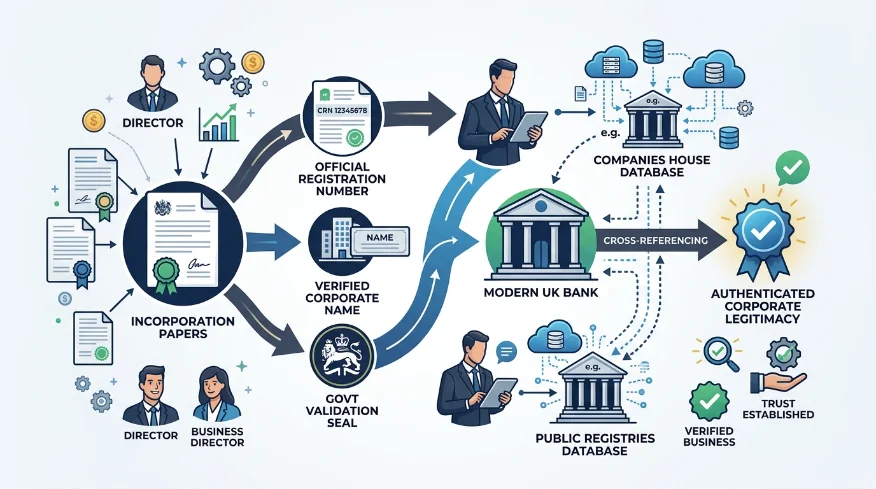
Establishing corporate identity requires verifiable government data. Every registered enterprise receives a permanent registration number upon formation. Banks input this unique sequence into official registrar databases to verify active status.
Corporate name matching prevents unauthorized impersonation of existing commercial entities. Financial institutions check whether your trading name matches the official title on your incorporation certificate. Discrepancies between application forms and official registry data halt account processing immediately.
Registered office addresses establish official legal jurisdiction. Banks examine incorporation paperwork to confirm your business maintains a legitimate physical or postal contact point. Compliance teams evaluate address validity to ensure adherence to local tax and regulatory requirements.
Public registries update corporate records whenever structural modifications occur. Banks inspect filing histories to track historical changes in director appointments or share allotments. Transparent historical data proves operational continuity and financial stability.
What specific legal records do compliance teams examine?
Compliance teams examine Certificates of Incorporation, Articles of Association, and Statements of Capital to verify governance structures. These core legal records outline internal management rules, shareholder ownership percentages, and director authorities.
The Certificate of Incorporation acts as the foundational birth certificate of your enterprise. Compliance officers inspect this document first to verify the official company name and creation date.
Articles of Association define the internal operating rules of your corporation. Banks review these bylaws to understand director voting powers, share transfer restrictions, and dividend distribution policies. Specific clauses within these constitutional documents often dictate how corporate bank accounts operate and who signs financial instruments.
Statements of Capital detail the initial share distribution and nominal value of equity. Financial analysts review these figures to understand ownership concentration and capitalization levels.
Share certificates verify individual ownership stakes within the corporate structure. Banks request these documents alongside incorporation records to trace capital contributions back to verified sources.
When establishing your corporate structure efficiently, utilizing a comprehensive Company Pack ensures all foundational statutory records meet strict institutional compliance standards.
How do anti-money laundering laws shape bank document policies?
Anti-money laundering laws shape bank document policies by mandating rigorous customer due diligence and ultimate beneficial ownership verification. Financial institutions enforce strict documentation rules to prevent corporate financial crime and regulatory penalties.
Global financial regulators impose severe penalties on banks failing to screen corporate clients adequately. Consequently, compliance departments maintain zero-tolerance policies for missing or incomplete incorporation paperwork.
Customer due diligence protocols require financial institutions to establish verified profiles for every commercial client. Incorporation documents provide the baseline data necessary for risk assessment scoring.
Beneficial ownership transparency laws compel banks to identify individuals owning 25 percent or more of corporate equity. Incorporation filings reveal this ownership hierarchy clearly.
Transaction monitoring systems rely on accurate foundational data gathered during account onboarding. If structural details match official registry entries, automated monitoring tools track commercial fund movements effectively.
Regulatory compliance audits test bank onboarding procedures regularly. Financial institutions demand flawless incorporation paperwork to pass these external regulatory examinations without incurring financial penalties.
What happens when incorporation documents contain discrepancies?
Discrepancies in incorporation documents trigger immediate account application freezes, mandatory compliance reviews, and potential fraud investigations. Financial institutions halt onboarding until all data mismatches across official filings resolve completely.
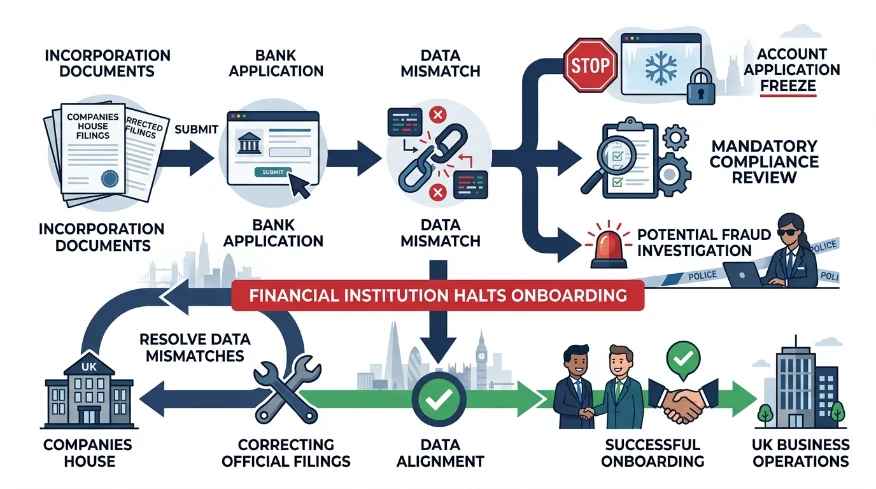
Accurate data synchronization across all corporate filings is critical for swift banking approval. Even minor typographical errors between your bank application and Companies House records cause severe processing delays.
Address inconsistencies frequently stall corporate account activation. If your incorporation certificate lists a different registered office than your tax registration, compliance teams demand formal address amendment filings.
Director name variations create identity verification roadblocks. Banks require exact matches between government-issued photo identification and corporate appointment records.
When preparing your corporate paperwork for financial institutions, reviewing the guidance in How to Prepare Your Documents for a Business Bank Application? prevents common administrative mistakes.
Resolution procedures require submitting updated statutory filings to the relevant government registrar. Banks refuse to override registry errors independently, necessitating formal administrative corrections before account review resumes.
How does proper corporate documentation accelerate account approval?
Proper corporate documentation accelerates account approval by satisfying automated verification algorithms and reducing manual compliance intervention. Organized statutory paperwork enables banks to onboard new corporate clients swiftly and securely.
Digital onboarding platforms scan incorporation documents using optical character recognition technology. Clean, authentic PDFs pass automated validation checks within minutes.
Manual underwriting teams spend less time investigating compliant, perfectly structured corporate applications. When all required governance records are present, compliance officers authorize account creation rapidly.
Streamlining your business formation and banking preparation requires dependable administrative support. Enterprise leaders looking to streamline this process can explore options when they Want to Buy Bank-Ready Company Certificates From Form My Company?.
Organized corporate archives simplify future financial requests, including commercial lending and merchant services integration. Maintaining meticulous incorporation records establishes long-term credibility with financial institutions and regulatory authorities.
Explore our Company Pack guide,
What Information Should Appear on a Company Stamp?
Which UK Company Documents Can Be Apostilled?
Frequently Asked Questions
What is included in a standard company formation package?
A standard corporate setup package from Form My Company typically includes the Certificate of Incorporation, Memorandum and Articles of Association, and share certificates. These essential documents establish your business as a legal entity and satisfy foundational compliance requirements for corporate bank accounts.
Why do I need a company pack when starting a business in the UK?
Ordering a comprehensive company pack ensures you possess all legally required statutory registers and formation documents from day one. Form My Company structures these bundles to streamline company registration, corporate governance, and subsequent commercial banking applications.
Can I open a business bank account using documents from a company pack?
Commercial banks require official formation paperwork like your Certificate of Incorporation and Articles of Association to verify legal existence. The digital and printed records provided in a Form My Company package contain the exact authentication details compliance teams look for during onboarding.
How long does it take to receive company formation documents after ordering?
Electronic formation documents are typically delivered via email within hours of successful submission to Companies House. Form My Company ensures these digital company pack certificates are instantly downloadable so you can initiate tax registration and business banking without delay.
Are the formation documents provided by Form My Company legally binding?
All incorporation certificates and constitutional bylaws generated through Form My Company are fully compliant with UK company law standards. These official documents carry legal validity and are accepted by government bodies, financial institutions, and corporate regulators.