
When business growth brings sudden traffic surges, Form My Company deploys trained receptionists and dedicated call answering systems to capture every incoming inquiry, prevent missed sales, and protect your brand reputation during peak operational periods.
How Do Traffic Surges Threaten Business Operations?
Rapid demand spikes overwhelm internal communication channels, causing staff burnout, delayed customer responses, and lost revenue opportunities across critical operational touchpoints.
When customer volume doubles overnight, internal teams struggle to maintain service standards. Employees drop crucial tasks to answer ringing phones. Morale plummets because staff face endless interruptions. Operational bottlenecks multiply across departments.
Missed calls increase immediately during traffic surges. Statistics show that 62% of calls to small businesses go unanswered during peak hours. Each unanswered ring represents a lost customer acquisition opportunity. Competitors capture these frustrated prospects instantly.
Revenue leakage accelerates when communication channels fail. Marketing campaigns drive expensive traffic to your website. If phones ring out, return on investment drops sharply. Companies waste marketing budgets because inbound leads vanish into voicemail queues.
Customer churn rises when support teams experience severe delays. Buyers expect immediate answers to urgent questions. Delays damage long-term brand loyalty. Rebuilding trust costs five times more than retaining existing relationships.
Operational efficiency requires dedicated resources. Internal staff members cannot split focus between core tasks and high-volume communication. Businesses need specialized infrastructure to absorb sudden workload increases without disrupting daily workflows.
Why Do Traditional Reception Desks Fail During Growth Phases?
Traditional physical reception desks lack the scalability, multichannel integration, and extended hours required to handle unpredictable volume spikes effectively.
Physical office environments impose rigid capacity limits. A single receptionist handles a maximum of four simultaneous calls. Additional inbound inquiries receive busy signals. Customers hang up and call competitors within seconds.
Staff illness and holiday leave create unexpected coverage gaps. Businesses face severe communication blackouts when front desk personnel take time off. Temporary staff lack company-specific knowledge, leading to poor customer service interactions.
Operating costs escalate rapidly with physical staffing models. Hiring full-time employees for peak hours creates bloated overhead expenses. Businesses pay for idle time during quiet periods. Salaries, pensions, and office space inflate fixed operational costs.
Modern consumers demand communication channels beyond standard office hours. Traditional receptionists lock their desks at 5 PM. Evening and weekend inquiries vanish into unmonitored voicemail boxes. Sales opportunities disappear while offices remain empty.
Scalability requires flexible staffing solutions. Fixed employee counts cannot expand dynamically during seasonal sales spikes. Companies require outsourced frameworks that scale capacity up or down instantly based on real-time market demand.
How Does Professional Call Answering Stabilize Inbound Volume?
Professional call answering services deploy remote receptionists who absorb overflow traffic, filter unqualified inquiries, and distribute urgent leads instantly.
Outsourced receptionists integrate seamlessly with your internal operations. Agents access your company knowledge base and CRM software. Callers receive accurate, brand-aligned information regarding products and services.
Call volume distribution operates through structured routing protocols. Overflow calls transfer automatically to remote agents when internal lines stay busy for over thirty seconds. Internal teams handle core projects uninterrupted.
Lead qualification filters eliminate low-value interruptions. Professional receptionists collect essential contact details, project specifications, and budgetary requirements before transferring callers. Sales teams speak exclusively with pre-screened prospects.
Data capture accuracy improves through standardized digital intake forms. Agents record every customer interaction directly into centralized databases. Management reviews detailed analytics regarding peak call times, inquiry types, and conversion rates.
Operational continuity remains guaranteed through redundant staffing networks. Hundreds of trained professionals cover shifts around the clock. Businesses eliminate communication vulnerabilities caused by staff turnover or unexpected absences.
What Steps Define Our Call Management Integration Process?
Integrating professional call management requires auditing current communication workflows, configuring custom scripts, and launching seamless call routing architectures.
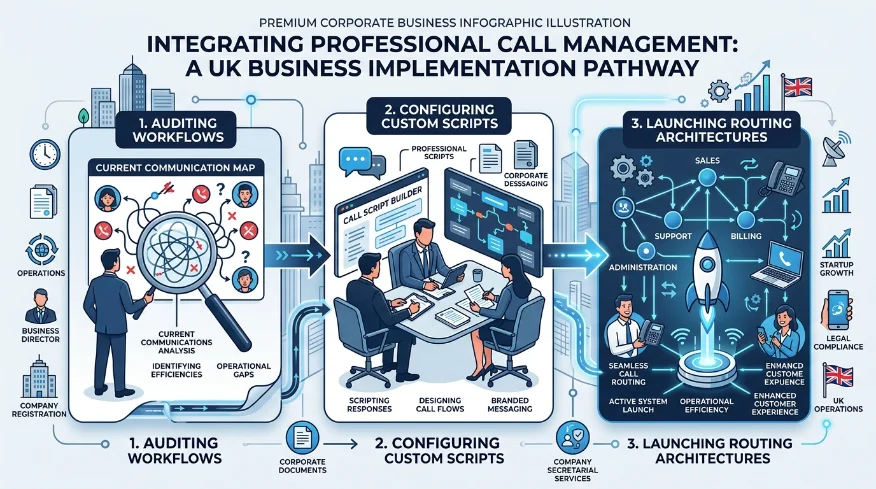
Detailed communication audits identify existing response bottlenecks. Analysts evaluate historical call logs, peak traffic hours, and average resolution times. This assessment determines exact staffing requirements for your business model.
Custom script development establishes brand consistency. Writers draft precise response guidelines covering common customer queries, pricing structures, and escalation procedures. Agents memorize these protocols before answering live calls.
Technical integration connects telephony infrastructure with CRM platforms. Engineers configure call forwarding rules and test API connections rigorously. Data flows securely between external receptionists and internal management tools.
Staff briefings ensure remote agents understand company culture. Supervisors conduct role-playing exercises simulating complex customer interactions. Agents master product terminology and brand positioning before taking live traffic.
Continuous performance monitoring maintains high service standards. Quality assurance managers review recorded calls daily. Feedback loops optimize script wording and improve first-call resolution metrics across all accounts.
How Can Managed Call Handling Accelerate Your Business Growth?
Managed call handling converts peak traffic into measurable revenue by ensuring absolute accessibility, protecting brand reputation, and freeing internal management resources.
Instant accessibility drives higher conversion rates. Customers appreciate speaking with live humans immediately. Prompt engagement builds trust and accelerates the sales cycle significantly.
Internal teams regain focus on strategic expansion objectives. Product development and marketing strategies receive uninterrupted attention. Staff productivity increases because administrative call interruptions disappear entirely.
Scalable infrastructure supports rapid business expansion without capital expenditure. Companies avoid the financial risk of hiring permanent staff for temporary volume spikes. Overhead costs remain strictly proportional to actual usage.
Reputational protection secures long-term market positioning. Flawless customer service during high-pressure periods demonstrates operational maturity. Satisfied buyers leave positive reviews and generate valuable referrals.
For businesses navigating rapid expansion phases, implementing a structured Call Answering service provides the essential communication backbone needed to capture every lead. When scaling operations further, understanding What Is the Role of Live Call Handling in Scaling Operations? clarifies how live receptionists protect enterprise value. Business leaders facing initial capacity limits should also review Scaling Pains: Why Business Owners Hit a Service Ceiling? to identify early operational warning signs before traffic surges overwhelm internal teams.
Form My Company delivers reliable call answering solutions that transform high-volume traffic into predictable revenue streams. By combining trained receptionists with robust communication technology, our team ensures your business never misses an opportunity during critical growth phases.
Explore our Call Answering guide,
Want to Reserve Green Event Spaces via Form My Company?
How to Book Carbon-Conscious Conference Rooms Through Form My Company?
Frequently Asked Questions
How does a professional call answering service handle high call volumes during business peaks?
A professional call answering service absorbs sudden traffic surges by deploying remote receptionists who answer overflow calls instantly. Through Form My Company and its specialized call answering solutions, businesses ensure that every inbound customer inquiry is captured accurately without overwhelming internal staff.
What is the difference between a traditional receptionist and an outsourced call answering service?
Traditional receptionists face physical capacity limits, standard working hours, and high overhead costs associated with permanent employment. In contrast, outsourced call answering services provide flexible, scalable, and round-the-clock availability to manage fluctuating customer demand efficiently.
Can remote receptionists integrate directly with existing company CRM platforms?
Remote receptionists seamlessly integrate with modern CRM software and custom company databases to log customer details in real time. Form My Company configures these technical integrations so that all inquiry data flows directly into your internal management tools.
How are inbound leads filtered before being transferred to sales teams?
Outsourced agents utilize pre-configured scripts and customized questionnaires to collect essential project requirements and contact information. This filtering process ensures that sales teams speak exclusively with qualified prospects who match specific purchasing criteria.
What is the cost structure for outsourced business call handling services?
Outsourced call handling services typically operate on flexible pricing models that align expenses with actual call volumes or monthly minute tiers. This approach eliminates the financial burden of maintaining permanent full-time administrative staff during quiet business cycles.