In the first half of 2026, 90 new businesses were created every hour in the UK. With such a crowded marketplace, using a company name checker is no longer optional; it’s a vital step to avoid rejection by Companies House. You’ve likely spent weeks brainstorming the perfect identity, only to worry that complex “same as” rules or hidden trademark conflicts will stall your launch. It’s a common anxiety for entrepreneurs who want to move fast but fear the administrative setbacks of a rejected application.
We’re here to strip away that uncertainty. This guide will show you how to master the latest 2026 naming regulations, navigate sensitive word requirements, and understand the crucial distinction between a registered name and a protected trademark. We’ll provide a clear, step-by-step path to help you organise your filing and move through the formation process with total confidence, ensuring your new venture starts on the strongest possible legal footing.
Key Takeaways
- Identify the “ignored” words and phonetic similarities that Companies House uses to determine if a name is too similar to an existing entity.
- Learn why cross-referencing your name with the Intellectual Property Office (IPO) is essential to avoid costly trademark disputes after your launch.
- Utilise a company name checker to test a shortlist of at least three potential names, ensuring you have a compliant backup ready for registration.
- Discover how to seamlessly transition from name verification to full incorporation using our Digital Package or Entrepreneurs Choice Package.
What is a Company Name Checker and Why is it Essential?
A company name checker acts as the primary gateway to UK business incorporation. It isn’t just a search bar; it’s a compliance filter that ensures your proposed identity meets strict legal standards. Every new venture must pass through this stage to prevent duplicate registrations and consumer confusion. If two businesses operate under identical or very similar names, it erodes brand trust and creates administrative chaos that the UK register is designed to avoid.
Think of this as the very first milestone in your journey to launch a business. Skipping it or treating it as an afterthought is a high-risk strategy. Without a verified name, your application will face immediate rejection by the Registrar of Companies, forcing you back to the drawing board whilst your competitors move ahead. This delay doesn’t just cost time; it can disrupt your entire launch schedule and delay your ability to open a business bank account or sign contracts.
The Legal Role of the Registrar of Companies
The registrar has a statutory duty to maintain a unique and transparent register of all corporate entities. To facilitate this, Companies House manages the Index of Company Names. The Index of Company Names is the official database of every registered entity in the UK. When you use a company name checker, the tool accesses this index in real-time to compare your choice against millions of existing records. This ensures that the register remains orderly and that no two companies share a name that could be considered “the same as” another.
Why Availability Doesn’t Equal Approval
A common mistake for new founders is assuming that a “green light” on a search tool means their name is legally sound. There is a significant difference between a name being “free” and it being “acceptable” under UK law. Even if a name isn’t currently in use, it might still violate regulations regarding sensitive words and expressions. These are terms that might imply a connection to the government, royal family, or professional bodies.
The Registrar of Companies must ensure that no business name is misleading or offensive. This means that even if your chosen title is technically unique, it could still be blocked if it suggests a status you don’t possess. For example, using words like “Accredited” or “Trust” without the proper evidence will lead to a swift rejection. Always verify your name’s acceptability before you invest in:
- Website domains and professional email addresses
- Logo design and brand identity packages
- Printed stationery and business cards
- Physical signage or marketing materials
Securing approval first saves you from the expense of rebranding a business that the Registrar refuses to recognise. Once your name is verified, our Entrepreneurs Choice Package can then handle the administrative burden of your formation, allowing you to focus on building your brand with total peace of mind.
Navigating the “Same As” Rules: What You Need to Know
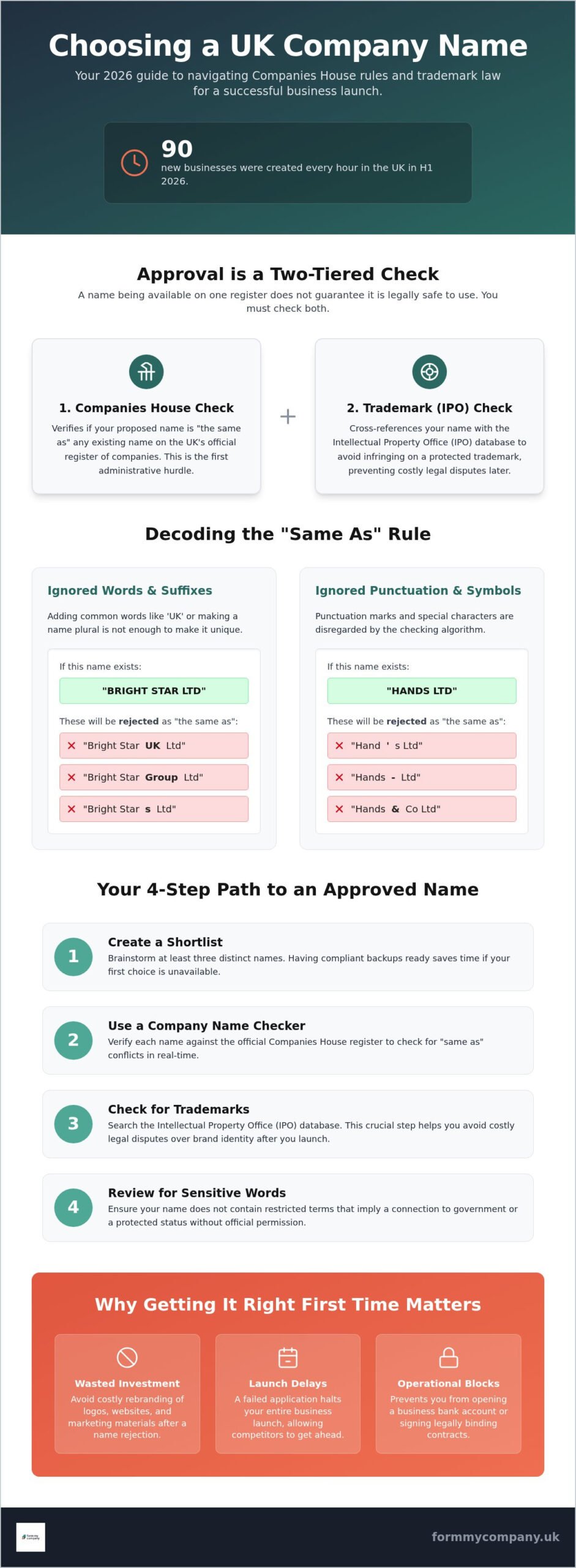
The “Same As” rule is the most frequent cause of application failure at Companies House. When you use a company name checker, you must look beyond exact character matches. The Registrar considers two names identical if the only difference consists of “ignored” words or characters. For instance, “Coffee & Cakes Ltd” is legally the same as “Coffee and Cakes Limited”. The system is designed to prevent entities from operating with names that are visually or phonetically indistinguishable from those already on the register.
The algorithm filters out specific suffixes and conjunctions to ensure the register remains distinct. Common terms like “Services”, “UK”, “Group”, and “International” are often disregarded when comparing names. If “Bright Star Ltd” already exists, you cannot register “Bright Star UK Ltd” or “Bright Star Group Ltd” because they are effectively the same in the eyes of the law. Under 2026 regulations, pluralisation is also treated strictly; adding an “s” to the end of a word rarely provides enough differentiation to pass the check.
Punctuation and Special Characters
The search algorithm treats most punctuation as invisible. Adding an apostrophe, hyphen, or asterisk will not create the legal separation required for a successful filing. If you search the official UK government tool, you will see that “Hand’s Ltd” and “Hands Ltd” are treated as duplicates. To ensure your application is accepted, you must focus on substantive word changes rather than symbolic tweaks.
Characters that the algorithm ignores include:
- Full stops, commas, and colons
- Asterisks, hyphens, and apostrophes
- Currency symbols like £ or $
- Mathematical symbols such as plus or equal signs
Simply changing “Blue-Sky” to “Blue Sky” or “Blue*Sky” will result in an immediate rejection. Your chosen identity must be distinct in its core vocabulary to survive the screening process.
The “Too Like” Rule and Potential Objections
Even if your name passes the “Same As” test, it could still fall foul of the “Too Like” rule. This is a more subjective standard where a name is deemed so similar to another that it could mislead the public. The Secretary of State has the power to direct you to change your name if an objection is raised and upheld. This usually happens if the names are phonetically identical or if the difference is so slight that a customer wouldn’t notice.
Existing companies have a 12-month window from your date of incorporation to object to your name. If their claim is successful, you’ll be forced to rebrand, which involves updating every aspect of your business from legal documents to marketing assets. To avoid this costly disruption, it’s wise to check your name availability against phonetic similarities before you commit to any branding. Choosing a truly unique name provides a clear identity that belongs solely to your business and protects you from future legal challenges.
Trademarks vs. Companies House: The Two-Tiered Check
A “pass” from a company name checker is only half the battle. Many founders mistakenly assume that successful registration with Companies House grants them exclusive ownership of their brand. This is a dangerous myth. Whilst Companies House manages the register of legal entities, the Intellectual Property Office (IPO) governs the protection of brand names and logos. You must understand the distinction between a company name vs. trademark to avoid costly legal disputes that could end your venture before it begins.
Trademark infringement carries severe consequences. Even if you hold a valid certificate of incorporation, a trademark owner can sue you for infringement if your name is too similar to theirs. This often results in a court injunction, forcing you to cease trading immediately and rebrand your entire operation. Performing both checks during the planning phase is the only way to safeguard your investment and your reputation.
Checking the UK Trademark Register
Sensitive Words and Expressions
Beyond trademarks, certain words require explicit pre-approval before they can be used in a business name. These “sensitive words” often imply national importance, royal patronage, or a specific professional status. Using them without permission will result in your application being rejected by the Registrar.
Categories requiring approval include:
- Words suggesting royal connections: “King”, “Queen”, “Prince”, or “Royal”.
- Words implying national authority: “British”, “English”, “National”, or “United Kingdom”.
- Professional designations: “Institute”, “Chartered”, “Apothecary”, or “Health Centre”.
To use these terms, you must obtain a “letter of non-objection” from the relevant governing body, such as the Cabinet Office or a professional regulator. Form My Company specialises in navigating these complex administrative hurdles. Whether you choose our Digital Package or our more comprehensive Entrepreneurs Choice Package, we help you identify these red flags early. We guide you through the process of securing the necessary permissions, ensuring your formation isn’t stalled by avoidable regulatory queries.
How to Use a Company Name Checker Effectively: A Step-by-Step Guide
Securing a compliant business name requires more than a single search. To build a resilient brand, you must follow a methodical workflow that balances your creative vision with strict regulatory requirements. Using a company name checker effectively means treating it as a diagnostic tool rather than a simple search bar. Follow these five steps to ensure your chosen identity is ready for registration.
- Step 1: Brainstorm a shortlist. Never rely on a single option. Prepare at least three distinct names to avoid disappointment if your primary choice is rejected or already taken.
- Step 2: Run an initial search. Use our integrated company name checker to get instant feedback on exact matches. This is your first filter to remove obvious duplicates.
- Step 3: Perform a “too like” search. Don’t just search for your exact phrase. Try variations, different spellings, and phonetic equivalents to see if anything similar appears.
- Step 4: Verify external status. Check the UK Trademark Register and domain availability simultaneously. A name that is free at Companies House might be legally protected elsewhere.
- Step 5: Identify sensitive words. If your name includes terms like “Association” or “Group”, prepare your justification or seek the necessary “letter of non-objection” before submitting.
Refining Your Search Results
When you receive “No results found”, you’ve cleared the first hurdle. However, if the tool returns a list of similar companies, you must evaluate the risk. If a name is “same as” due to ignored characters, you’ll need to modify it substantively. Instead of adding a hyphen, try adding a unique prefix or a descriptive word that changes the core vocabulary of the name.
You should also check the “Dissolved” register. Whilst a name from a dissolved company might technically be available, it carries the baggage of that previous entity’s reputation. If a business with your proposed name was struck off for bad debt or poor conduct, you don’t want your new venture to be associated with that history when potential clients search for you online.
Digital Presence and Social Media
A business name is only as strong as its digital reach. Before you commit to a legal name, check for available handles on LinkedIn, Instagram, and X. Consistent branding across these platforms is vital for modern growth. You should also secure the matching .co.uk or .com domain at the same moment you register the company to prevent “domain squatters” from buying it once your incorporation becomes public record.
To ensure you haven’t missed any vital launch requirements, consult our Essential Pre-Submission Checklist. This guide provides a full list of pre-launch steps to help you organise your filing without errors. Ready to secure your business identity? Search our company name checker now to begin your formation and take the first step toward your new venture.
Securing Your Name and Finalising Your UK Formation
Successfully using a company name checker is a significant win, but it’s only the start of the formation sequence. Our platform integrates this search tool directly into the registration flow to eliminate manual entry errors. When you select a name through our Digital Package, the data carries over automatically, ensuring that the identity you’ve verified is the exact one submitted to the Registrar. This seamless transition removes the friction often found in traditional administrative processes, allowing you to move from idea to incorporation in minutes.
Privacy is a priority for modern founders. By using our Registered Office Address Service, you ensure your home address remains off the public register from day one. This service provides a professional corporate front whilst protecting your personal space from unwanted solicitations. For those seeking long-term support, our Entrepreneurs Choice Package handles the ongoing administrative burden after the name is secured. It’s designed for business owners who value their time, allowing you to focus on growth whilst we manage the essential filings and compliance requirements.
Why Form Through an Agent Like Form My Company?
We act as a final safety net for your new venture. Our team performs an expert review of every application before it reaches Companies House, catching the minor errors that often lead to rejection. This is particularly valuable for foreign nationals or those seeking Company Formation for Europeans, where specific regulatory nuances can often cause delays. Beyond the name, we provide a VAT Registration Service and Virtual Office Services to ensure your firm is fully operational and professionalised from its first hour. We strip away the intimidation factor of legal paperwork, acting as a reliable facilitator for your entrepreneurial journey.
Next Steps After Name Approval
Once the name is secured, you’ll need to appoint your directors and Persons with Significant Control (PSCs). You’ll also need to select the correct Standard Industrial Classification (SIC) codes to describe your business activities to the government. For those who need to move fast, our Digital & Print Package offers rapid market entry, providing both your electronic certificates and high-quality physical copies for your corporate records. This ensures you have everything required to open a business bank account and begin trading immediately. If you’re still weighing your structural options, our guide to UK company registration and the best formation paths in 2026 can help you choose the right structure before you proceed.
Ready to start? Check your company name availability now!
Launch Your UK Business with Confidence
Choosing a unique identity is the foundation of your brand’s future success. You now understand that a compliant registration requires more than just a creative spark; it demands a clear grasp of “same as” rules and a thorough cross-reference of the UK trademark register. By using a robust company name checker during your planning phase, you’ve already mitigated the primary risks that lead to application rejection. This level of preparation ensures your transition from a concept to a legal entity is both efficient and legally sound.
As an official UK formation agent, Form My Company is here to streamline the final hurdles of your incorporation. We offer privacy-first Registered Office services to keep your personal data secure, alongside specialist support for foreign nationals navigating the UK marketplace. Our packages are designed to provide a professional front from the very first hour of trading. Register your UK company today with Form My Company and turn your vision into a reality. Your new venture deserves the strongest possible start; let’s build it on a foundation of accuracy and compliance.
Frequently Asked Questions
Can I use a name that is similar to an existing company?
You cannot use a name that is considered “the same as” an existing entity on the register. Companies House ignores certain words like “Limited” or “and” and punctuation when comparing names. If your choice is too similar, the original company has a 12-month window to object. It’s safer to choose a distinct identity to avoid being directed to change it later by the Secretary of State.
What happens if Companies House rejects my chosen name?
If your application is rejected, you’ll need to submit a fresh application with a new name. Rejection usually happens due to “same as” conflicts or sensitive word violations. Whilst you’ll need to pay the filing fee again, using a company name checker beforehand significantly reduces this risk. Our team reviews every submission to catch these errors before they reach the registrar, ensuring your formation remains on track.
Do I need to check for trademarks as well as company names?
Yes, checking the UK Trademark Register is a separate and essential step. Companies House only ensures your name is unique on the business register; they don’t protect you from trademark infringement claims. If your name is similar to a protected brand in your sector, you could face legal action. Always cross-reference with the Intellectual Property Office to safeguard your long-term brand identity and corporate reputation.
Are there any words I am strictly prohibited from using in my company name?
You are prohibited from using offensive language or names that suggest a connection to the government or Royal Family without permission. Certain words are considered sensitive and require a letter of non-objection. These include:
- Words suggesting national status like “British”
- Royal references such as “King”
- Professional designations like “Institute”
The registrar can also reject names that could facilitate fraudulent activity or mislead the public.
How long does it take for a name to be officially registered?
Most digital applications are processed within 24 hours. If you need immediate results, you can use an expedited service for a higher fee to secure same-day incorporation. Once the registrar approves your application, your name is officially protected on the Index of Company Names. Our Digital Package ensures your data is transmitted securely and quickly to minimise any potential delays in your market entry and launch.
Can I change my company name after I have already incorporated?
You can change your company name at any time by passing a special resolution and notifying Companies House. You’ll need to file a “Notice of change of name by resolution” and pay the required digital filing fee. Once approved, the registrar will issue a Certificate of Incorporation on Change of Name. Remember to update your website, stationery, and business bank account details immediately to reflect the change.
Does a company name checker also check for available website domains?
A standard company name checker focuses on the official Companies House register. However, it’s vital to check domain availability independently for .co.uk or .com extensions. Securing a matching domain at the point of incorporation prevents others from buying it once your business details become public. We recommend checking social media handles simultaneously to ensure your brand remains consistent across all digital platforms and marketing channels.
What is the difference between a business name and a registered company name?
A registered company name is the official legal title of your entity as it appears on the register at Companies House. A business name, or “trading name”, is what you use for daily operations and branding. Whilst you can trade under a different name, you must still display your registered company name on all official documents, invoices, and your website to comply with UK transparency laws.