
Filing Persons with Significant Control for complex corporate hierarchies requires identifying ultimate beneficial owners across multi-tiered entities, mapping voting rights, and submitting accurate statutory data to Companies House within rigid regulatory compliance deadlines.
Navigating multi-layered ownership networks involves dissecting intricate corporate ownership chains. Regulatory mandates require corporate entities to maintain transparency regarding ultimate beneficial owners. Hidden voting rights and layered shareholdings obscure true control. Businesses operate across diverse jurisdictions, which complicates statutory disclosure obligations. Form My Company manages these statutory intricacies through specialized corporate compliance solutions.
How Do You Identify Ultimate Beneficial Owners Across Multi-Tiered Corporate Hierarchies?
Identifying ultimate beneficial owners across multi-tiered corporate hierarchies requires tracing share ownership percentages, tracking voting rights through intermediary holding companies, and isolating individuals who exercise significant influence or control.
Corporate structures often feature holding companies, subsidiary networks, and offshore trusts. Tracing ownership demands meticulous examination of share registers across every corporate layer. When a parent company holds more than 25% of shares in a subsidiary, the parent entity often qualifies as a registrable relevant legal entity. Individuals owning more than 25% of the ultimate parent company qualify as Persons with Significant Control over the entire operational group. Statutory thresholds dictate mandatory disclosure whenever ownership crosses specific numerical boundaries.
Corporate layers obscure the identity of natural persons exercising ultimate control. Shareholder agreements alter voting rights independently of nominal share distribution percentages. Voting rights dictate control regardless of direct equity ownership shares. Intermediary entities complicate compliance because corporate registration rules require uninterrupted transparency from the operating company up to the ultimate individual owner. Regulatory authorities enforce strict penalties for opaque corporate registries. Form My Company assists businesses in untangling multi-tiered ownership webs to ensure accurate compliance.
What Are the Compliance Challenges of Multi-Tiered Ownership Networks?
Compliance challenges of multi-tiered ownership networks involve reconciling conflicting international corporate laws, resolving missing beneficial ownership data, and meeting strict statutory filing deadlines enforced by regulatory authorities.
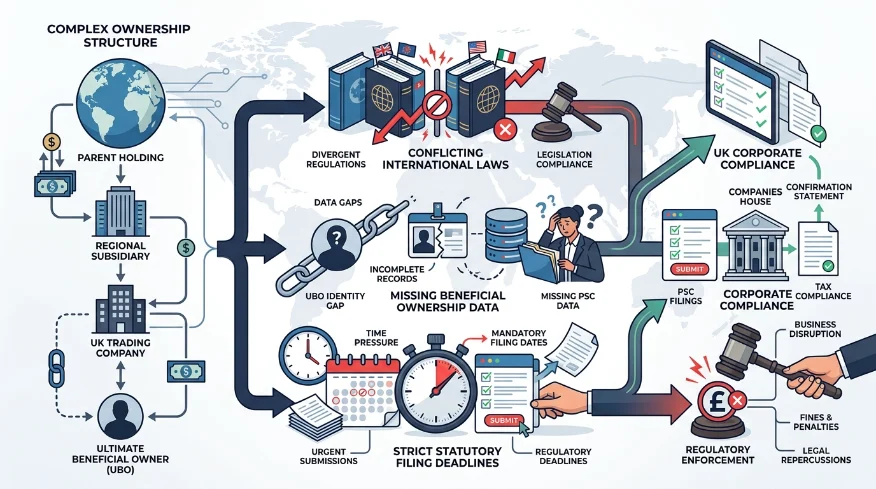
Multi-jurisdictional operations introduce conflicting disclosure requirements across different geographic regions. Foreign holding companies operate under distinct legal frameworks that obscure beneficial ownership transparency. When foreign subsidiaries conceal ownership details, UK operating entities face severe compliance bottlenecks. Directors must obtain accurate information despite cross-border legal barriers.
Data gaps disrupt statutory register maintenance and trigger mandatory investigation notices. Companies issue formal notices under statutory powers to unearth hidden ownership details from uncooperative shareholders. Shareholders face voting restrictions if they fail to respond to statutory information requests within statutory timeframes. Administrative burdens overwhelm internal corporate secretarial teams. Accurate documentation protects corporate governance integrity and avoids severe financial penalties.
How Does Form My Company Streamline PSC Filings for Complex Structures?
Form My Company streamlines Persons with Significant Control filings for complex structures by executing meticulous ownership audits, automating Companies House submissions, and applying professional compliance frameworks.
Corporate secretarial professionals manage complex statutory filings through dedicated administrative portals. Form My Company provides comprehensive corporate support via our specialized PSC Register management service. Corporate structures require tailored filing strategies because standard templates fail to capture nuanced multi-tiered voting rights. Experts analyze corporate constitutions and shareholder agreements to determine precise control thresholds.
Accurate filings prevent administrative rejections from Companies House. Automated validation checks eliminate clerical errors before statutory submission. Businesses facing intricate ownership webs benefit from structured guidance outlined in our guide on how to map PSCs across a group company structure. Clear procedural mapping reduces compliance risks and establishes transparent governance records.
Corporate transparency remains a legal imperative for all UK registered entities. Navigating complex ownership structures demands precision, adherence to statutory thresholds, and deep regulatory expertise. Organizations operating multi-tiered hierarchies minimize compliance friction by leveraging professional corporate secretarial assistance. Companies pursuing seamless administrative execution utilize commercial strategies detailed in our analysis of how do you identify a psc in a complex ownership structure. Form My Company delivers reliable administrative infrastructure to secure absolute regulatory compliance.
Explore our PSC Register guide,
How Can You Suppress a PSC Home Address With Form My Company?
How Can You Suppress a PSC Home Address With Form My Company?
Frequently Asked Questions
What is a PSC register and who needs to maintain one?
A PSC register is a statutory document that UK companies must maintain to record details of individuals with significant control or influence. Every UK limited company, Societas Europaea, and limited liability partnership must keep this register updated and file the data with Companies House. Form My Company assists businesses in setting up and managing compliant PSC registers to meet statutory obligations.
How do you identify a Person with Significant Control in a company?
An individual qualifies as a PSC if they meet at least one of five specific conditions, such as holding more than 25% of shares or voting rights, or exercising significant influence over the company. When dealing with complex ownership structures, tracing these thresholds requires analyzing multi-layered corporate hierarchies and shareholder agreements. Form My Company provides specialized guidance to help businesses accurately identify and document all qualifying beneficial owners.
What are the filing requirements for PSC details with Companies House?
Companies must submit initial PSC information upon incorporation and update their public register within 14 days of any changes occurring. Following these updates, businesses are required to file the revised PSC data with Companies House within a further 14 days. Form My Company streamlines this reporting process to ensure corporate filings remain accurate and meet strict regulatory deadlines.
Can a corporate entity be listed as a PSC on the UK register?
A corporate entity can only be listed on the PSC register if it is a Relevant Legal Entity that keeps its own disclosure-compliant register or trades on specific international stock exchanges. If an entity sits below an RLE in a corporate chain, companies must look further up the hierarchy to identify the ultimate individual beneficial owner. Form My Company helps organizations navigate these intricate multi-tiered ownership rules to maintain compliance.
What are the penalties for failing to maintain a accurate PSC register?
Failing to keep an accurate PSC register or neglecting to provide required information to Companies House constitutes a criminal offense under UK law. Defaulting companies and their officers face severe financial fines, and persistent non-compliance can lead to prosecution or administrative intervention. Form My Company offers professional support to mitigate these risks and ensure complete statutory accuracy.