
Why should the excitement of launching a new venture be buried under a mountain of Companies House bureaucracy and complex legal jargon? You’ve likely spent weeks refining your business idea, only to find yourself stalled by questions about identity verification or the risk of exposing your private home address on public records. It’s frustrating to feel like a simple administrative error could derail your progress before you’ve even made your first sale. This complete guide to Form My Company is designed to strip away that intimidation and put you back in the driving seat.
We’ll show you exactly how to master the UK company formation process using professional registration services that prioritise speed and accuracy. You’ll learn how to select the ideal legal structure, whether that is a Ltd, LLP, or PLC, whilst ensuring your business remains fully compliant with the latest 2026 regulations. We’ll also explore how to maintain a professional image with a registered office address, allowing you to focus on growth instead of paperwork. By the end of this walkthrough, you’ll have a clear, fast-track path to turning your entrepreneurial vision into a legally recognised reality.
Key Takeaways
- Identify the most advantageous legal structure for your venture by comparing the specific 2026 requirements for Limited Companies, LLPs, and PLCs.
- Master the entire incorporation journey with this complete guide to Form My Company, ensuring every step from name compliance to digital filing is handled accurately.
- Protect your home address privacy by utilising professional Registered Office services and specific packages designed to keep personal data off the public register.
- Accelerate your launch by choosing tailored formation packages that bundle essential requirements like VAT registration and digital document delivery.
- Understand your ongoing obligations, such as the mandatory annual confirmation statement, to maintain a legally compliant and healthy business profile.
Understanding Form My Company: A Professional Gateway to Incorporation
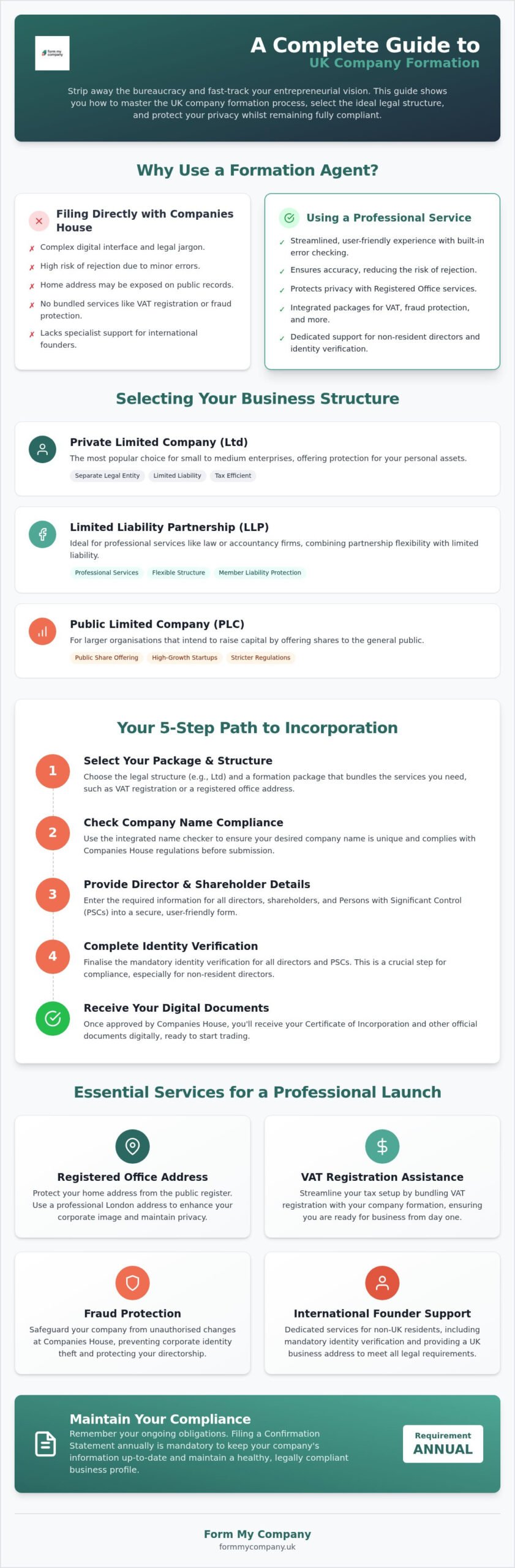
Form My Company acts as a specialised intermediary between you and the official registrar. It simplifies the often-daunting digital interface of Companies House, ensuring your data is formatted correctly before submission. This complete guide to Form My Company highlights how the platform transforms a complex legal requirement into a streamlined, user-friendly experience. It isn’t just about filing papers; it’s about accuracy. By using a registered agent, you reduce the risk of rejection due to minor administrative oversights.
The value proposition centres on speed and completeness. Whether you’re a UK resident launching a side hustle or part of a professional partnership, the platform provides bundled support that goes beyond basic incorporation. You can integrate VAT registration assistance or secure fraud protection from the outset. This holistic approach ensures your business starts on a firm legal footing without the need to manage multiple disparate service providers. It saves time and prevents the headache of retroactively fixing filing mistakes.
The platform supports a diverse range of legal entities to suit your specific goals. You can choose from:
- Private Limited Companies (Ltd): The most common choice for small to medium enterprises.
- Limited Liability Partnerships (LLP): Ideal for professional services like law or accountancy firms.
- Public Limited Companies (PLC): For larger organisations intending to offer shares to the public.
- Companies Limited by Guarantee: Often used by non-profits and charities.
Why Use a Formation Agent Instead of Filing Directly?
Filing directly can be a minefield for the uninitiated. Form My Company uses built-in error-checking mechanisms to catch inconsistencies before they reach the registrar. You gain access to specialist options like the Privacy Package or the Fully Inclusive Package, which aren’t available through standard government channels. A centralised digital dashboard allows you to manage multiple entities with ease, keeping your statutory documents organised and accessible at all times.
Tailored Solutions for International Founders
The UK remains a premier destination for global investment. Form My Company offers dedicated support for European and foreign nationals who want to establish a British presence. Since November 2025, strict identity verification is mandatory for all directors. The identity verification service simplifies this for those based overseas. Additionally, non-residents must provide a UK-based business address to comply with local laws. This ensures your international venture meets every regulatory hurdle with confidence.
Selecting Your Business Structure: Limited Company, LLP, or PLC?
Choosing the right legal structure is your first strategic hurdle. It dictates how you pay tax, how much personal risk you carry, and how investors perceive your brand. This complete guide to Form My Company provides the clarity needed to make an informed choice before you register your company. Each structure has distinct advantages depending on whether you are a solo freelancer, a professional partnership, or a high-growth startup aiming for a public listing.
The Limited Company: The Standard for Modern Entrepreneurs
The Private Limited Company (Ltd) remains the most popular choice for modern entrepreneurs. Its main draw is its separate legal personality. This means the business is its own entity; your personal assets are protected if the business faces debt. It is the standard structure for those selecting the Digital or Entrepreneurs Choice Packages. To get started, you only need one director and one shareholder, though you must also identify any Persons with Significant Control (PSCs). This structure is highly efficient for tax planning and is easily recognised by UK banks and lenders.
Professional Partnerships and LLPs
Professional partnerships often favour the Limited Liability Partnership (LLP). This structure offers the protection of limited liability whilst retaining the internal management flexibility of a traditional partnership. It is a favourite amongst solicitors, consultants, and accountants because profits are distributed directly to members. For foreign nationals, this can be a complex area to navigate regarding tax residency and compliance. You must ensure all members complete the necessary Identity Verification Service Director Or Psc to meet current 2026 standards. This ensures the partnership remains transparent and legally sound from day one.
Scaling Up: When to Consider a PLC
Scaling to a Public Limited Company (PLC) is a move reserved for large-scale ventures. It carries significant prestige but comes with higher regulatory oversight and transparency requirements. In 2026, a PLC must have at least two directors and a qualified Company Secretary to manage compliance. You also need a minimum allotted share capital of £50,000, with at least 25% paid up before you can obtain a trading certificate. While the administrative burden is higher, the ability to raise capital through public share sales is a powerful advantage for ambitious firms.
If your goals are non-commercial, such as running a sports club or a charity, the “Limited by Guarantee” option is your best fit. Instead of shareholders, you have members who act as guarantors, ensuring the organisation’s focus remains on its social or community purpose rather than profit distribution. You can explore our various formation packages to see which matches your chosen structure and business goals.
The Step-by-Step Formation Process: From Name Search to Incorporation
Transitioning from a concept to a legal entity requires a methodical approach. This complete guide to Form My Company breaks down the technical barriers, allowing you to focus on your business strategy rather than administrative hurdles. The process is designed to be sequential and intuitive, ensuring no critical data point is missed before your application reaches the registrar. It turns a bureaucratic requirement into a manageable task that you can complete in minutes.
Your journey begins with the company name checker. This tool is essential for verifying that your proposed name is unique and compliant with UK regulations. Once you’ve secured your name, you’ll select a formation package. For most, the Digital Package offers the fastest route to market, whilst the Digital & Print Package provides physical certificates for those who prefer tangible records. After choosing your bundle, you’ll enter director and shareholder details through a secure portal, followed by a final review before submission.
Choosing Your Company Name Wisely
A business name is more than just a label; it’s a vital part of your brand’s psychological impact. However, creativity must be balanced with compliance. You must avoid sensitive words or expressions that imply government connection or professional status without the necessary permissions. Your name cannot be “too like” an existing firm on the register. Even subtle similarities can lead to objections or legal challenges later. For a deeper dive into the regulatory landscape, consult this Official government guide to setting up a limited company to understand the full scope of naming restrictions.
Essential Information Required for Submission
Accuracy at the data entry stage is paramount to avoid delays. You’ll need to provide full names, residential addresses, and service addresses for all directors. You must also supply details for any Persons with Significant Control (PSC). Maintaining an accurate Psc Register is a statutory requirement that ensures transparency regarding who truly owns or controls the business.
During the process, you will adopt the Memorandum and Articles of Association. These are the constitutional documents that define how the company is governed and the relationship between shareholders. Most entrepreneurs opt for model articles for simplicity, but bespoke versions are available for more complex setups. Once these details are confirmed, the system performs a final sweep for errors; it then transmits your application directly to Companies House for approval. This complete guide to Form My Company ensures you are prepared for every field in the application, reducing the risk of a rejected submission.
Beyond Registration: Protecting Privacy and Enhancing Corporate Image
Incorporation is a public act. Once your application is approved, your company details become part of a searchable database accessible to anyone. This complete guide to Form My Company explores how to manage that visibility to protect your personal life. Using a residential address as your registered office exposes your front door to the world. It often leads to a flood of unsolicited junk mail and, more importantly, removes the layer of safety every founder deserves. The Privacy Package solves this by substituting your home details with a professional location on the public register from the very start.
Establishing a professional image goes beyond just hiding a home address. It is about how your brand is perceived by banks, suppliers, and potential clients. A prestigious footprint suggests stability and growth, even if you are currently operating as a solo founder from a spare room. By decoupling your physical location from your corporate identity, you gain the freedom to work from anywhere whilst maintaining a consistent, high-end presence in the UK market.
The Registered Office Address Service
Every UK business must have a physical address for official correspondence. A professional Business Address service ensures you meet this legal mandate without compromising your residential privacy. It acts as a vital filter for your organisation. Official mail from HMRC or Companies House is received at a professional centre and forwarded to you, ensuring you never miss a critical filing deadline. This service is a standard requirement for non-resident directors who must provide a UK-based point of contact by law.
Virtual Offices and Call Answering
Perception is reality in the business world. Utilising Virtual Offices provides a prestigious footprint that builds immediate trust with your target audience. For solo entrepreneurs, this image is often bolstered by professional call answering services. It ensures every enquiry is greeted with a high level of authority, making your operation feel established and reliable. You aren’t just securing a postal point; you’re investing in a corporate reputation that opens doors to larger contracts and better partnerships.
Professional Spaces for Important Milestones
There comes a point where a digital-only presence isn’t enough for your growing venture. Important milestones, such as pitching to an investor or signing a major client contract, require a physical setting that matches your ambition. Moving your interactions to professional Meeting Rooms or high-spec Boardrooms elevates the entire experience. These environments provide the privacy, technology, and professional atmosphere needed for successful outcomes, far removed from the distractions of a home office.
Secure your professional image and personal privacy today by selecting the Privacy Package to keep your home details off the public record.
Maintaining Compliance: Post-Incorporation Support and Services
Success is a marathon, not a sprint. Whilst the initial setup is a major milestone, keeping your business in good standing requires ongoing attention to statutory duties. This complete guide to Form My Company ensures you don’t fall into common traps once the excitement of your launch fades. Companies House requires active management of your corporate record to maintain transparency and legality. Neglecting these duties can lead to financial penalties or, in extreme cases, the removal of your company from the register entirely.
Confirmation Statements and Secretarial Support
Every 12 months, you must verify that the information held by the registrar is accurate. This is known as the Annual Confirmation Statement. It isn’t just a suggestion; failure to File A Confirmation Statement is a criminal offence. If you miss the deadline, which is 14 days after your review period ends, your company risks being struck off. Many founders choose to use a company secretarial service to manage their statutory registers. This professional oversight ensures filings are always accurate and submitted well before the deadline.
VAT and Financial Administration
As your turnover grows, your financial obligations will evolve. In 2026, the VAT registration threshold stands at £90,000 based on a rolling 12-month period. You must monitor your income monthly to ensure you don’t cross this limit unexpectedly. Proactive Vat Registration Assistance helps you transition smoothly into this tax regime without disrupting your cash flow. If you plan to hire staff, early PAYE registration assistance is equally vital. It ensures your payroll is compliant and your tax obligations as an employer are met from the first payday.
Proving Legitimacy with Official Certificates
External partners often require formal proof of your company’s health. Banks or lenders may ask for a Certificate Of Good Standing before approving a business loan or opening a high-level corporate account. This document confirms that your company has been in continuous existence and is up to date with all filings. For those expanding internationally, apostilled documents are essential. These are legalised versions of your papers, recognised by foreign governments for opening overseas branches or signing international trade agreements.
Finally, consider implementing fraud protection to monitor for unauthorised changes to your company records. This service alerts you immediately if someone attempts to change your directors or registered office address without your permission. Staying compliant is a continuous process, but with the right support, it becomes a routine part of your business growth strategy.
Launch Your UK Business with Confidence
You now have a clear roadmap to navigate the complexities of 2026 UK company registration. From selecting the most tax-efficient legal structure to ensuring your home address remains private, you’re equipped to make decisions that protect your interests and enhance your corporate image. This Complete guide to Form My Company has highlighted how professional support strips away the administrative burden, allowing you to focus on what truly matters: building your brand.
Whether you’re a UK resident or a non-resident director, maintaining compliance doesn’t have to be a source of stress. With specialist packages for every business stage and comprehensive address solutions, you can guarantee your venture starts on a firm legal footing. Don’t let bureaucracy slow your momentum. Take the first step toward your entrepreneurial goals and start your UK company formation today with Form My Company. Your journey from a promising idea to a fully incorporated entity is just a few clicks away. We’re ready to help you grow.
Frequently Asked Questions
How long does it take to form a company with Form My Company?
Most companies are formed within 24 working hours, depending on Companies House processing speeds. This Complete guide to Form My Company clarifies that digital submissions are significantly faster than traditional paper filings. Once you submit your details through our secure portal, we perform an immediate error check before transmission. You’ll receive an email notification the moment the registrar approves your application, allowing you to start trading almost immediately.
Can I register a UK company if I am not a UK resident?
You can absolutely register a UK company as a non-resident. We offer specialist services for foreign and European nationals that address specific requirements like mandatory identity verification. Whilst you don’t need to live in the UK, you must provide a UK-based registered office address. Our packages for international founders bundle this address service with the necessary digital filings to ensure your business meets all local regulatory standards from overseas.
What is the difference between the Digital and the Fully Inclusive package?
The Digital Package is our most streamlined option, providing essential electronic documents for a rapid launch. In contrast, the Fully Inclusive Package offers a more comprehensive suite of services for established growth. This includes physical print copies of your certificates, a registered office address, and VAT registration assistance. It’s designed for entrepreneurs who want a complete compliance shield and professional footprint from the very first day of their incorporation.
Do I need a separate business address if I work from home?
You aren’t legally required to have a separate business address, but it is highly recommended for privacy and professionalism. Using your home address means your private details appear on the public register, which is visible to anyone. Our Registered Office Address Service keeps your residential data off the public record. It also ensures your home isn’t deluged with unsolicited marketing mail, whilst projecting a more established corporate image to your clients.
What documents will I receive once my company is incorporated?
Once incorporated, you’ll receive a Certificate of Incorporation, the Memorandum and Articles of Association, and Share Certificates for each shareholder. These documents prove your company’s legal existence and define its internal governance. Depending on your chosen package, these are delivered digitally as PDFs or as high-quality printed versions. You’ll need these essential records to open a business bank account or register for various tax schemes with HMRC.
Can Form My Company help with VAT registration after my business is formed?
Yes, we provide a dedicated VAT Registration Service to help your business manage this transition. This Complete guide to Form My Company has already noted the importance of monitoring your turnover against the £90,000 threshold. Our team handles the application process on your behalf, ensuring your data is accurate and submitted correctly to HMRC. This prevents common administrative delays and ensures you can start reclaiming VAT on business expenses without unnecessary hurdles.
What is a Confirmation Statement and when do I need to file it?
A Confirmation Statement is a mandatory annual filing that verifies your company’s current details on the public register. You must file it at least once every 12 months, even if no changes have occurred within your business. The deadline is 14 days after the end of your review period. Failure to submit this document is a criminal offence that can lead to your company being struck off the register by Companies House.
Is it possible to change my company directors after incorporation?
It is possible to change your company directors at any time after incorporation. You can appoint new directors or manage resignations through our digital dashboard, which synchronises directly with the registrar. Every change must be reported to Companies House within 14 days to ensure your public record remains accurate. We offer specific services for director appointments and resignations to help you manage these transitions whilst staying fully compliant with the Companies Act.