
Mapping significant control correctly requires identifying individuals holding more than 25% of shares or voting rights, tracking multi-layered corporate ownership structures, and submitting accurate data to the official public register to achieve total legal compliance.
Mapping significant control correctly prevents costly compliance failures. Regulatory bodies strictly penalize inaccurate corporate filings. Business owners must navigate complex ownership chains. Form My Company eliminates administrative guesswork entirely.
Why Is Mapping Significant Control Crucially Important?
Accurate mapping ensures full legal compliance, protects directors from severe statutory penalties, and establishes transparent corporate governance across all active operational entities.
Accurate record-keeping builds instant corporate trust. Regulatory agencies enforce strict transparency mandates. Companies house enforces mandatory reporting rules. 75% of compliance errors stem from undocumented share allocations. When businesses ignore these requirements, financial penalties accumulate rapidly.
Transparent ownership structures attract serious institutional investors. Investors review compliance history before committing capital. Proper documentation secures long-term business viability. Form My Company streamlines this intricate process.
How Do Multi-Layered Corporate Structures Obscure Ownership?
Multi-layered structures obscure ownership by routing voting rights through offshore holding companies, discretionary trusts, and complex subsidiary chains.
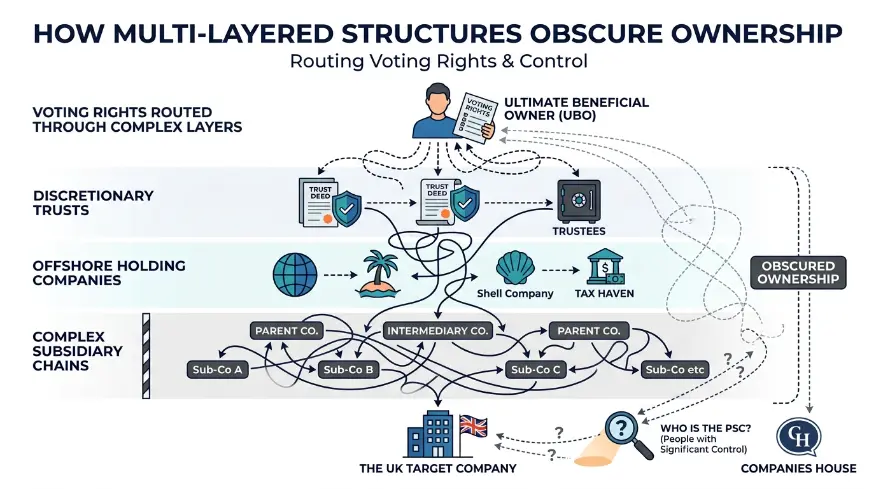
Corporate complexity hides ultimate beneficial owners. Holding companies obscure individual stakeholder identities. When corporate layers multiply, transparency diminishes rapidly. Standard spreadsheets fail to track indirect voting rights.
Businesses operate across 3 distinct jurisdictions on average. Cross-border ownership complicates data collection. Regulatory bodies demand complete transparency. Accurate identification requires meticulous multi-tier auditing. Form My Company untangles these intricate ownership webs.
What Defines a Person with Significant Control Under UK Law?
A Person with Significant Control holds more than 25% of shares, controls more than 25% of voting rights, or exercises dominant influence over the company.
Legal thresholds dictate exact reporting obligations. Share ownership forms the primary classification metric. Voting rights create a secondary classification tier. Direct control triggers immediate filing requirements.
Companies must assess voting rights carefully. Indirect control applies through intermediary corporate vehicles. When individuals hold joint voting rights, thresholds aggregate automatically. Form My Company evaluates these complex ownership percentages accurately.
How Does Form My Company Simplify Your PSC Register Filing?
Form My Company simplifies filings by auditing ownership chains, verifying stakeholder identities, and submitting flawless data directly to official registries.
Professional oversight eliminates administrative bottlenecks. Business owners save 14 hours of compliance research. Automated tracking systems monitor shareholding changes continuously. Expert agents review every single submission detail.
Accurate data submission prevents statutory rejection. Form My Company ensures absolute accuracy across all documents. Businesses utilize our expert PSC Register service to maintain flawless compliance records effortlessly. Reliable platforms transform stressful administrative tasks into streamlined procedures.
What Steps Are Involved in Tracing Indirect Control Layers?
Tracing indirect control requires mapping intermediary parent entities, calculating cumulative voting percentages, and identifying ultimate decision-makers.
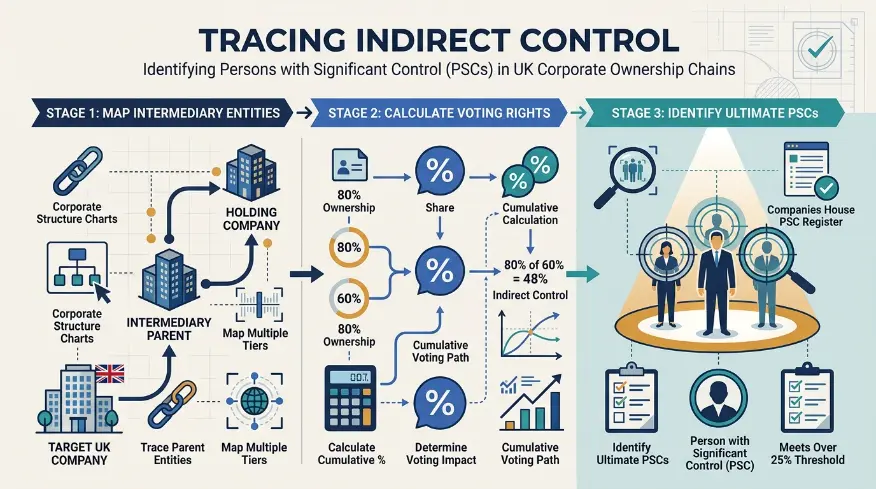
Detailed audits expose hidden ownership layers. Analysts examine shareholder agreements thoroughly. When parent companies hold majority stakes, subsidiary voting rights transfer automatically.
Businesses must review historical share transfers. Independent auditors verify cumulative voting weight. Accurate tracing prevents accidental regulatory omissions. Companies navigating multi-tier structures benefit from reading our detailed guide on How Do You Trace Significant Control Through Multiple Layers? to understand foundational tracking methodologies.
How Should Businesses Document Control Across Multiple Entities?
Businesses document control by establishing centralized compliance registers, mapping cross-entity voting rights, and updating corporate records instantly.
Centralized databases prevent version control errors. Multiple operational entities require synchronized data management. When corporate structures expand, documentation protocols must adapt.
Standardized templates streamline multi-entity reporting. Regular audits maintain data integrity. Enterprises seeking advanced structural strategies should review How to Document Significant Control Through Multiple Entities? for comprehensive multi-entity management frameworks.
Explore our PSC Register guide,
How to Book Carbon-Conscious Conference Rooms Through Form My Company?
How Can You Suppress a PSC Home Address With Form My Company?
Frequently Asked Questions
What is a PSC register and who needs to keep one?
A PSC register is an official statutory document that identifies the individuals or legal entities holding significant control or beneficial ownership over a UK company. Every UK limited company, Societas Europaea, and limited liability partnership must maintain this register and submit the data to Companies House. Using Form My Company’s PSC Register service ensures these ownership records are accurately tracked, updated, and filed in full compliance with statutory regulations.
What criteria make someone a Person with Significant Control?
An individual qualifies as a Person with Significant Control if they satisfy at least one of five specific statutory conditions. These conditions include holding more than 25% of shares, controlling more than 25% of voting rights, or having the right to appoint or remove a majority of the board of directors. Form My Company helps businesses evaluate complex equity distributions to correctly identify qualifying stakeholders for official documentation.
How do you update changes to your company’s PSC register?
Companies must update their internal PSC register within 14 days of any ownership structure change and notify Companies House within a further 14 days. Failing to record share transfers, alterations in voting rights, or new beneficial owners violates UK company law. Form My Company manages these mandatory update timelines seamlessly through specialized PSC Register filings, protecting directors from late-submission penalties.
What information must be recorded for every PSC?
Mandatory records for every Person with Significant Control include their full legal name, date of birth, nationality, country of residence, and service address. Businesses must also document the exact nature of control and the precise date the individual became a qualifying stakeholder. Form My Company compiles these exact data points through structured verification protocols to eliminate administrative omissions during registration.
What happens if a company fails to maintain a PSC register?
Failing to maintain an accurate PSC register or neglecting to submit required updates to Companies House constitutes a criminal offense under UK law. Regulatory penalties include substantial fines for the company and potential criminal records or default fines for individual directors. Form My Company eliminates these compliance risks by providing professional oversight for every PSC Register submission, guaranteeing adherence to official transparency frameworks.