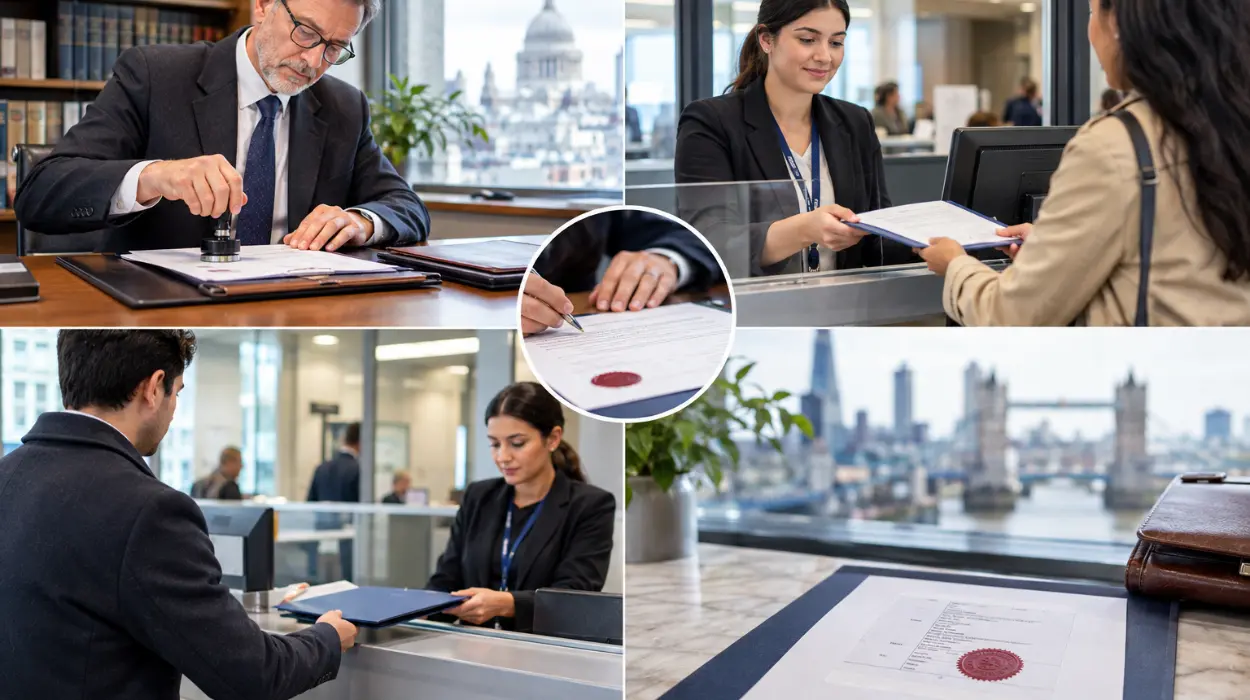
The UK apostille process involves four distinct stages: verifying document origins through official registries, submitting physical or digital applications to the Foreign, Commonwealth & Development Office, processing government authentication checks, and dispatching the certified paperwork back to the applicant via secure courier delivery.
Why Is Document Verification the First Stage of the Apostille Process?
Document verification requires checking original certificates against official UK databases to confirm authenticity before government submission occurs.
Validating a UK public document requires strict adherence to official legal standards. Officials examine physical certificates or digital counterparts to ensure they bear valid signatures, seals, or stamps from recognised authorities. When verifying a birth certificate, registrars check local council records. When authenticating corporate paperwork, officers cross-reference company data with official registries. Failing this initial validation step results in immediate application rejection by government processing centres.
Applicants must inspect their paperwork for damage, missing stamps, or outdated signatures. Three common document types require this initial check: corporate incorporation certificates, educational degree transcripts, and personal vital records. Professional authentication services examine these files beforehand to eliminate errors. Securing error-free paperwork accelerates the entire legalisation timeline significantly.
How Does Submission to the Foreign Office Work?
Submission requires transmitting verified documents to the Foreign, Commonwealth & Development Office alongside completed application forms and correct processing fees.
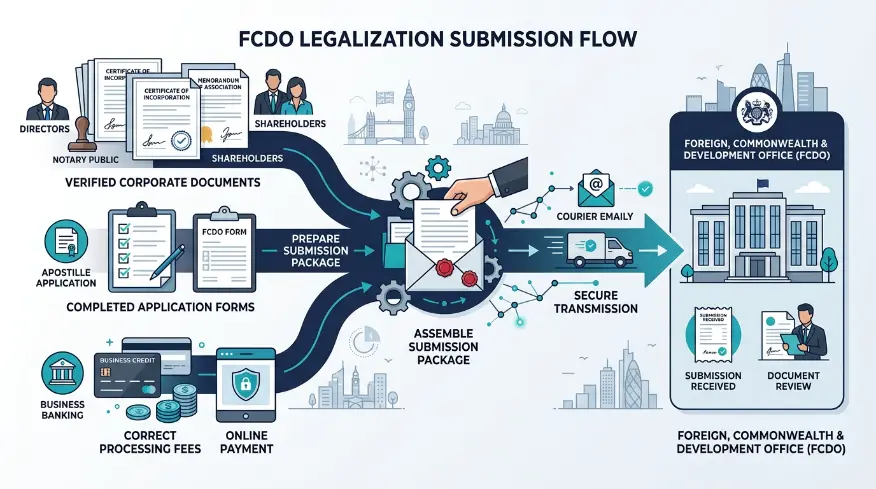
Submitting paperwork to the Foreign, Commonwealth & Development Office involves choosing between standard postal services or premium counter drop-off routes. Paperwork packages must include payment confirmation, return delivery instructions, and the original public documents requiring legalisation. When utilizing postal routes, applicants dispatch files via tracked delivery services to ensure secure transit. When utilizing business drop-off services, couriers deliver batches directly to government intake desks.
Government intake teams log each application into tracking systems within 24 hours of receipt. Two primary submission formats exist: traditional paper documents bearing wet-ink signatures and modern electronic documents bearing digital government certificates. Processing queues operate on strict first-come-first-served timelines unless expedited tiers are selected. Submitting complete paperwork prevents administrative queries and administrative delays. Utilizing structured workflows ensures files move smoothly into the active authentication phase.
What Happens During Government Authentication and Certification?
Government authentication involves examining security features, matching official sign-off credentials, and attaching the official apostille certificate.
Executing government certification requires trained examiners to cross-reference signatory signatures against comprehensive government databases of registered UK officials. When signatures match authorised records, staff print a secure, serialized apostille certificate directly onto the reverse of the document or attach it as an allonge. This official certificate features a unique tracking number, an embossed seal, and the signature of a designated government official. Foreign governments rely on these security markers to accept foreign public documents without secondary consular legalisation.
Each certificate undergoes quality control checks to verify print clarity and holographic security elements. Three standard processing speeds dictate turnaround times: standard postal processing taking multiple business days, premium counter services concluding within hours, and digital e-apostille issuance completing rapidly. Government departments process thousands of applications weekly using standardized verification protocols. Ensuring documents meet these stringent state standards guarantees international recognition across member nations of the Hague Convention.
How Are Apostilled Documents Returned to the Applicant?
Document return involves packaging certified paperwork securely, generating tracked courier waybills, and dispatching parcels to domestic or international destinations.
Returning legalised paperwork requires secure logistics management to protect sensitive personal and corporate records during transit. Dispatch teams enclose apostilled certificates in protective plastic sleeves inside reinforced cardboard envelopes to prevent bending or water damage. When shipping internationally, logistics providers attach customs documentation to comply with global freight regulations. When shipping domestically, next-day courier services guarantee rapid delivery to business or residential addresses.
Recipients receive digital tracking numbers immediately upon parcel dispatch from the government processing facility. Three reliable delivery methods secure transit: international courier networks, domestic tracked mail, and secure office collection points. Ensuring secure transit protects critical assets like those managed through our professional Apostilled Documents service. Proper final delivery concludes the entire legalisation lifecycle successfully, allowing businesses to execute international operations without regulatory friction.
Navigating the legalisation workflow requires precision at every operational milestone. Understanding document preparation, government submission protocols, state authentication checks, and secure logistics ensures international compliance. Form My Company assists organisations by streamlining these complex administrative requirements through structured corporate solutions. Review our guide on how to avoid delays at each stage of the apostille process for deeper strategic insights. When you are ready to streamline your compliance timeline, explore ordering a fully managed apostille service from Form My Company to secure verified international paperwork efficiently.
Explore our Apostilled Documents guide,
Can Board Resolutions and Powers of Attorney Be Apostilled?
Why Do Banks Ask to See Your Incorporation Documents?
Frequently Asked Questions
How long does it take to get an apostille in the UK?
Standard postal processing through the Foreign, Commonwealth & Development Office typically takes multiple business days, excluding delivery time. Form My Company offers expedited handling for Apostilled Documents to accelerate government authentication for urgent international business needs.
Can electronic documents receive a UK apostille?
Yes, the UK government issues electronic apostilles, known as e-apostilles, for eligible digital public documents bearing verified digital certificates. Form My Company assists clients in evaluating whether their digital files qualify for electronic legalisation rather than traditional paper processing.
Which documents require legalisation before international use?
Public documents such as corporate incorporation certificates, educational degree transcripts, and vital records require legalisation for recognition abroad. Form My Company verifies these document origins to ensure seamless processing through official UK authentication channels.
Do I need an apostille or consular legalisation for my paperwork?
Destination countries that are signatories to the Hague Convention require only an apostille for foreign public documents. If the destination country is not a convention member, secondary consular legalisation at embassy offices becomes necessary alongside standard apostille certification.
What information appears on an official UK apostille certificate?
An official apostille certificate displays a unique tracking number, an embossed state seal, and the signature of an authorised government official. Form My Company ensures all returned Apostilled Documents feature these required security markers for immediate international acceptance.