
Auditing a People with Significant Control register involves cross-checking statutory ownership records against Companies House filings, verifying individual identity credentials, and identifying hidden beneficial owners holding over 25% voting rights or share capital to prevent regulatory penalties.
What Triggers a Compliance Gap in Your PSC Register?
Compliance gaps occur when corporate entities omit required beneficial owners, miss statutory reporting deadlines, or fail to record changes in share distribution and voting rights exceeding the 25% threshold.
Corporate transparency regulations require absolute precision regarding corporate ownership. When an individual acquires more than 25% of shares or voting rights, the corporate entity must submit statutory updates instantly. Regulatory software monitors digital submissions continuously. Three primary triggers initiate regulatory penalties:
Miss the 14-day statutory reporting window following ownership modifications.
Omit mandatory individual identity verification codes during digital submissions.
Submit conflicting beneficiary data that fails cross-checks with HMRC or public records.
Failing to maintain accurate records exposes company directors to severe statutory liabilities. Companies House enforces these requirements through automated compliance tracking and rigorous administrative reviews. Businesses must evaluate their internal data collection protocols to identify discrepancies before statutory enforcement actions occur. Regular internal reviews protect the organisation from unexpected compliance notices.
How Can You Verify Beneficial Ownership Accurately?
Accurate beneficial ownership verification requires examining legal share distribution, shareholder agreements, and voting control mechanisms to identify every individual exercising significant influence.
Identifying ultimate beneficial owners demands a granular review of corporate documentation. Directors must evaluate multiple criteria to ensure complete coverage. Three verification methods include:
Reviewing statutory registers against actual share certificates
Inspecting corporate articles for hidden appointment rights
Analyzing indirect shareholdings held through subsidiary structures
Complex corporate hierarchies often obscure who actually controls a business. When shares are held through trusts or intermediary firms, trustees and partners must be recorded as persons with significant control. Cross-referencing shareholder registers with board minutes reveals unrecorded voting agreements. Maintaining transparency ensures alignment with UK regulatory frameworks.
What Steps Define a Comprehensive Internal Audit Process?
A comprehensive internal audit process requires reconciling register data with Companies House filings, verifying personal identification codes, and documenting every review step for regulatory inspection.
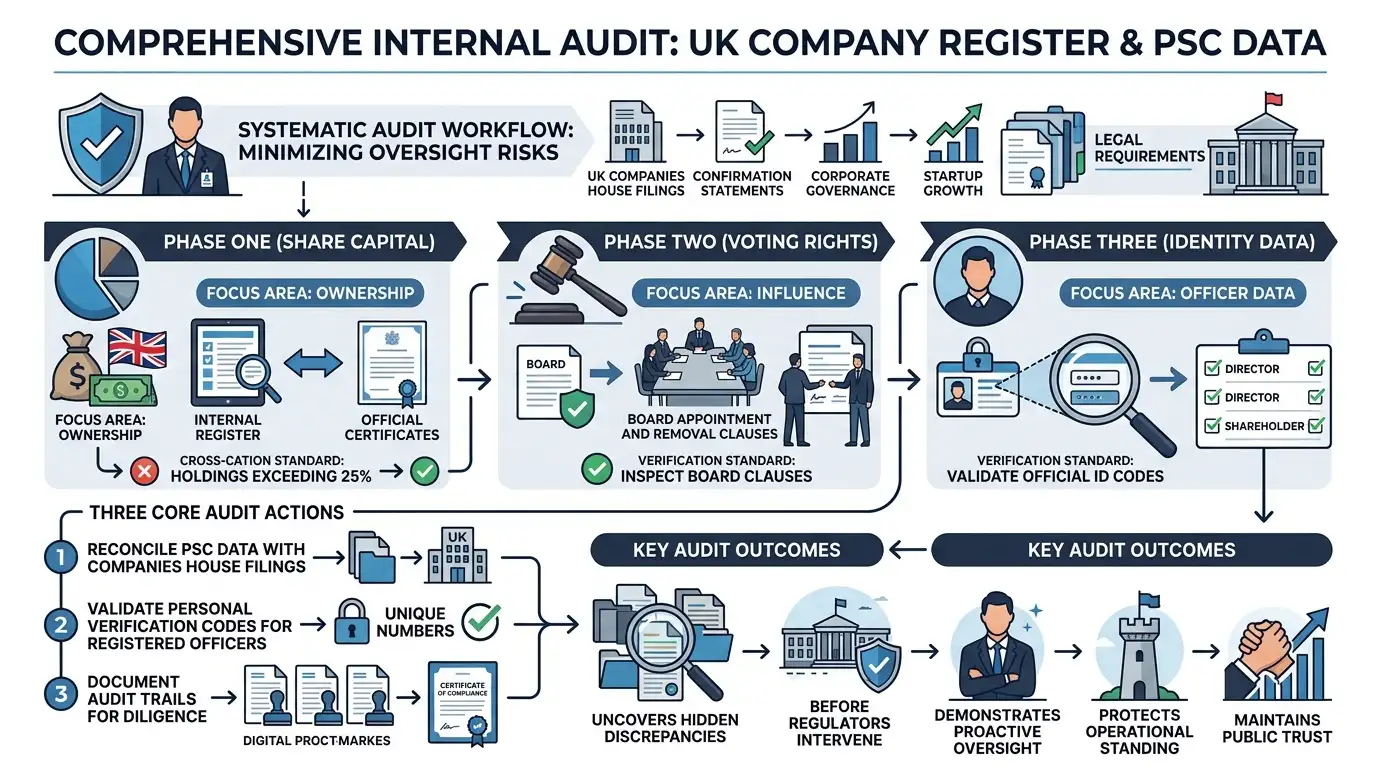
Executing a systematic audit minimizes oversight risks. Compliance officers must follow structured procedures to evaluate register accuracy. Three audit actions involve:
Reconcile internal PSC data with current confirmation statement filings
Validate personal verification codes for every registered officer
Document audit trails to prove ongoing corporate governance diligence
| Audit Phase | Focus Area | Verification Standard |
| Phase One | Share Capital | Cross-check all holdings exceeding 25% |
| Phase Two | Voting Rights | Inspect board appointment and removal clauses |
| Phase Three | Identity Data | Validate official personal identification codes |
Executing these sequential phases uncovers hidden discrepancies before external regulators intervene. Clear documentation demonstrates proactive oversight. Organizations that implement rigorous internal reviews protect their operational standing and maintain full public trust.
How Does Form My Company Support Statutory Compliance?
Form My Company delivers expert PSC Register solutions that evaluate ownership structures, correct administrative omissions, and align corporate records with statutory requirements.
Maintaining ongoing compliance demands specialized expertise and continuous monitoring. When companies navigate complex ownership structures, professional assistance prevents costly oversights. Form My Company provides comprehensive corporate services to streamline this administrative burden. Leveraging professional support ensures every regulatory filing meets strict deadlines.
Business owners seeking to resolve existing compliance gaps can utilize specialized oversight tools. Ready to Get a PSC Register Compliance Audit From Form My Company? Professional auditors analyze your governance structures to protect against legal penalties. Maintaining accurate records supports long-term operational stability. Explore our What Are the Warning Signs of a Non-Compliant PSC Register? guide to identify early risk indicators. Secure your corporate standing through proactive PSC Register management today.
Explore our PSC Register guide,
How to Choose a Well-Connected Conference Venue?
How to schedule back-to-back interviews across multiple rooms?
Frequently Asked Questions
How often must a UK company update its PSC register?
UK companies must update their PSC register within 14 days of any change occurring and file this information with Companies House within a further 14 days. Form My Company assists businesses in tracking these statutory deadlines to maintain continuous compliance.
What information is required on a Persons with Significant Control register?
A PSC register must record the full name, service address, country of residence, nationality, and exact nature of control for every qualifying individual. Form My Company ensures all mandatory details are accurately gathered and verified according to UK regulatory standards.
Who qualifies as a person with significant control in a UK company?
An individual qualifies as a person with significant control if they hold more than 25% of shares, hold more than 25% of voting rights, or exercise significant influence or control over the company. Form My Company helps businesses evaluate complex ownership structures to identify all qualifying beneficial owners.
What are the penalties for failing to maintain a correct PSC register?
Failing to keep an accurate and up-to-date PSC register can result in criminal fines for the company and its officers, as well as potential administrative sanctions from Companies House. Form My Company provides professional audit services to identify compliance gaps before penalties occur.
Can a company keep its PSC register on the central public register instead?
Private limited companies can choose to keep their PSC information on the central register kept by Companies House rather than maintaining their own separate register at their registered office. Form My Company guides corporate clients through the legal notification process required to opt into central filing.