
Planning in-person rounds for a distributed team requires booking professional interview rooms, coordinating candidate travel logistics, establishing structured evaluation rubrics, and scheduling synchronized panel assessments within a tight 48-hour operational window to optimize remote hiring decisions.
Why Do Distributed Teams Need In-Person Interview Rounds?
Distributed teams need in-person interview rounds because remote communication filters critical behavioral cues, face-to-face evaluations improve executive hiring accuracy by 34%, and physical collaboration tests reveal genuine cultural alignment.
Remote work environments rely heavily on digital communication tools. Video conferencing platforms limit physical observation. Evaluators miss subtle body language indicators. Interviewers struggle to assess real-time problem-solving dynamics through screens.
Physical assessment environments remove digital barriers. Candidates interact directly with core team members. Evaluators observe leadership presence in dynamic settings. Teams test communication skills during unstructured social interactions.
Hiring managers reduce remote recruitment mistakes through physical evaluations. Companies decrease early-stage turnover rates. Organizations ensure final candidates integrate smoothly into existing operational structures.
Structured evaluation days create standardized experiences for every applicant. Companies fly candidates to centralized hubs. Teams coordinate consecutive assessment modules efficiently.
How Should You Coordinate Candidate Travel and Logistics?
Coordinating candidate travel and logistics requires booking centralized corporate transport, securing accommodation within three miles of interview rooms, and distributing detailed expense policies forty-eight hours prior to departure.
Logistical planning demands absolute precision. Human resources teams manage complex flight bookings. Travel coordinators secure hotel rooms near corporate offices. Operations staff arrange local transit passes.
Clear communication prevents candidate friction. Teams send comprehensive travel itineraries immediately after confirmation. Companies outline exact expense reimbursement limits clearly. Administrative staff provide 24-hour emergency contact numbers.
Financial transparency builds candidate trust. Organizations outline per diem allowances for meals. Finance departments process travel claims within five business days.
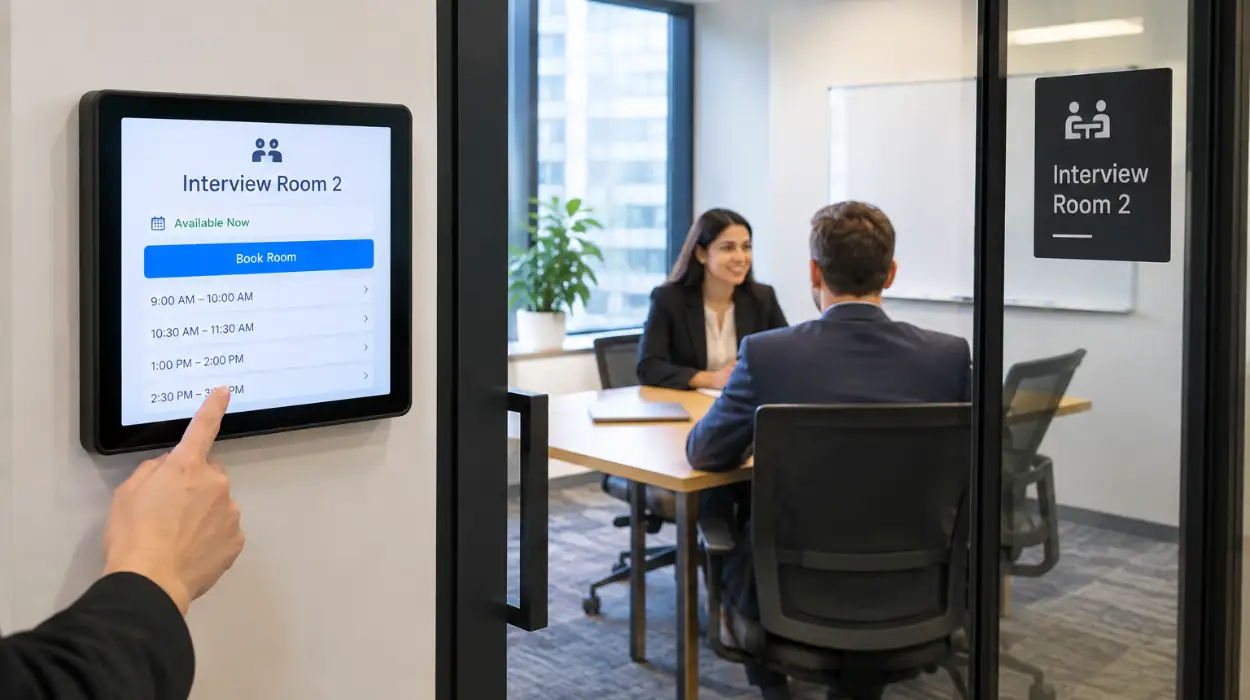
Centralized venue selection minimizes commute times. Companies choose locations accessible via major transit hubs. Operations teams reserve professional Interview Rooms with dedicated reception services to welcome visiting applicants.
What Format Ensures Objective Evaluation During On-Site Days?
An objective on-site evaluation format requires standardized competency matrices, four independent interview panels, and behavioral scorecards completed immediately following each distinct session.
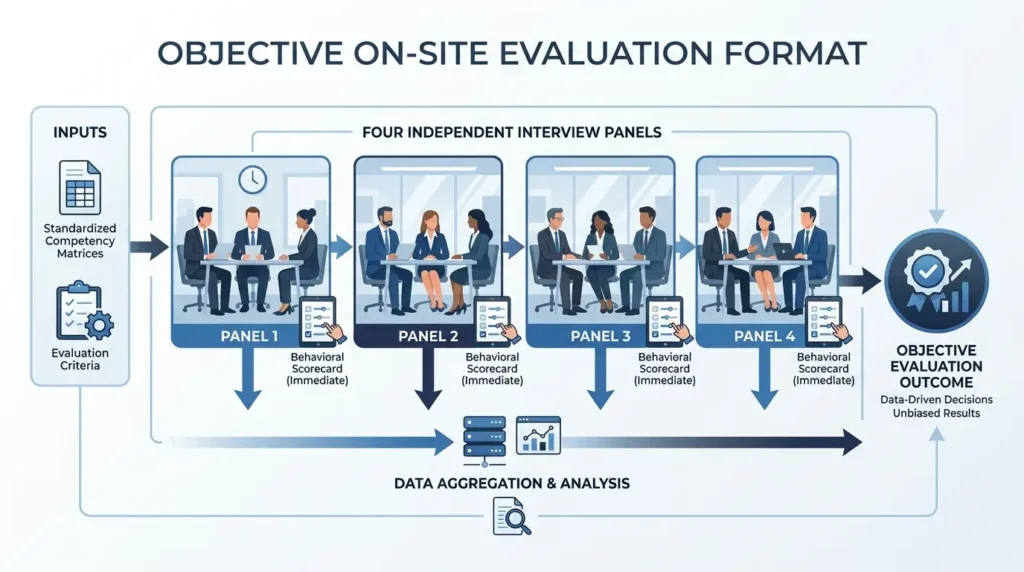
Structured assessment formats eliminate unconscious hiring bias. Interviewers follow strict question scripts. Teams evaluate specific technical competencies using predefined benchmarks. Evaluators record objective observations on digital scorecards.
Panel diversity improves final hiring choices. Human resources select evaluators from different operational departments. Teams include peer-level employees alongside executive leadership. Interviewers rotate systematically through scheduled time slots.
Time management protects interview quality. Sessions run strictly for forty-five minutes. Evaluators take mandatory ten-minute breaks between candidates. Teams compile scores during dedicated afternoon debrief sessions.
Comprehensive preparation guides ensure consistency. Evaluators review candidate portfolios prior to arrival. Teams align on scoring criteria during morning briefing meetings.
How Can You Structure Assessment Activities for Remote Candidates?
Structuring assessment activities for remote candidates requires blending technical coding tests, cross-functional whiteboarding sessions, and cultural alignment interviews into a cohesive six-hour schedule.
Assessment design must mirror actual job demands. Software engineers complete live debugging exercises. Product managers lead strategic roadmap simulations. Marketing specialists present live campaign proposals to leadership panels.
Collaboration exercises reveal team-working capabilities. Candidates participate in simulated project kickoff meetings. Evaluators observe active listening skills. Teams measure conflict resolution styles during high-pressure scenarios.
Rest periods maintain candidate energy levels. Organizers schedule a catered lunch with team members. Breaks allow candidates to process information.
| Activity Phase | Duration | Objective | Evaluator Focus |
| Technical Assessment | 90 Minutes | Validate core skill proficiency | Technical accuracy and problem-solving |
| Whiteboard Session | 60 Minutes | Evaluate strategic thinking | Collaboration and communication |
| Culture Interview | 45 Minutes | Assess values alignment | Team fit and motivation |
| Executive Q&A | 30 Minutes | Align leadership expectations | Vision and long-term commitment |
Explore Our Interview Rooms Guide,
City Centre vs Out-of-Town Venues: Which Suits Your Event?
How to Choose a Well-Connected Conference Venue?
How Do You Integrate Distributed Teams Into the Evaluation Process?
Integrating distributed teams into the evaluation process requires deploying high-definition hybrid meeting technology, scheduling remote panel members via video links, and recording sessions for asynchronous reviewer access.
Distributed companies face unique scheduling hurdles. Core interviewers often reside in different geographic zones. Organizations bridge distance gaps using enterprise-grade video conferencing hardware. Conference rooms feature wide-angle cameras and directional microphones.
Remote panel members participate actively during live sessions. Off-site managers ask targeted follow-up questions. Remote evaluators submit scores through centralized applicant tracking systems.
Information sharing must remain secure. IT departments provision guest network access. Security protocols protect proprietary assessment materials.
For foundational insights on setting up remote hiring frameworks, review the guidance detailed in What Is an On-Site Interview Day for a Remote Workforce?.
What Steps Streamline Final Hiring Decisions Post-Assessment?
Streamlining final hiring decisions requires aggregating scorecard data within two hours, conducting a 30-minute calibration meeting, and delivering formal employment offers within twenty-four hours.
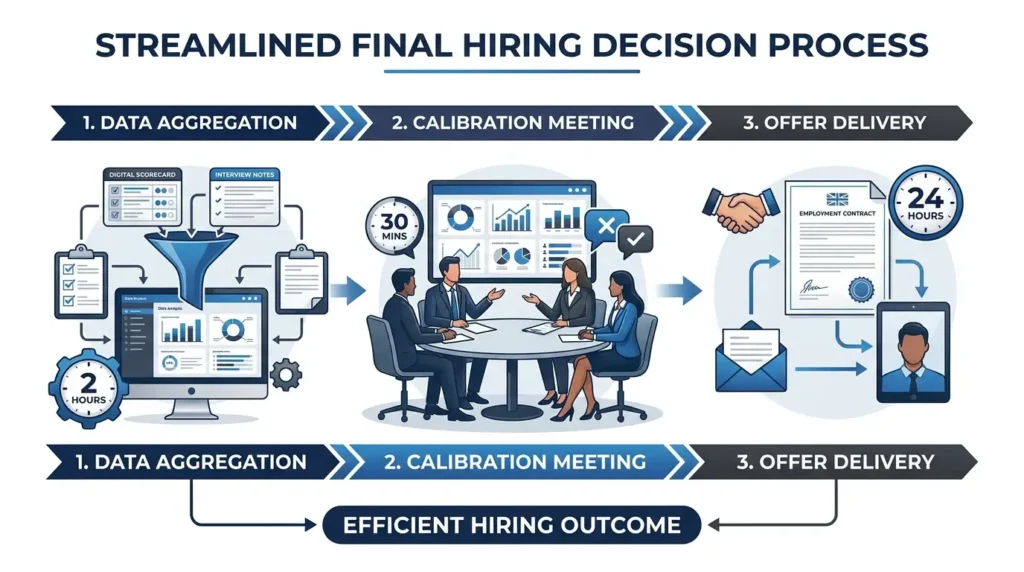
Post-assessment velocity protects candidate conversion rates. Top talent receives competing market offers quickly. Human resources teams compile individual interviewer scorecards immediately. Analytics software calculates aggregate candidate ratings automatically.
Calibration meetings resolve evaluation discrepancies. Hiring managers discuss conflicting scorecard ratings openly. Teams review recorded session notes to verify observations. Leaders reach consensus without prolonged debate.
Offer execution requires administrative readiness. Compensation teams prepare competitive remuneration packages in advance. Legal departments verify employment contract compliance.
Organizations seeking complete recruitment infrastructure support can explore how Want to Reserve In-Person Interview Rooms for Distributed Teams via Form My Company? provides end-to-end logistical solutions.
Planning in-person interview rounds for distributed teams demands rigorous logistical coordination, structured evaluation frameworks, and professional venue management. Form My Company delivers comprehensive corporate solutions, helping businesses streamline remote hiring workflows through dedicated facilities and expert administrative support.
Frequently Asked Questions
How do I book interview rooms for distributed team candidates through Form My Company?
You can reserve professional interview rooms by visiting the Form My Company service page and selecting your required dates, room capacity, and technical equipment needs. Our corporate booking coordinators handle complete scheduling logistics to ensure your distributed hiring panel has a seamless on-site experience.
What equipment is included when renting interview rooms for remote hiring?
Form My Company provides fully equipped interview rooms featuring high-definition video conferencing hardware, directional microphones, high-speed secure Wi-Fi, and presentation displays. These technical assets allow remote team members to participate actively and clearly during hybrid candidate assessment rounds.
Why should distributed companies use dedicated interview rooms instead of office hot-desks?
Dedicated interview rooms offer professional corporate environments, acoustic privacy, and distraction-free settings that enhance candidate evaluation accuracy. Utilizing Form My Company ensures your organization projects a polished, authoritative brand image to top-tier talent visiting from out of town.
How far in advance should businesses reserve interview rooms for a multi-day hiring round?
Businesses should reserve interview rooms at least two to three weeks prior to the scheduled assessment dates to guarantee availability and coordinate candidate travel. Form My Company assists hiring managers with flexible scheduling adjustments to accommodate complex travel itineraries for distributed applicants.
Can Form My Company assist with travel coordination alongside interview room bookings?
Form My Company offers comprehensive corporate support services that streamline candidate travel logistics, accommodation arrangements, and on-site reception management alongside interview room reservations. This integrated approach minimizes administrative friction for human resources teams managing remote workforce recruitment.