
UK companies must maintain both physical and digital company records to ensure total statutory compliance. While digital records streamline daily administration, UK corporate law and legal authorities explicitly mandate physical statutory registers and hard-copy share certificates for official verification, audits, and corporate transactions.
What Are the Key Differences Between Physical and Digital Company Records?
Physical company records exist as tangible paper documents stored in physical locations, whereas digital company records exist as electronic files stored on secure cloud servers or hard drives. Both formats serve distinct legal, operational, and administrative purposes within UK corporate governance structures.
UK corporate law establishes clear boundaries between physical and digital document formats. Physical records include printed share certificates, bound statutory registers, and paper minute books. Directors keep these hard-copy documents at the registered office address or a Single Alternative Inspection Location. Paper files provide physical proof of ownership during in-person audits. Board members sign physical documents using wet-ink signatures for formal legal execution.
Digital records consist of electronic PDF files, scanned documents, and cloud-hosted databases. Companies use software platforms to update digital records instantly. Digital systems enable rapid sharing among directors, accountants, and legal advisers. UK companies use digital formats for daily administrative tasks. However, digital files remain vulnerable to cyber threats, software corruption, and unauthorized data modifications without proper access controls.
Data accessibility separates the two record formats significantly. Digital records allow simultaneous multi-user access across different geographic locations. Physical records restrict access to one individual at a time in a specific location. Despite digital convenience, legal authorities require physical originals for specific corporate actions. Courts and regulatory bodies often demand physical documentation during formal legal proceedings.
| Feature | Physical Company Records | Digital Company Records |
| Storage Location | Registered office address or SAIL | Secure cloud servers or local drives |
| Access Speed | Requires physical retrieval time | Instant remote multi-user access |
| Legal Status | Required for wet-ink statutory compliance | Accepted for routine reporting and filing |
| Security Risk | Physical damage, theft, or fire loss | Cyber attacks, data corruption, or breach |
Which Company Records Does UK Law Mandate in Physical Format?
UK law mandates that statutory registers, official minute books, and paper share certificates remain accessible in physical format. The Companies Act 2006 requires companies to maintain these core corporate registers at their registered office address for public inspection upon formal request.
The Companies Act 2006 imposes strict statutory obligations regarding record retention. UK statutory registers comprise five core books: the register of members, register of directors, register of director’s residential addresses, register of secretaries, and register of people with significant control. Companies must keep these physical books continuously updated. Failure to maintain physical statutory registers constitutes a criminal offence by company officers.
Share certificates represent another legal area requiring physical documentation. Shareholders receive paper share certificates as prima facie evidence of title to shares. When executing corporate actions, financial institutions and legal counsel demand physical share certificates for verification. Transferring shares involves submitting physical stock transfer forms alongside original share certificates. Electronic entries in private internal databases do not replace statutory physical share certificates.
Board meeting minutes and general meeting resolutions demand permanent physical retention. Directors must record written minutes of every board meeting in official minute books. Chairman signatures on paper minutes create legal proof of board proceedings. Regulatory bodies inspect physical minute books during statutory investigations. Storing electronic meeting notes does not satisfy formal legal requirements without verified digital signature protocols.
How Do Digital Company Records Improve Operational Efficiency?
Digital company records improve operational efficiency by automating document retrieval, accelerating statutory filings, and enabling seamless remote collaboration. Electronic record management reduces administrative costs and eliminates manual processing errors across daily business operations.
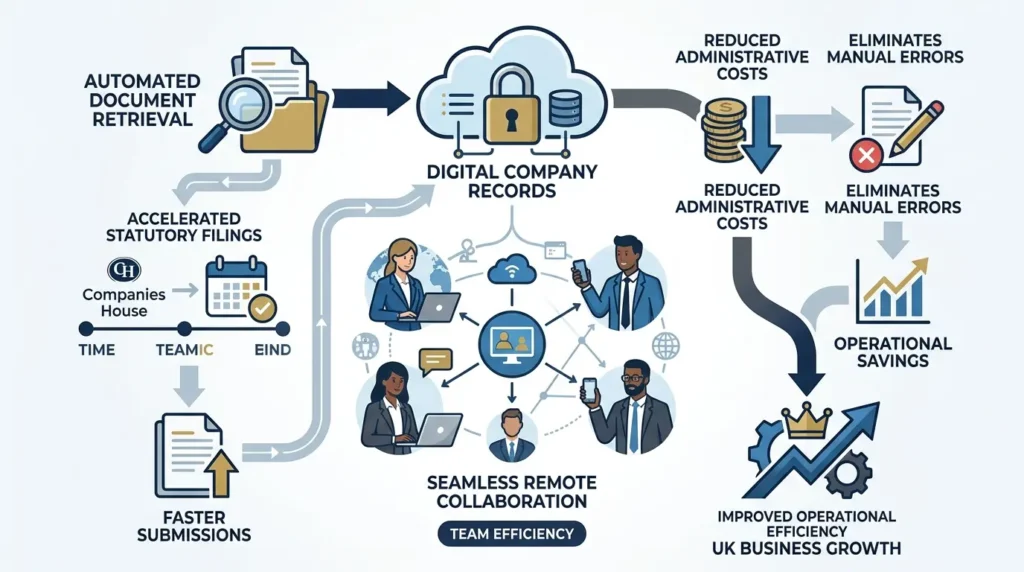
Electronic document management speeds up corporate administrative workflows. Directors search thousands of electronic files in seconds using automated keyword search features. Fast retrieval eliminates time spent manually searching physical filing cabinets. Company secretaries update digital corporate profiles immediately after internal structural changes occur. Rapid updates prevent data discrepancies across operational departments.
Companies Filing information with Companies House relies heavily on digital systems. Electronic filing platforms process annual confirmation statements and officer changes instantly. Digital integration reduces rejection rates caused by manual paper entry errors. Automated system alerts remind administrators about upcoming filing deadlines. Timely electronic submissions protect companies from statutory late filing penalties.
Remote business operations require secure cloud-based document sharing. External advisors examine corporate files remotely during routine accounting reviews. Digital repositories permit granular access permissions for specific advisory teams. File encryption protocols protect sensitive financial information during transmission. Organizations streamline internal communications by centralizing document access within secure online environments.
Why Do Investors Require a Physical Document Set During Due Diligence?
Investors require a complete physical document set during due diligence to verify corporate ownership, authenticate statutory books, and prevent legal fraud. Physical documents provide indisputable legal proof of title that electronic files cannot independently guarantee.
Institutional investors conduct thorough legal reviews before committing capital to UK companies. Due diligence teams examine physical statutory registers to confirm historical share ownership. Scanned PDFs can be altered easily using basic editing software. Physical registers with bound pages prove historical accuracy and continuous record maintenance. Investors verify equity structures using tangible paper records.
Legal counsel representing investors demands original share certificates before closing investment rounds. Missing share certificates delay venture capital investments and commercial acquisitions. Original certificates prove that shareholders have not pledged shares as collateral elsewhere. Investors mitigate financial risk by inspecting physical certificate chains.
Complex commercial transactions demand physical documentation for regulatory compliance. Investment banks and venture funds require physical minute books to verify past board authorizations. Written board approvals confirm that directors held proper authority to issue new equity. You can read more about why do investors prefer a complete physical document set to understand investor compliance expectations during funding rounds.
How Should UK Businesses Balance Physical and Digital Record Management?
UK businesses balance record management by adopting a hybrid strategy that combines physical compliance storage with digital operational files. This approach secures mandatory statutory physical registers while utilizing cloud platforms for daily business administration.
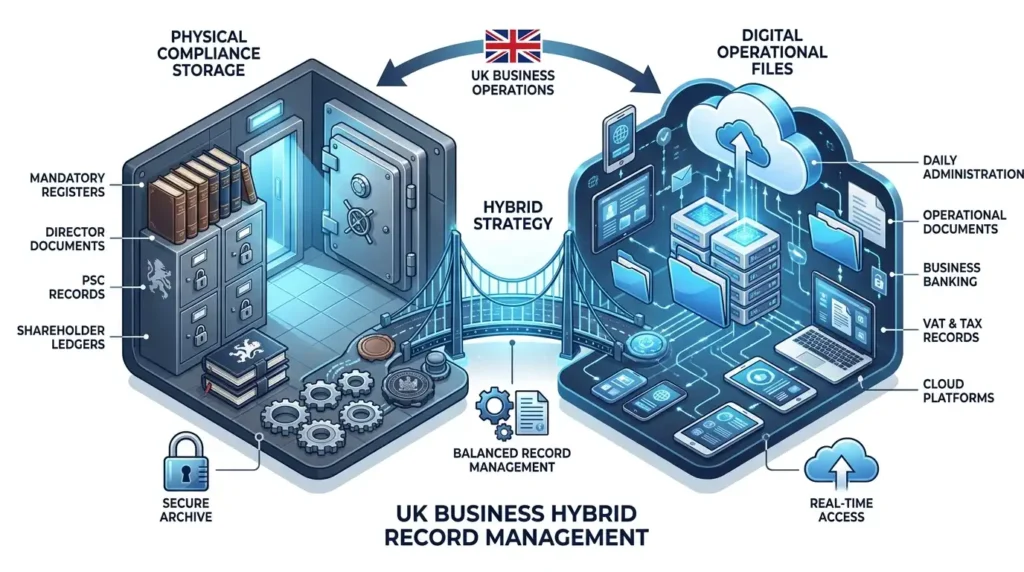
A structured hybrid strategy ensures full compliance without sacrificing operational speed. Companies create digital scans of every physical document upon receipt. Scanned files enter a central cloud repository tagged with specific metadata categories. Staff members access digital copies for daily administrative tasks. Meanwhile, original paper documents move directly to secure, fireproof physical storage facilities.
Businesses must establish clear internal protocols for document classification. Three classification tiers organize corporate records effectively: statutory physical documents, operational digital records, and temporary working files. Statutory physical documents remain permanently at the registered office. Operational digital records remain stored in secure cloud systems. Temporary working files undergo automatic deletion after specific retention periods expire.
Regular compliance audits prevent record discrepancies between physical and digital formats. Company secretaries cross-check physical share registers against Companies House records quarterly. Discrepancies between physical registers and online public data create severe legal complications during corporate actions. Maintaining exact alignment between physical registers and digital databases protects company integrity.
When expanding corporate operations, acquiring professional corporate governance support becomes essential. Businesses utilize expert supplementary company documents services to maintain compliant statutory registers across all operational stages. External corporate services ensure physical registers meet evolving legal standards.
Explore Our Supplementary Company Documents Guide,
How to Choose Which Corporate Documents Need Legalisation First?
How to Plan a Carbon-Conscious Conference Step by Step?
What Are the Legal Risks of Relying Solely on Digital Records?
Relying solely on digital records exposes UK companies to severe regulatory penalties, legal invalidity during court disputes, and failed commercial transactions. UK corporate law explicitly mandates physical statutory registers alongside public electronic filings.
Companies House public filings do not constitute official company registers. Section 113 of the Companies Act 2006 states that the statutory register of members serves as definitive legal proof of ownership. Storing records solely in digital spreadsheets violates statutory obligations. Directors face statutory fines for failing to maintain physical registers at the registered office.
Cybersecurity vulnerabilities create catastrophic risks for purely digital record systems. Ransomware attacks lock corporate servers and destroy unbacked-up legal files. Data corruption renders electronic minute books unreadable during court proceedings. Without physical backup copies, companies struggle to prove past corporate decisions during legal disputes. Courts require authenticated physical evidence when electronic records face tampering allegations.
Commercial banks reject corporate financing applications that lack valid physical documentation. Lenders inspect physical statutory books before approving corporate credit facilities. Missing paper records halt commercial loan approvals and corporate property acquisitions. Restoring lost statutory registers requires expensive court applications and legal fees.
Maintaining physical statutory books requires professional binding and legal precision. Companies avoid expensive legal complications when they order professionally bound company records from Form My Company for full compliance. Form My Company prepares complete physical registers that satisfy strict legal inspection standards. Form My Company delivers durable hard-copy document sets directly to your registered office address.
Frequently Asked Questions
What are supplementary company documents in the UK?
Supplementary company documents are official statutory records—such as bound minute books, registers of directors and members, and hard-copy share certificates—that complement basic incorporation filings. Form My Company provides these essential physical legal documents to ensure full statutory compliance under the Companies Act 2006. Maintaining an accurate secondary record set helps UK businesses satisfy legal verification requirements during audits and corporate transactions.
Why do UK businesses need physical statutory registers and document sets?
While electronic filings are submitted to Companies House, UK corporate law explicitly requires companies to keep physical statutory registers at their registered office or SAIL address. Having a complete set of supplementary company documents from Form My Company ensures legal proof of ownership, valid board resolutions, and smooth compliance inspections. Physical documentation also prevents operational delays during commercial banking applications, legal audits, and investment due diligence.
How do I order supplementary company documents for an existing business?
You can order customized supplementary company documents directly through the Form My Company platform by selecting your required statutory items. Form My Company compiles, binds, and delivers tailored hard-copy registers, official seal certificates, and member records directly to your registered office address. This streamlined service ensures your historical and current corporate records remain fully updated and legally compliant.
What is included in a complete supplementary company document package?
A complete supplementary company document package typically includes bound statutory registers, customized share certificates, first board meeting minutes, and official company registers for secretaries and people with significant control (PSC). Form My Company delivers professionally formatted physical binders designed to meet strict UK legal standards. These hard-copy documents provide tangible proof of title and governance structure for investors and financial institutions.
Are physical company records legally required alongside Companies House digital filings?
Yes, digital filings at Companies House do not legally replace a company’s internal statutory registers required by Section 113 of the Companies Act 2006. UK directors are legally obligated to maintain updated physical registers, making supplementary company documents a mandatory aspect of corporate governance. Utilizing services from Form My Company protects company officers from regulatory fines associated with incomplete statutory recordkeeping.