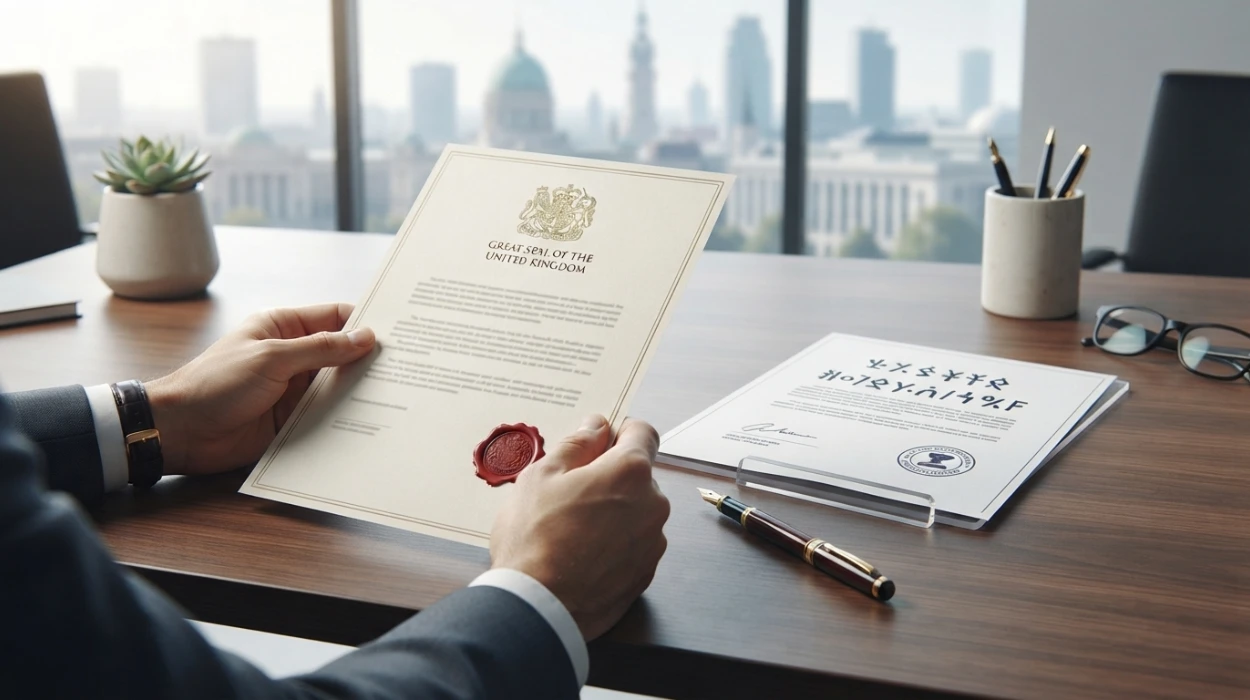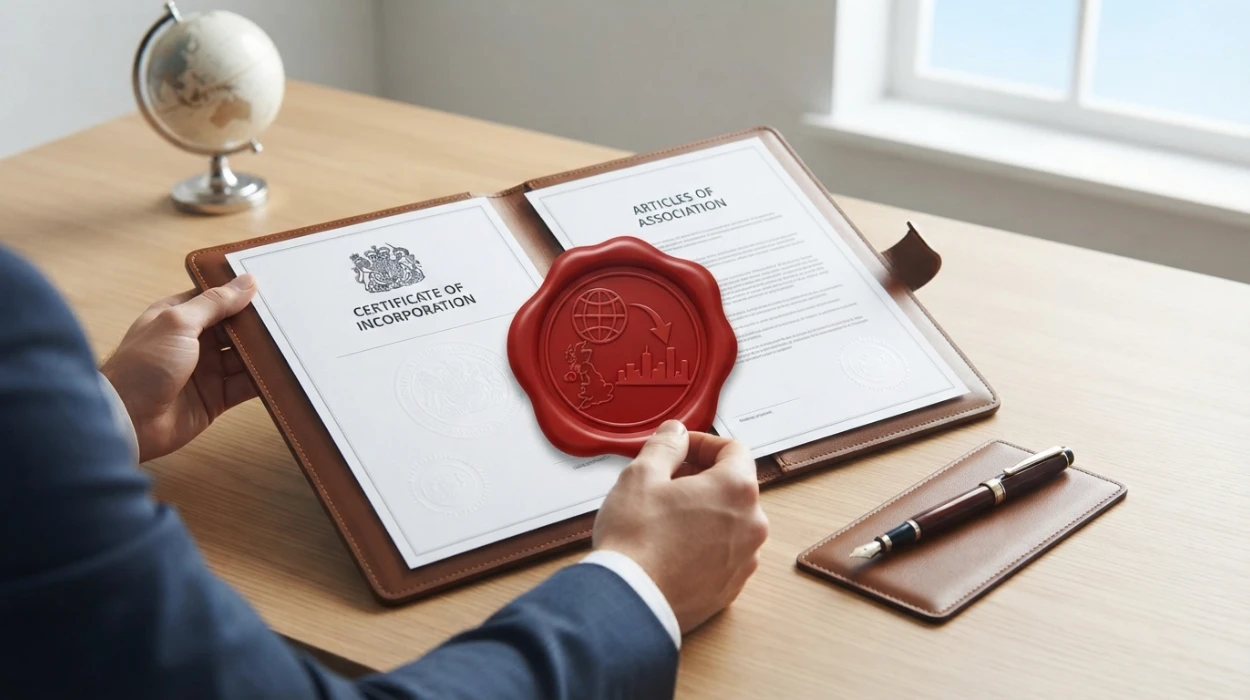
Preparing company documents for international use requires obtaining certified copies, securing a Foreign, Commonwealth & Development Office apostille, and procuring verified translation services. Businesses follow these three core steps to satisfy foreign legal requirements and validate corporate registration credentials across international borders.
How do you verify company document authenticity for international use?
Verifying company document authenticity for international use demands official registry certification from Companies House and notarisation by a practising notary public. Corporate entities execute these validation procedures to prove legal existence to foreign authorities and prevent document rejection.
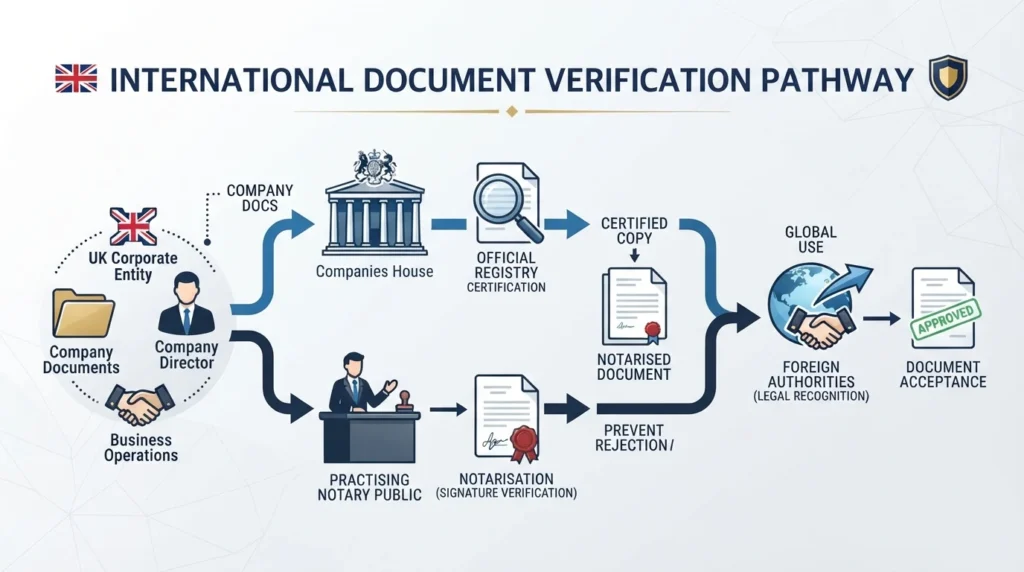
Document authenticity serves as the foundational barrier against international fraud. Foreign commercial registries demand absolute proof of corporate validity before permitting foreign registration. 45% of international corporate expansion delays stem from improper document certification. Companies submit official incorporation certificates and memorandum of association records directly to official registrars. Two primary validation steps comprise this verification phase: solicitor notarisation and official state certification. Legal experts inspect corporate registers to confirm active trading status. Independent public notaries witness signature execution on all board resolutions and governance charters.
Validation protocols protect foreign governmental bodies from fraudulent shell corporations. 82% of cross-border trade disputes involve improper document authentication. Businesses utilise Supplementary Company Documents to establish verifiable legal lineages across international jurisdictions. Official corporate seals authenticate every physical page submitted to foreign chambers of commerce. Regulatory auditors cross-reference registration numbers against national company databases. Statutory registers record every director appointment and share allocation accurately. Foreign trade departments inspect these audit trails before issuing local operating licences. Precision in initial document verification eliminates costly legal challenges abroad.
What is the exact process for obtaining an official apostille?
Obtaining an official apostille requires submitting certified corporate documents to the Foreign, Commonwealth & Development Office for legalisation. Corporate compliance officers complete this authentication process to grant domestic documents international legal recognition under the Hague Convention.
The apostille mechanism simplifies cross-border legalisation by replacing complex embassy legalisation with a single certificate. 78% of international jurisdictions mandate an apostille for foreign corporate filings. Businesses compile certificates of incorporation and annual accounts into secure digital or physical bundles. The Foreign, Commonwealth & Development Office examines official signatures affixed by registered UK public notaries. Official examiners attach a secure physical or electronic apostille stamp to verify document provenance. Three validation checkpoints govern this state approval: signature verification, seal matching, and official registry cross-checking.
State-level legalisation ensures foreign commercial courts accept UK business records without dispute. 93% of multinational joint ventures require apostilled articles of association prior to capital deployment. Compliance managers track apostille issuance through secure government tracking portals. Digital apostille systems process electronic corporate filings within 48 operational hours. Physical document bundles require secure courier transit to government legalisation offices. Official state stamps prevent unauthorised document alteration during international transit. Systematic apostille procurement guarantees seamless integration into foreign regulatory frameworks.
Why is certified translation necessary for overseas company documents?
Certified translation is necessary because foreign regulatory bodies legally require corporate documents translated into their official local language by sworn professionals. International businesses secure certified translations to ensure complete linguistic accuracy and legal compliance during foreign subsidiary registration.
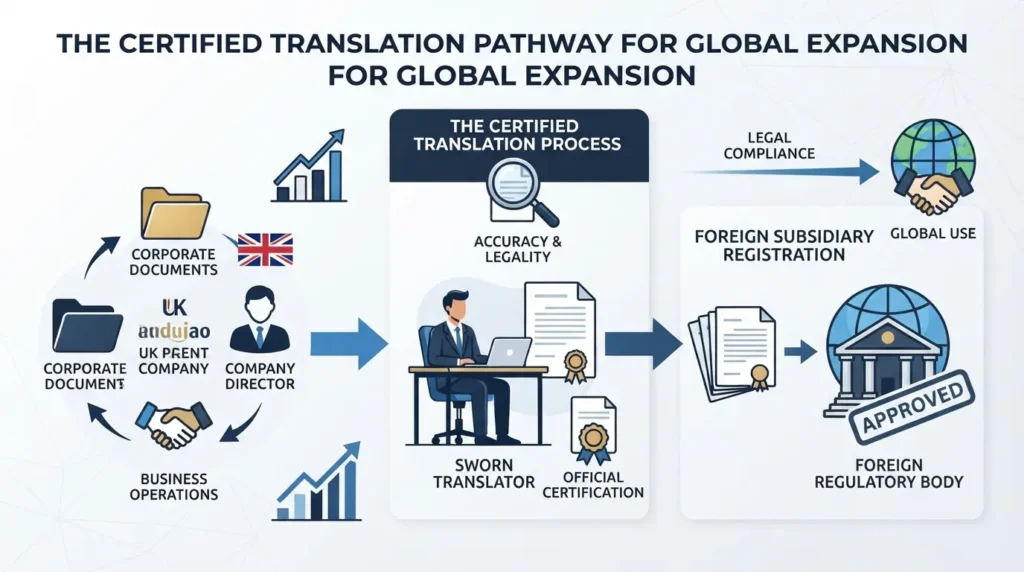
Language barriers frequently stall international expansion if translation accuracy remains unverified. 61% of foreign regulatory rejections occur due to inaccurate or uncertified document translations. Professional translators convert complex financial statements and legal contracts while maintaining precise legal terminology. Certified translations include a signed statement of truth and professional credential identifiers. Three essential translation safeguards protect corporate filings: sworn translator attestation, exact formatting replication, and industry-specific terminology matching.
Accurate translations prevent misinterpretations of corporate liability and shareholder rights abroad. 89% of foreign commercial courts reject machine-translated corporate governance documents instantly. Translation agencies employ native-speaking legal linguists specialised in corporate law. Official translation seals match the exact layout of original UK registry filings. Regulatory compliance officers inspect translation certificates alongside primary apostille stamps. Linguistic precision secures rapid approval from foreign trade ministries and tax authorities. Professional translation completes the tripartite document preparation framework required for global operations.
How do you ensure compliance with foreign regulatory authorities?
Ensuring compliance with foreign regulatory authorities involves aligning prepared corporate filings with local statutory disclosure laws and filing deadlines. Corporate strategists implement rigorous compliance checks to prevent regulatory penalties and secure permanent trading privileges abroad.
Foreign compliance mandates strict adherence to local corporate governance and annual reporting schedules. 54% of foreign subsidiaries face financial penalties due to late document submission. Companies submit apostilled statutory accounts and director identity records to local commercial registers. Local legal counsel reviews all foreign filings to confirm alignment with regional corporate law. Three regulatory compliance milestones dictate successful operations: initial trade registration, annual financial disclosure, and tax residency validation.
Proactive compliance management safeguards corporate assets and brand reputation in international markets. 76% of cross-border investments depend on flawless regulatory standing and transparent governance records. Businesses utilize Get Apostille-Ready Company Documents From Form My Company to streamline multi-jurisdictional compliance workflows. Regulatory authorities conduct random audits of foreign branch documentation annually. Systematic document archiving ensures rapid retrieval during unexpected government inspections. Maintaining rigorous compliance standards empowers sustainable long-term commercial growth overseas.
Preparing company documents for international deployment requires a structured approach involving notarisation, apostille legalisation, and certified translation. Executing these steps meticulously guarantees that corporate filings satisfy foreign legal standards and regulatory expectations. Brand Name delivers the solution by providing streamlined documentation services that eliminate administrative friction and ensure cross-border validity.
Explore More Supplementary Company Documents Guide,
How to Keep Your Statutory Documents Safe and Accessible
How to Legalise Documents for Non-Hague Convention Countries
Frequently Asked Questions
What are supplementary company documents and when are they needed?
Supplementary company documents are official corporate records, such as certificates of incorporation, memoranda of association, and director details, that verify a business’s legal standing. Form My Company provides these certified records when expanding operations abroad, opening international bank accounts, or establishing foreign corporate branches.
How do I get UK company documents apostilled for international use?
Getting UK company documents apostilled requires submitting official records to the Foreign, Commonwealth & Development Office for formal legalisation under the Hague Convention. Form My Company assists businesses in authenticating these supplementary company documents so they receive full legal recognition from foreign commercial authorities and registries.
Can I get a certificate of good standing for an overseas branch?
A certificate of good standing can be obtained to prove that a UK corporate entity is legally active, compliant, and up-to-date with national filing requirements. Form My Company supplies these vital supplementary company documents to satisfy foreign regulatory bodies and international banking compliance checks.
Why do foreign authorities require notarised company documents?
Foreign authorities require notarised company documents to ensure that corporate records are authentic, unaltered, and executed by authorised company officers. Form My Company coordinates professional notary services to validate supplementary company documents before they undergo state legalisation or international translation.
How long does it take to prepare company documents for overseas use?
Preparing company documents for overseas use typically takes between two and five working days, depending on whether state apostilles or certified translations are required. Form My Company streamlines this procurement process for supplementary company documents to ensure rapid compliance with international trade and expansion timelines.