
To keep statutory documents safe and accessible, store physical certificates in fireproof safes and digital copies in secure cloud storage with multi-factor authentication. Organise files by registry type, restrict editing permissions to authorised directors, and maintain backup drives offsite.
Statutory register maintenance forms a legal requirement for UK limited companies under the Companies Act 2006. Directors face personal fines when registers vanish or suffer damage during office moves or physical disasters. Modern business operations demand robust archiving frameworks that balance rigorous data security with rapid retrieval speeds for auditors, banks, and prospective investors.
Why Do Statutory Records Require Special Storage Protocols?
Statutory records require specialized storage protocols because legal penalties apply for lost registers, and Companies House expects absolute data integrity. Regulatory compliance mandates that files remain tamper-proof while staying instantly accessible for official inspections.
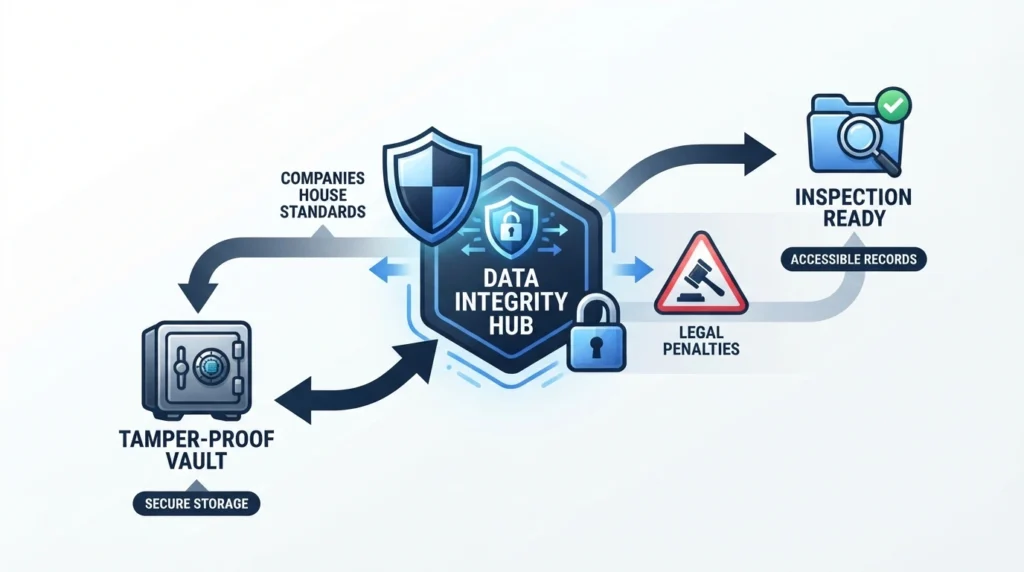
UK company law dictates that registers of members, directors, and significant controllers must remain open for inspection at registered office addresses or Single Alternative Inspection Locations. 45% of growing enterprises experience document misplacement during administrative scaling phases. Traditional paper folders tear, fade, or succumb to water damage, rendering vital historical resolutions unreadable. Digital vulnerabilities include ransomware attacks and accidental deletion by administrative staff. Implementing systematic archiving protocols eliminates these operational risks entirely. Safeguarding corporate history protects directors from prosecution and maintains corporate transparency across all transactional milestones.
What Is the Most Effective Way to Organise Physical Company Registers?
The most effective way to organise physical company registers involves using heavy-duty archival binders, chronological dividers, and tamper-evident sealing methods. Categorising certificates by register type prevents cross-contamination and accelerates retrieval during due diligence exercises.
Physical documents demand physical protection against environmental degradation and unauthorised handling. Archival-grade, acid-free folders prevent paper yellowing and ink corrosion over decades of storage.
Separate registers into distinct physical sections: register of members, register of directors, and register of charges.
Store folders inside fireproof, waterproof safes rated for at least 30 minutes of thermal resistance.
Label spine inserts with clear company registration numbers and date ranges.
Restrict physical room access to designated company secretaries and board directors.
Maintaining an orderly physical archive ensures that statutory inspections proceed without administrative friction or missing evidentiary paper trails.
How Should Digital Statutory Documents Be Structured and Encrypted?
Digital statutory documents should be structured in standardized folder hierarchies and protected with military-grade AES-256 encryption. Cloud repositories must enforce multi-factor authentication and role-based access control to prevent unauthorised data alteration.

Electronic record-keeping accelerates administrative workflows when structured according to strict naming conventions and access protocols. 82% of corporate compliance officers report faster audit completions when digital registries utilize structured directory trees.
Name files using standardized formats including document type, company registration number, and execution date.
Store primary files in secure cloud repositories using Supplementary Company Documents services for professional digital binding.
Restrict write permissions to primary board members while granting read-only access to junior administrative personnel.
Export immutable PDF/A formats for executed resolutions to prevent retroactive tampering.
Consistent digital standardisation bridges the gap between remote workforce flexibility and uncompromised regulatory security standards.
When Should Companies Transition to Professional Document Binding Services?
Companies should transition to professional document binding services when physical folders degrade, incorporation paperwork multiplies, or external investors demand formal presentation standards. Professional binding secures loose certificates into tamper-evident legal records.
As enterprises evolve past their startup phase, loose-leaf paperwork accumulates rapidly across multiple filing cabinets. 67% of venture capital firms evaluate corporate hygiene through the physical presentation of statutory registers during funding rounds. Professional binding services solve this by transforming loose certificates into durable, gold-embossed archival books. When you Order a Bound Company Folder Today From Form My Company, you secure your records in a professional format. This structured presentation aligns with corporate governance expectations and protects historical resolutions from accidental loss. Furthermore, integrated physical archiving complements your broader strategy on What Is the Best Way to Organise Your Company Records? by establishing a permanent, audit-ready baseline. Form My Company delivers robust physical protection that satisfies both statutory mandates and investor scrutiny.
Explore More Supplementary Company Documents Guide,
Apostille vs Consular Legalisation: Which Route Does Your Country Need?
How to Legalise Documents for Non-Hague Convention Countries
Frequently Asked Questions
What are supplementary company documents and why are they needed?
Supplementary company documents include essential administrative records such as registers of members, directors, and significant controllers required by UK company law. Maintaining these records accurately ensures full compliance with the Companies Act 2006. Form My Company provides professional Supplementary Company Documents to help businesses organise and preserve these vital statutory records securely.
Are bound statutory company registers a legal requirement in the UK?
While companies are legally mandated to keep up-to-date statutory registers, UK law does not explicitly mandate a specific physical binding method. However, using durable, bound registers prevents loose-leaf loss and protects historical resolutions from accidental damage during audits. Form My Company offers professional Supplementary Company Documents services to keep your statutory records organised, tamper-evident, and fully audit-ready.
What information must be recorded in a company register of members?
A company register of members must record each shareholder’s full name, residential or service address, the date they were entered onto the register, and the class and number of shares held. Keeping this information accurate is a continuous legal obligation for company directors and secretaries. Utilising structured Supplementary Company Documents from Form My Company ensures that share allocations and member details remain clear and accessible.
Where should a UK limited company keep its statutory registers?
UK limited companies must keep their statutory registers either at their registered office address or at a designated Single Alternative Inspection Location (SAIL) address. These records must remain available for inspection by shareholders, regulatory authorities, and members of the public during normal business hours. Form My Company supplies professional Supplementary Company Documents to help businesses maintain compliant and easily accessible archives at their chosen location.
How do professional binding services protect corporate history?
Professional binding services safeguard corporate history by securing loose incorporation certificates and registers into durable, archive-grade books that resist wear and tear. This physical consolidation prevents individual pages from fading, tearing, or going missing over decades of operational scaling. Form My Company provides specialized Supplementary Company Documents solutions to preserve vital company milestones in a professional, long-lasting format.