Will a registered office letter prove everything an organisation is asking for? Not necessarily. If you need to Secure a Registered Office Letter From Form My Company, first be clear about what the letter can show and where its limits lie. It can confirm permission to use an address as a company’s registered office, but it isn’t a Certificate of Incorporation or a guarantee that a bank or other organisation will accept it for a separate proof-of-address check.
It’s easy to confuse address authorisation, proof of address and official Companies House documents, especially when an application is waiting on evidence. Knowing the difference helps you prepare the right company and address details, and avoid delays caused by incomplete or inconsistent paperwork.
This guide explains what a registered office letter is for, what it can and can’t prove, and what information to have ready. You’ll also learn how Form My Company’s Registered Office Address Service, which includes an authorisation letter, can support your next step.
Key Takeaways
- Identify exactly what the organisation requesting evidence needs the letter to demonstrate before you apply.
- Compare the company name, registered address and other details on the letter with the recipient’s instructions.
- Understand how address authorisation differs from proof of address, a director’s service address and incorporation evidence.
- Prepare your company details and the recipient’s evidence requirements before requesting a letter, so your request is clear and complete.
- For address support, Form My Company’s Registered Office Address Service includes an authorisation letter.
What is a registered office letter, and when might you need one?
Before an application, account set-up or verification check, you may need evidence that your company can use its registered address. A registered office letter can document that arrangement. Whether it meets a particular request depends on what the letter says and what the organisation asking for it accepts.
A registered office letter is written evidence relating to permission for a company to use an address as its registered office. It isn’t a statutory certificate, and it doesn’t prove that the company has completed every filing or met every compliance obligation. For background on the role of the address itself, see What is a registered office.
What can a registered office letter demonstrate?
Check the wording. If the letter identifies a company and an address, and confirms permission to use that address, it can help evidence the address-use arrangement. Don’t rely on it to prove anything beyond what it states.
Permission to use an address is different from whether a company exists, who owns or controls it, or whether its filings are up to date. An address letter doesn’t by itself establish company identity, ownership, good standing or compliance. Depending on the purpose of the check, separate evidence may be needed.
Who might ask for registered office evidence?
A bank, payment provider or business verification process may ask for evidence connected to a company’s address during account set-up or a review. There’s no single document that automatically satisfies every request: each organisation sets its own evidence requirements and acceptance criteria.
Before starting an application, identify the exact document requested. “Authorisation to use the registered office” isn’t necessarily the same as “proof of address” or evidence of incorporation. Read the organisation’s instructions for any specified details, such as the company name, address or document date.
This distinction can prevent avoidable follow-up. A letter may help confirm permission to use an address, but it doesn’t guarantee acceptance for a separate identity or address check. Before requesting a letter through Form My Company’s Registered Office Address Service, pin down the recipient’s requirement and make sure the company and address details you provide are accurate.
What information should a registered office letter confirm?
There isn’t one universal template for a registered office letter. The wording and acceptable evidence depend on the organisation requesting it, so use its instructions as your checklist rather than assuming every letter must contain identical fields. A recipient may specify particular details or ask for a specific type of document.
Where details are included, compare the company name and registered address with your current company records and the application. Check spelling, punctuation and address formatting. An abbreviated address or an old company name could prompt questions if it differs from the information on the application. Consistent details make it easier for the recipient to assess the document against its requirements.
A practical checklist for reviewing the letter
Before submitting the document, check that it is clear, consistent and relevant to the request. Use these prompts as a guide, not as a list of mandatory fields for every letter:
- Company name: Does it match the name on the application and the company’s current records?
- Registered address: Is the address written consistently with the details you’ve supplied?
- Relevant parties: Where relevant, does the document identify who is issuing it or granting permission?
- Purpose: Is it clear what the letter confirms about the address?
- Date or reference: Is one included if the recipient’s instructions ask for it?
Don’t assume a reference number, date or specific wording is always required. Check the requesting organisation’s instructions and make sure the information is accurate and the letter addresses the purpose for which you’ll submit it.
Match the evidence to the recipient’s request
Read the request closely. Is the organisation asking for permission to use a registered office, confirmation of the company’s address, or another document? A general proof-of-address request may concern a person’s residence or a business address check. A registered-office request may focus on the company’s authority to use that address. The same phrase can be used differently, so identify the specific evidence the recipient asks you to provide.
Evidence is useful only when it answers the request made. If the instructions are unclear, establish what document is required before submitting anything. For example, an organisation asking for address confirmation may not accept a document that only confirms company incorporation.
Once you understand the requirement, prepare consistent company and address details. Form My Company’s registered office address service includes an authorisation letter. Start with the recipient’s instructions and the accurate details it will need to assess the evidence.
Registered office letter vs proof of address: which document does what?
These documents can all refer to an address, but they answer different questions. A registered office is the company’s official address, and the Companies Act 2006 requirement provides for every company to have one. That doesn’t make every document mentioning the address interchangeable.
| Document | Typical issuer | Purpose | Question it answers |
|---|---|---|---|
| Address authorisation letter | The address provider or other party granting permission | Evidence connected to permission to use an address | Is the company authorised to use this address? |
| Generic proof of address | Varies, depending on the evidence requested | To support an address check for a person or organisation | Does this evidence meet the recipient’s address-check requirement? |
| Director’s service address | Provided for the director’s official correspondence | Gives the director an address for service, distinct from the company’s registered office | Where can official correspondence for the director be sent? |
| Certificate of Incorporation | Companies House | Confirms that the company has been incorporated | Has the company been incorporated? |
How an authorisation letter differs from proof of address
An authorisation letter relates to permission to use an address for the company. Proof of address may instead mean evidence of a person’s residential address, or another document that meets a particular organisation’s address-check process. The phrase isn’t always used in the same way, so don’t assume an authorisation letter will satisfy a general proof-of-address request. Follow the recipient’s document instructions and match the evidence to the question it needs answered.
How it differs from Companies House documents
A provider-issued letter and a Companies House document have different issuers and purposes. An address letter may evidence an arrangement to use an address, according to its wording. A Certificate of Incorporation is issued by Companies House and confirms incorporation; it isn’t an address authorisation letter. A company record may show registered details, but that doesn’t make a provider’s letter an official Companies House certificate.
Keep the registered office separate from a director’s service address in your paperwork. If address support is what you need, explore Form My Company’s registered office address support. First identify the document the recipient wants, then choose evidence that directly addresses that request.
How to secure a registered office letter: prepare and request it
Preparation makes it easier to request the right address evidence. Keep two tasks separate: obtaining a letter about permission to use an address and making any required Companies House filing are not the same action. A letter doesn’t update company records, so consider each requirement on its own.
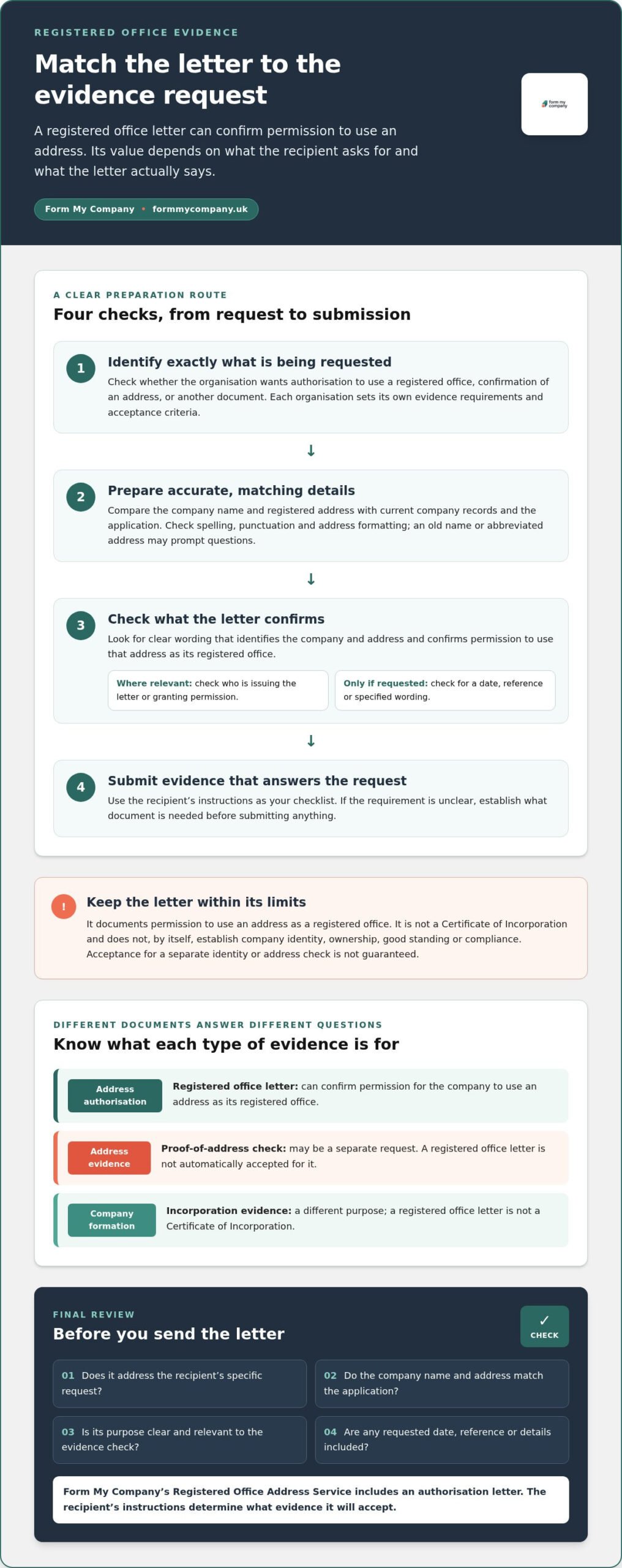
- Check the request. Read the recipient’s instructions and identify exactly what it needs: permission to use a registered office, address confirmation or another document. Note any requested wording, issue date or file format. Don’t assume a general “proof of address” request means the same thing as registered office authorisation.
- Gather the company and address details. Have the registered company name and current registered office address to hand. Use the spelling and formatting shown in the company’s current records. Keep the recipient’s instructions nearby so you can refer to them when making the request.
- Identify the address situation. Establish whether you’re arranging a new registered office address or seeking evidence for an existing arrangement. This helps you explain what you need without confusing a request for a new address with a request for documentation about an address already in use.
- Use the relevant provider route. For address support, start with Form My Company’s registered office address service, which includes an authorisation letter. Provide the relevant company and address information through the service route, and make your evidence requirement clear.
- Review the document before submitting it. Compare the letter with the recipient’s instructions. Check the company name and address, who issued it, what it confirms, and any date or other detail the recipient specifically requested. Resolve any discrepancies before sending it in.
For example, if an organisation asks for confirmation that your company has permission to use its registered office, check that the letter addresses that point. If it asks for a different kind of evidence, don’t assume an address authorisation letter will be accepted instead. Let the recipient’s instructions guide what you submit.
Before requesting a letter from Form My Company, prepare the exact company name, current registered address and the recipient’s evidence requirements. Explore registered office address support as your next step, and keep any separate Companies House filing requirements distinct from the evidence request.
Secure your registered office letter with Form My Company
Match your request to the evidence the recipient needs. Identify whether it wants confirmation relating to permission to use a registered office address or a different document. Then prepare accurate company details and use Form My Company’s Registered Office Address Service, which includes an authorisation letter.
What to have ready before you proceed
Bring the essential information together before you start. This helps you make a clear request and reduces the risk of inconsistencies in the details supplied.
- Exact company name: Use the current registered name, not a trading name or an earlier version.
- Registered office address: Check it against the company’s current records and use consistent spelling and formatting.
- Recipient’s instructions: Keep the organisation’s request close at hand, including any specific evidence, wording or document requirements.
- Address context: Be clear whether you need support with a new registered office arrangement or evidence relating to an existing address.
These checks help you explain what you need without assuming that one type of address evidence will satisfy every application. Follow the recipient’s instructions, especially if it specifies the kind of document it will accept.
Take the next step with Form My Company
Form My Company’s Registered Office Address Service provides support with your company’s registered office address and includes an authorisation letter. The evidence you submit should still be guided by the organisation making the request.
To secure a registered office letter from Form My Company, start with the registered office address support page and have your company details and evidence instructions ready. Review the letter against the recipient’s requirements before submitting it.
Ready to take the next step? Explore Form My Company and use the recipient’s evidence instructions to guide your application.
Move forward with the right address evidence
A registered office letter can help show that a company has permission to use an address, but it isn’t a substitute for proof of identity, incorporation evidence or every document a recipient might request. Start by checking the organisation’s instructions, then prepare the exact company name and current registered office address so your request is clear and consistent.
Form My Company’s Registered Office Address Service includes an authorisation letter and is a practical next step for registered office address support. Keep the recipient’s evidence requirements close at hand and review the letter against them before submitting it. Form My Company also supports UK company formation and related administrative needs.
Explore Form My Company and take the next step with your registered office address.
Frequently Asked Questions
What is a registered office letter?
A registered office letter is written evidence relating to a company’s permission to use an address as its registered office. Its meaning depends on the wording and who issued it. It can help show an address-use arrangement, but it isn’t a statutory certificate or proof that the company has met every filing or compliance requirement. Check what the letter confirms before relying on it for an application or verification.
Is a registered office letter the same as proof of address?
No. A registered office letter relates to a company’s permission to use an address, whilst proof of address may refer to evidence of a person’s residence or another address check. Organisations can use the phrase differently, so don’t assume one document will satisfy both purposes. Read the requesting organisation’s instructions and match the evidence to its specific requirement. It decides which documents it accepts for its checks.
How do I get a registered office letter from Form My Company?
Start with Form My Company’s Registered Office Address Service, which includes an authorisation letter. Prepare your exact company name, current registered office address and the organisation’s evidence instructions so your request is clear. First identify what the recipient needs the evidence to show, then review the letter against those instructions before submitting it.
Can I use a registered office letter as a Companies House certificate?
No. A letter issued in connection with an address arrangement isn’t a Companies House certificate, even if it refers to the company’s registered office. Companies House documents serve separate official purposes. For example, a Certificate of Incorporation is issued by Companies House and confirms that the company has been incorporated. Use the document named in the recipient’s request, rather than treating an address letter as an official company certificate.
Does a registered office letter prove that my company is incorporated?
No. A registered office letter may relate to permission to use an address, but it doesn’t by itself prove that a company has been incorporated. Incorporation evidence has a different purpose and is issued by Companies House. If an organisation asks for proof that your company exists, check whether it specifically requests a Certificate of Incorporation or another official company record, and submit the document that matches its instructions.
What should I check before submitting a registered office letter?
Check that the company name and registered address match your current records and the application. Make sure the issuer is identifiable and the letter clearly states what it confirms. Check for a date, reference or other detail if the recipient asks for one. Most importantly, compare the document with the organisation’s evidence instructions. An accurate letter can still be unsuitable if it doesn’t address the specific request.
Does a registered office letter replace updating Companies House?
No. A letter relating to permission to use an address and a Companies House filing are separate actions. The letter doesn’t, by itself, change the registered office address recorded for a company. If the address is changing, follow the relevant Companies House process as well as arranging any address evidence you need. Check that the company’s official records and the details used in your application are consistent.