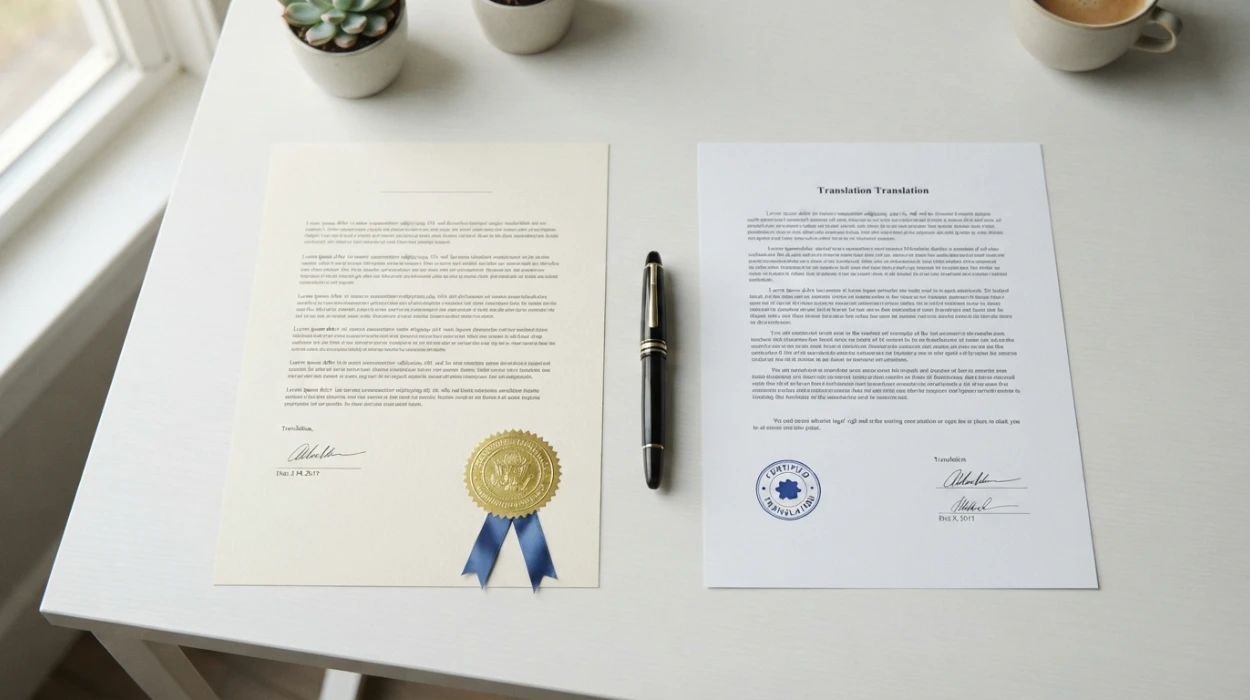
An apostille is an official government certificate that authenticates the legal status and signatures of public documents for cross-border recognition under the 1961 Hague Convention, eliminating the need for complex consular legalization when trading internationally.
Global expansion requires strict document compliance across sovereign borders. When UK enterprises register overseas subsidiaries, open foreign bank accounts, or file intellectual property, international registries demand absolute proof of corporate authenticity. Foreign authorities reject uncertified certificates of incorporation because they cannot independently verify UK registrar seals. Government authentication bridges this legal gap.
Why Do Foreign Authorities Require Document Authentication?
Foreign authorities require document authentication to eliminate corporate fraud, verify official company signatures, and establish legal certainty across sovereign borders during commercial transactions and overseas regulatory filings.
Cross-border trade exposes foreign regulatory bodies to significant compliance risks. 82% of international commercial disputes stem from unverified corporate credentials or fraudulent foreign entity registrations. When a UK director submits articles of association to a registry in Frankfurt or Tokyo, local officials cannot inspect Companies House archives directly. They rely on standardized certification frameworks to confirm that corporate records originate from legitimate government agencies.
National legal systems operate under distinct rules of evidence. A document valid in Cardiff or London holds zero legal weight abroad without formal certification. Authentication establishes a chain of custody from the issuing public official to the national authority executing the apostille. This process protects foreign markets from shell companies and unauthorized business operations.
How Does the Hague Apostille Convention Simplify Cross-Border Trade?
The Hague Apostille Convention simplifies cross-border trade by replacing multi-tiered embassy legitimization with a single, standardized certificate that is legally recognized across 125 member countries.
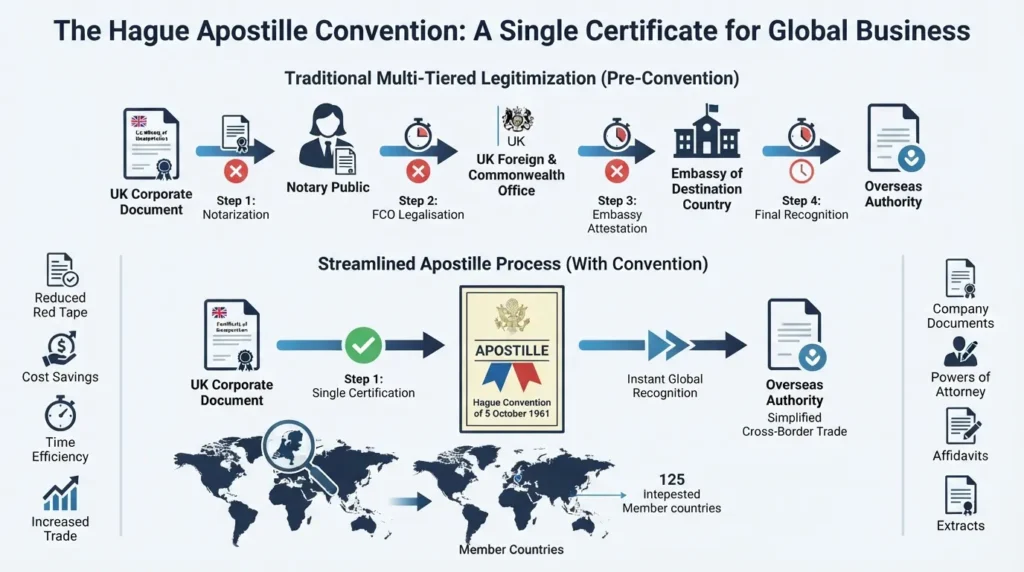
Before 1961, international business expansion required a bureaucratic nightmare of sequential certifications. Exporters had to authenticate corporate paperwork through domestic foreign ministries, followed by destination embassy or consulate approvals in London. This traditional diplomatic legalization frequently consumed 30 to 45 business days per filing. The treaty streamlined this workflow into a single verification step issued by a designated competent authority, such as the UK Foreign, Commonwealth & Development Office.
Eliminating redundant diplomatic layers reduces transaction costs for expanding enterprises. 94% of multinational corporate legal teams report that standardized treaty compliance accelerates foreign market entry timelines. When documents carry this official seal, destination countries accept them without secondary verification. Businesses can open overseas bank accounts and execute foreign contracts within days rather than months.
Which Corporate Documents Require an Official Seal?
Corporate documents requiring an official seal include certificates of incorporation, memorandum and articles of association, board resolutions, and certified director identity papers.
Establishing a foreign branch or subsidiary demands rigorous documentation of corporate existence. Overseas regulatory bodies inspect foundational constitutional documents to verify authorized share capital, registered office addresses, and voting director appointments. Three primary file categories undergo authentication: certificates of incorporation, registered company bylaws, and official financial statements. Foreign compliance officers inspect these files to evaluate commercial legitimacy before granting operational licenses.
To secure these records smoothly, companies often utilize specialised supplementary company documents to ensure every piece of compliance paperwork meets international legal thresholds. Official company registers must match the exact data submitted to foreign tax authorities. Discrepancies between domestic filings and foreign applications trigger immediate regulatory rejections. Precise document preparation prevents costly operational delays during international expansion.
What Is the Step-by-Step Verification Process?
The step-by-step verification process involves solicitor notarization of original corporate records, submission to government legalization departments, and final issuance of the official certificate.
Validating corporate paperwork requires strict adherence to institutional protocols. First, a registered UK notary public or practicing solicitor inspects the original company records and signs a formal notarial certificate. Second, the authenticated file goes to the national competent authority for official logging and seal application. Third, electronic or physical certificates are attached directly to the corporate bundle, creating a tamper-evident legal package.
Each stage requires absolute accuracy to prevent administrative rejections. 76% of initial document rejections occur because of improper solicitor attestation or expired corporate extracts. When dealing with foreign jurisdictions, businesses must verify whether destination authorities demand translations alongside the primary authentication. Professional compliance teams streamline this workflow by coordinating notarization and government submission concurrently. For practical guidance on handling these requirements, review How to Prove Your UK Company Status to Foreign Authorities to understand intermediate verification strategies.
How Does Authentication Impact Foreign Banking and Compliance?
Authentication impacts foreign banking and compliance by satisfying stringent Know Your Customer mandates, preventing anti-money laundering investigations, and securing overseas merchant accounts.
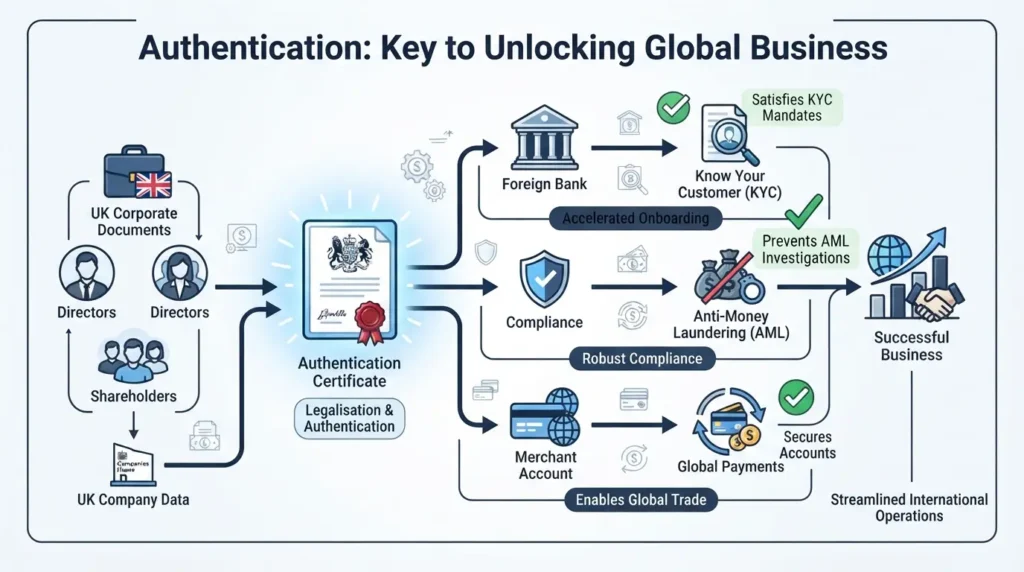
International commercial banks enforce rigorous compliance mandates before approving corporate accounts for foreign entities. Compliance officers demand verified proof of beneficial ownership and active corporate standing before releasing loan funds or processing cross-border wires. Unauthenticated papers trigger immediate freezes on corporate bank applications. 89% of tier-one international banks reject foreign corporate account requests that lack proper government validation.
Maintaining compliant corporate files protects businesses from severe regulatory penalties abroad. When foreign tax authorities audit local branches, directors must present verified proof of parent company legitimacy. Secure documentation safeguards corporate assets and ensures uninterrupted commercial operations. To initiate this process for your international expansion, explore Get Documents for Your Foreign Branch From Form My Company to secure verified corporate files directly.
International business expansion demands absolute legal certainty across sovereign borders. Standardized authentication frameworks eliminate bureaucratic delays and protect global markets from corporate fraud. Form My Company delivers the exact statutory records and expert compliance coordination required to navigate cross-border regulatory hurdles. Proper document preparation ensures seamless international operations.
Explore More Supplementary Company Documents Guide,
What Is Consular Legalisation for Non-Hague Convention Countries?
When Does a Document Need Embassy Attestation as Well as an Apostille?
Frequently Asked Questions
What are supplementary company documents for a UK business?
Supplementary company documents are official records—such as certificates of good standing, certified articles of association, and registry extracts—that provide verified proof of a company’s legal status. Form My Company supplies these vital corporate records to help businesses meet external regulatory, banking, and international compliance requirements.
Why do international authorities require document authentication?
Foreign regulatory bodies and overseas registries require government authentication to verify corporate legitimacy and eliminate fraudulent entity registrations across sovereign borders. Using certified supplementary company documents ensures that international partners and financial institutions accept your UK corporate history without question.
How long does it take to obtain certified company documents?
Obtaining certified corporate records typically takes between 2 to 5 business days, depending on whether the issuing registry requires standard processing or expedited dispatch. Form My Company streamlines this retrieval process to ensure your international filings and banking applications proceed without administrative delays.
Do foreign banks require apostilled company records for account opening?
International commercial banks enforce strict Know Your Customer mandates that require apostilled corporate records and supplementary company documents before approving foreign accounts. Providing officially authenticated proof of beneficial ownership and active corporate standing prevents immediate application freezes.
Can Form My Company assist with international document legalization?
Form My Company coordinates the complete document preparation workflow, including solicitor notarization, registry certification, and government legalization. This ensures every supplementary company document meets the exact legal thresholds required by foreign authorities and global trade partners.