
A Certificate of Good Standing does not feature a fixed statutory expiration date under UK corporate law. Companies typically require a fresh renewal every 3 months to 12 months because commercial partners, foreign registries, and financial institutions enforce strict validity windows for official verification.
Why Do Third Parties Require Frequent Renewals?
External institutions demand recent verification documents because corporate status changes dynamically through directors’ filings, registered office updates, and annual confirmation statement submissions.
Financial institutions require up-to-date documentation to satisfy anti-money laundering regulations and verify active corporate existence. Foreign government authorities mandate fresh authentication to ensure that a registered entity remains active and compliant in its home jurisdiction before expanding operations abroad. Overseas banks refuse documents older than 90 days because corporate directors can resign or companies can face administrative dissolution without immediate public notice.
Commercial partners request recent status confirmations during high-value contract negotiations to mitigate liability risks associated with dormant or dissolved entities. Business verification teams inspect registrar records to confirm that authorized signatories retain binding legal authority over corporate assets. Verification procedures protect enterprise clients from entering binding agreements with non-compliant trading partners across international markets.
What Factors Determine Your Specific Renewal Timeline?
Specific renewal frequencies depend entirely on external stakeholder demands, international trade requirements, and corporate finance compliance schedules across specific jurisdictions.
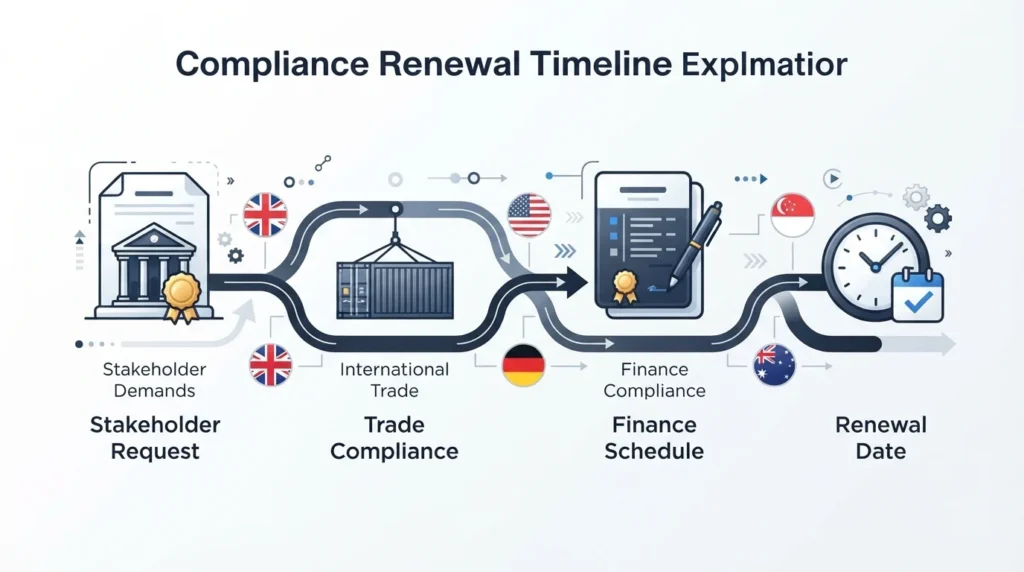
International expansion projects accelerate renewal schedules because foreign company registries enforce strict 30-day or 90-day validity windows for inbound branch registrations. Tender processes for public sector procurement contracts mandate documentation issued within the preceding 30 days to prove ongoing corporate solvency. Corporate banking reviews occur annually, requiring scheduled renewals to maintain active credit facilities and international merchant accounts. Mergers and acquisitions due diligence exercises necessitate real-time status proof, compelling legal teams to pull fresh documentation during active negotiations.
Regulated industries such as financial services and defense contracting adhere to strict compliance frameworks that mandate quarterly status validation. Internal corporate governance policies often dictate semi-annual reviews to ensure seamless operational continuity across multiple trading subsidiaries. Compliance officers track filing deadlines carefully to prevent administrative bottlenecks during critical commercial transactions.
How Does Document Expiration Impact International Expansion?
Expired documentation halts international expansion immediately because foreign regulatory authorities reject outdated corporate status proofs during cross-border subsidiary registration processes.
Overseas trade authorities require certified proof of active legal status to issue local business licenses and commercial operating permits. Foreign tax authorities freeze corporate bank account applications when presented with verification documents exceeding standard three-month validity thresholds. International commercial disputes require current standing proof to establish legal standing before foreign courts and arbitration panels.
Global supply chain partners terminate vendor agreements automatically when compliance departments detect lapsed corporate status verifications in annual audits. Cross-border asset acquisitions stall indefinitely while legal teams wait for updated registrar authentication from the home jurisdiction. Maintaining continuous compliance prevents costly operational delays and protects international business reputations across global markets.
When Should Companies Initiate the Renewal Process?
Companies must initiate the renewal process 14 days before submitting documentation to external stakeholders to accommodate standard registrar processing times and postal delivery windows.
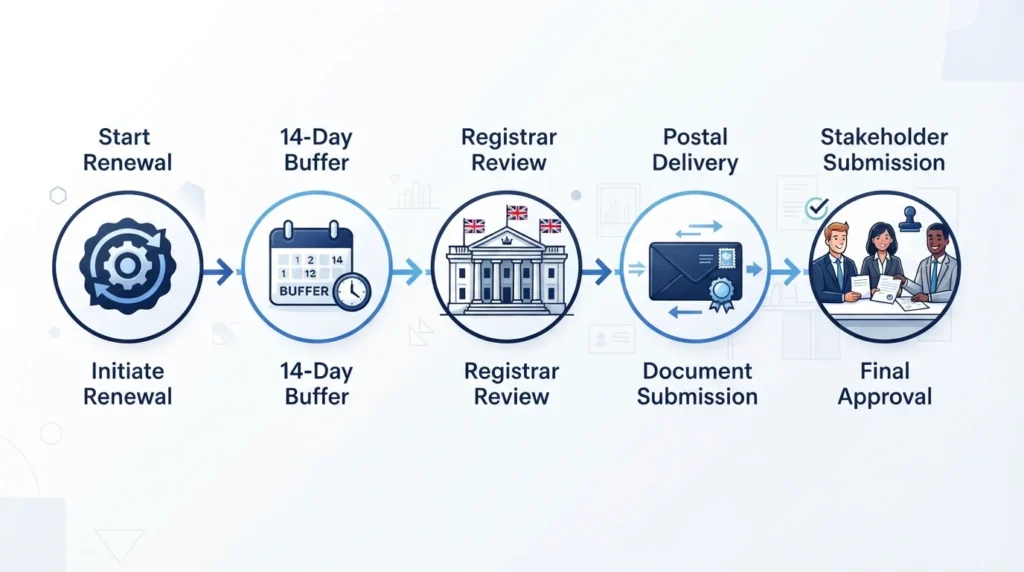
Corporate secretaries track registrar processing queues to anticipate seasonal backlogs at Companies House during peak financial reporting periods. Expedited service options reduce turnaround times significantly when urgent commercial transactions require same-day document dispatch. Administrative teams coordinate filing schedules with confirmation statement deadlines to streamline overall corporate compliance management.
Proactive planning prevents transaction failures during time-sensitive bank account openings and property lease negotiations across international borders. Maintaining an organized renewal calendar ensures seamless document availability for corporate legal audits and investor due diligence reviews. Businesses seeking streamlined document retrieval can utilize services like a Certificate of Good Standing to secure official registrar authentication efficiently.
How Can Businesses Streamline Their Compliance Tracking?
Businesses streamline compliance tracking by integrating document expiration alerts into central corporate calendars and automating scheduled status reviews across all operating entities.
Corporate compliance officers establish internal protocols that flag upcoming expiration dates 60 days prior to submission deadlines. Automated alerts notify directors when annual accounts or confirmation statements approach filing windows that affect corporate standing. Centralized document repositories store digital copies of historical certificates for immediate retrieval during unexpected compliance audits.
Standardizing renewal procedures across parent companies and overseas subsidiaries reduces administrative overhead and eliminates compliance gaps. Regular reviews of registrar filings ensure that company records remain accurate and reflect current director appointments and registered office details. Organizations looking for structured guidance on managing these timelines can review strategies outlined in How to Choose a Renewal Schedule for Your Certificate of Good Standing. Entities requiring end-to-end management can Get Your Certificate of Good Standing Renewed Before Deadline With Form My Company to guarantee timely document delivery.
Explore More Certificate of Good Standing Guide,
Why International Partners May Request a UK Certificate of Good Standing?
Why Do Tenders and Contracts Often Require a Certificate of Good Standing?
Frequently Asked Questions
What is a Certificate of Good Standing in the UK?
A Certificate of Good Standing is an official document issued by Companies House that confirms a UK company has been in continuous and unbroken existence since incorporation. Form My Company assists businesses in obtaining this certified proof to satisfy legal, banking, and international trade requirements.
How long does it take to get a Certificate of Good Standing?
Standard processing by Companies House typically takes between 3 to 5 working days, while expedited digital options can deliver results within 24 hours. Form My Company manages the entire application workflow to ensure rapid document retrieval for urgent commercial transactions.
Can an active company be denied a Certificate of Good Standing?
Companies House will reject a request if the entity has overdue filing obligations, such as unsubmitted annual accounts or overdue confirmation statements. Form My Company reviews your filing history beforehand to ensure all statutory requirements are met before submission.
Do foreign authorities require an apostille on the certificate?
International authorities operating outside the UK frequently require an apostille stamp or notarization to verify the authenticity of the certificate for cross-border use. Form My Company provides comprehensive legalization services to ensure your document meets foreign regulatory standards.
What information appears on the official certificate?
The document displays the company name, registration number, date of incorporation, and a formal statement confirming that no striking-off or liquidation proceedings are currently underway. Form My Company ensures all corporate details match current registrar records before dispatching the final authentication.