
Choosing a renewal schedule for your Certificate of Good Standing requires aligning document validity windows with partner requirements, as international banks typically mandate documents issued within 30 to 90 days, while domestic regulatory filings generally operate on an annual compliance cycle.
What factors determine your certificate renewal frequency?
Business transaction frequency, international banking compliance standards, and corporate governance requirements dictate your exact certificate renewal frequency across operational jurisdictions.
Operating a UK company involves managing various compliance documents. When global entities request proof of corporate vitality, they enforce strict freshness rules. Foreign authorities rarely accept historical verification records. Three primary operational drivers govern your renewal schedule: overseas expansion milestones, banking compliance audits, and corporate restructuring events.
International trade operations accelerate document turnover. Overseas registries demand fresh validation to confirm active corporate status. When directors engage in cross-border asset acquisition, counterparties require newly authenticated registry extracts. Foreign trade departments refuse documents older than 90 days. This restriction eliminates stale verification data from foreign trade pipelines.
Banking partners enforce rigid compliance schedules. Financial institutions require updated compliance evidence during annual reviews. Two common banking requirements include updating signature mandates and verifying director identities. Compliance officers freeze corporate accounts when verification documents expire. Establishing a proactive renewal calendar prevents unexpected operational disruptions.
Corporate restructuring events demand immediate documentation updates. Mergers, acquisitions, and equity financing rounds require pristine standing records. Legal advisors inspect corporate registers before closing transactions. Maintaining an active subscription for a Certificate of Good Standing ensures seamless legal transitions during major corporate milestones.
How do international trade requirements impact document validity?
International trade requirements impact document validity by enforcing strict age limits, as destination customs authorities and foreign banks mandate certificates issued within thirty days.
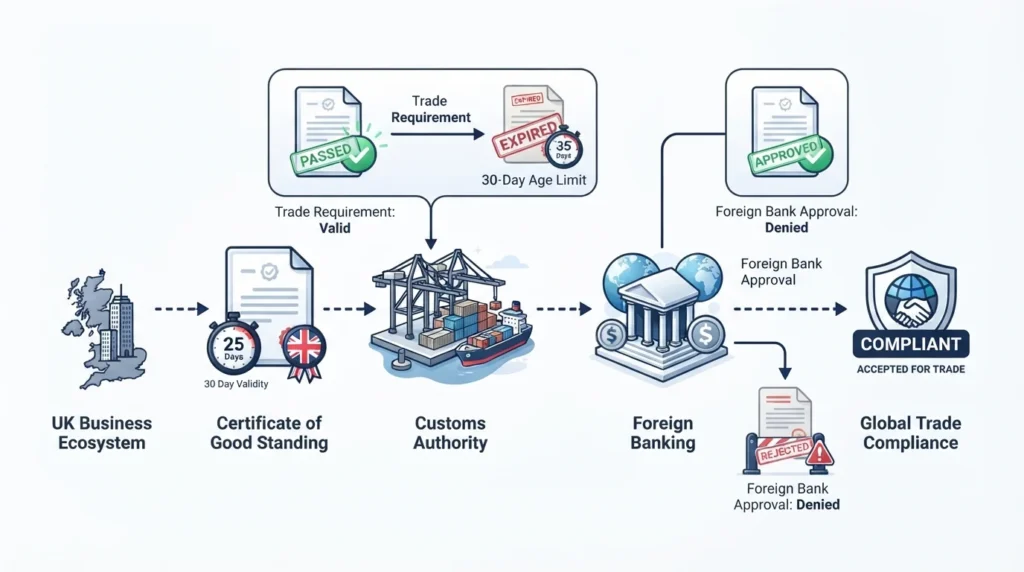
Exporting goods across international borders exposes businesses to rigorous administrative checks. Foreign customs departments scrutinize corporate credentials to prevent fraudulent market entry. Three common overseas trade demands include notarized registry extracts, apostille authentications, and consular legalizations. Each authentication layer consumes valuable operational time.
Foreign banking institutions maintain zero-tolerance policies for outdated corporate records. Compliance departments review corporate standing during every major credit facility renewal. Overseas subsidiaries must present current documentation to satisfy local tax authorities. Failing to provide fresh validation triggers administrative penalties and account freezes.
Navigating foreign bureaucracy requires advanced planning. Obtaining international authentication involves multiple government departments. Businesses must coordinate registry issuance, foreign office certification, and embassy legalization. Aligning your internal document cycle with foreign trade demands eliminates costly shipping delays.
How do banking compliance audits influence your schedule?
Banking compliance audits influence your schedule by triggering mandatory document submissions during annual reviews, anti-money laundering checks, and credit facility renewals.
Financial institutions operate under strict regulatory mandates. Compliance officers monitor corporate accounts for unusual transaction patterns. Two standard audit triggers include beneficial ownership changes and cross-border wire transfers. Banks demand fresh verification to confirm that corporate entities remain legally active.
Maintaining continuous access to financial services requires proactive planning. Commercial lenders review risk profiles every twelve months. When lenders request updated records, businesses have limited response windows. Submitting fresh validation documentation prevents temporary freezes on active business accounts.
Proactive management reduces administrative friction during bank audits. Corporate treasurers maintain digital repositories containing recently issued extracts. Financial institutions accept these validated documents to satisfy annual know-your-customer mandates. Streamlined compliance processes protect corporate liquidity and operational continuity.
How does corporate restructuring dictate validation timelines?
Corporate restructuring dictates validation timelines by requiring verified status proof during equity financing rounds, mergers, and corporate name changes.
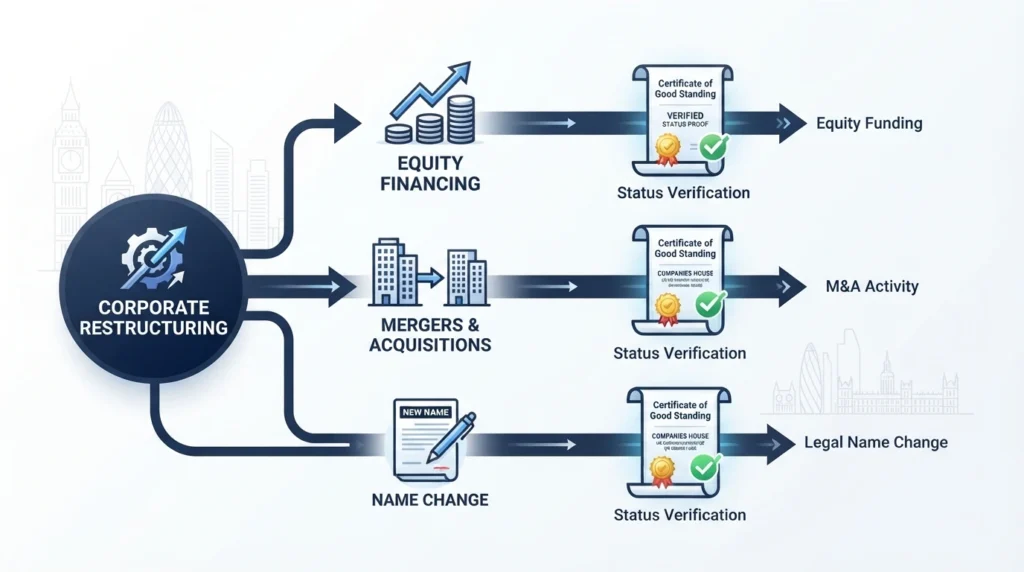
Corporate evolution introduces complex legal dependencies. Legal counsel audits corporate registers before approving major structural changes. Three typical restructuring activities include issuing new share classes, appointing additional directors, and relocating registered offices. Each action requires verified proof of corporate vitality.
Investors demand absolute certainty regarding target company status. Venture capital firms inspect corporate standing before releasing investment funds. Legal due diligence teams reject unverified historical extracts. Presenting current documentation accelerates funding rounds and builds investor confidence.
Corporate name changes and capital restructuring require official registry confirmation. Companies House updates official records to reflect structural adjustments. Following these registry updates, securing a fresh document proves that the corporate entity survived structural modifications without losing legal standing.
How can you establish an optimal document renewal calendar?
Establishing an optimal document renewal calendar involves auditing partner demands, synchronizing with annual accounting cycles, and automating document requests.
Building an efficient compliance calendar protects your enterprise from administrative oversight. Operations managers evaluate historical document requests across all active business units. Two effective calendar strategies include quarterly compliance reviews and annual audit synchronizations. These methods ensure documents remain fresh without generating unnecessary administrative expenses.
Automating document requests eliminates human error. Administrative teams schedule recurring orders through professional corporate secretarial providers. This systematic approach ensures critical deadlines pass without incident. Companies save valuable staff hours by outsourcing routine administrative tracking.
Reviewing renewal schedules annually keeps your business agile. Regulatory frameworks evolve across global jurisdictions. Adapting your document strategy to match changing regulatory demands ensures uninterrupted international operations. Consistent compliance protects your corporate reputation in competitive global markets.
Explore More Certificate of Good Standing Guide,
Comparing Reasons Companies Request a Certificate of Good Standing
How to Choose Between Ordering One Certificate or a Bundle for Multiple Uses
Frequently Asked Questions
How long is a Certificate of Good Standing valid in the UK?
A Certificate of Good Standing typically remains valid for 30 to 90 days depending on the requesting authority’s internal policies. Because international banks and foreign registries enforce strict freshness rules, Form My Company recommends securing fresh documentation if your corporate filing exceeds three months.
What information does a Certificate of Good Standing display?
A Certificate of Good Standing displays your company registration number, official corporate name, incorporation date, and a statement confirming the company is actively registered with Companies House. Form My Company assists businesses in obtaining official verification confirming that no strike-off or dissolution actions are currently pending.
Can a dissolved UK company obtain a Certificate of Good Standing?
A dissolved company cannot obtain a Certificate of Good Standing because the official register status must be active and compliant. When businesses require corporate verification, Form My Company verifies that annual confirmation statements and accounts are fully up to date before ordering the document.
Why do international banks require a recent Certificate of Good Standing?
International banks require a recent Certificate of Good Standing to satisfy anti-money laundering regulations and verify active corporate governance during compliance audits. Form My Company helps international enterprises secure authenticated registry extracts that meet the rigorous 30-day window demanded by overseas financial institutions.
How can Form My Company expedite my Certificate of Good Standing request?
Form My Company expedites your Certificate of Good Standing request by submitting electronic orders directly through official channels to bypass standard postal delays. Business owners receive certified digital copies promptly, ensuring seamless compliance for international trade, banking reviews, and corporate restructuring events.