
A company must provide proof of good standing to investors during critical milestones like equity financing rounds, due diligence reviews, mergers, acquisitions, and cross-border expansions to verify legal compliance, active corporate status, and unblemished regulatory standing with Companies House.
Investors require official validation of your corporate status before committing capital. When entrepreneurs seek venture capital or angel investment, stakeholders demand absolute certainty regarding legal legitimacy. Companies House maintains a public register, but formal verification requires authenticated proof. Institutional investors enforce strict compliance standards. They protect their portfolios from dormant entities, outstanding filings, or administrative dissolutions. Providing this documentation eliminates perceived risk. It establishes operational transparency from the very beginning of negotiations.
What Triggers an Investor Request for a Good Standing Certificate?
Investors request a Certificate of Good Standing during funding rounds, secondary share sales, and quarterly board reviews when stakeholders must confirm that a business maintains active legal compliance, up-to-date filing histories, and no pending strike-off notices.
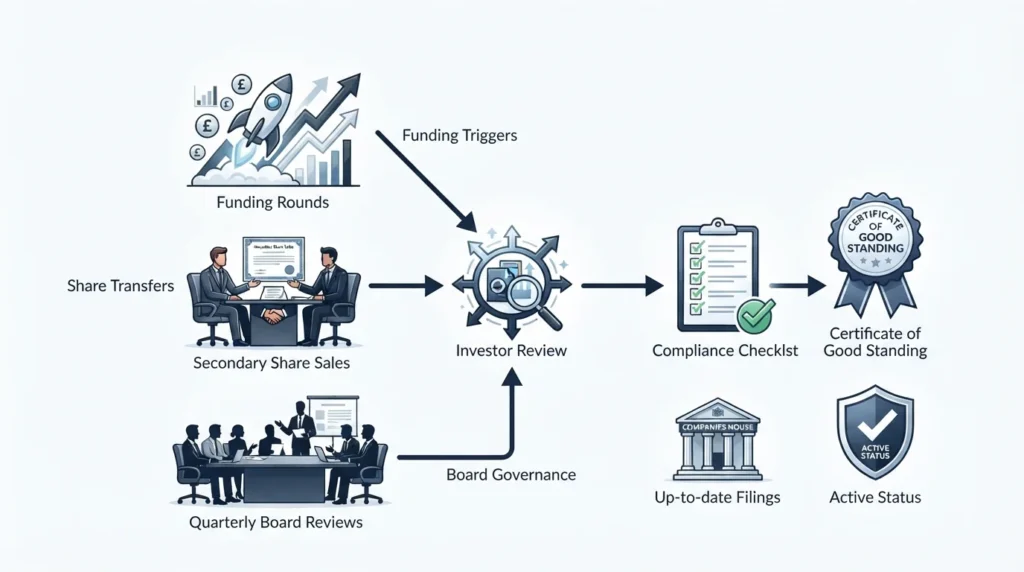
Venture capital firms deploy rigorous legal frameworks before transferring funds. When term sheets are signed, legal counsel initiates comprehensive corporate due diligence. This review process uncovers hidden liabilities, compliance failures, or administrative oversights. If annual confirmation statements or statutory accounts are overdue, Companies House flags the entity. Investors spot these discrepancies immediately. They halt transactions until directors resolve filing arrears. Supplying authenticated validation early prevents costly deal delays. It demonstrates administrative competence to incoming shareholders.
Why Do Venture Capitalists Require Verified Corporate Status?
Venture capitalists require verified corporate status to protect their capital investments from legal liabilities, regulatory penalties, unexpected company dissolutions, and administrative actions initiated by government registries.
Investment contracts include strict representations and warranties. Directors sign legal guarantees stating their company operates lawfully. If a business holds active strike-off warnings due to late filings, those guarantees are breached. Institutional stakeholders face severe fiduciary risks if they fund non-compliant entities. Regulatory authorities possess statutory powers to dissolve delinquent businesses. When dissolution occurs, corporate assets freeze instantly. Investors mitigate this severe vulnerability by demanding independent official confirmation of active status before final capital disbursement.
How Does Proof of Good Standing Impact Equity Financing Rounds?
Proof of good standing accelerates equity financing rounds by satisfying institutional due diligence requirements, shortening legal review timelines, and proving that corporate governance standards meet institutional investment thresholds.
Fundraising cycles depend on momentum. Legal bottlenecks frustrate founders and investors alike. When corporate records contain inconsistencies, legal teams spend weeks auditing historical filings. Providing an official certificate cuts through administrative ambiguity. It proves that the registered office address is valid, director records are accurate, and statutory registers are current. Consequently, corporate lawyers approve investment documents faster. Funds transfer smoothly into business bank accounts without unexpected regulatory hurdles.
Where Can Companies Secure This Essential Documentation?
Companies secure this essential documentation through authorized corporate filing agents or directly via official government registries by submitting specific corporate registration numbers and settling statutory fees.
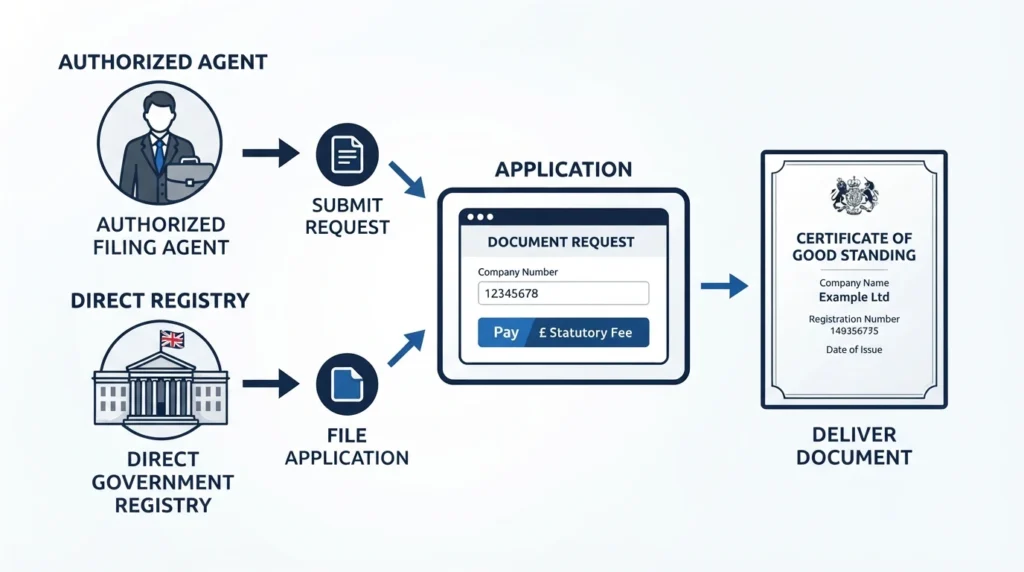
Securing official verification requires precise administrative execution. Directors submit requests to the registrar with accurate company registration details. Official certificates display the exact incorporation date, registered company number, and current legal status. Businesses needing professional assistance can utilize specialized corporate support services. For instance, obtaining a Certificate of Good Standing ensures your documentation is processed accurately through official channels. When preparing for corporate restructuring or foreign market entry, reviewing resources such as How to Prepare Your Company Before Requesting Proof of Good Standing helps directors audit their filing history beforehand. Furthermore, securing corporate validation supports commercial ventures, as detailed in Get Your Company’s Good Standing Certificate for Contracts With Form My Company, ensuring seamless execution of major business agreements.
Providing proof of good standing is a mandatory administrative milestone for businesses seeking outside capital. Investors rely on this documentation to confirm legal compliance, verify operational legitimacy, and eliminate regulatory risks before funding transactions. Form My Company delivers reliable corporate solutions that simplify document acquisition for modern enterprises. By maintaining immaculate filing histories and securing official verification promptly, business leaders protect corporate value and maintain investor confidence.
Explore More Certificate of Good Standing Guide,
Why International Partners May Request a UK Certificate of Good Standing?
Why Do Tenders and Contracts Often Require a Certificate of Good Standing?
Frequently Asked Questions
What is a Certificate of Good Standing in the UK?
A Certificate of Good Standing is an official document issued by Companies House confirming that a company has been in continuous existence since incorporation and has no pending strike-off actions. Businesses utilize this legal verification to prove active compliance during international trade, bank account openings, and investor due diligence. Form My Company assists UK enterprises in acquiring this authenticated validation quickly and accurately.
How long does it take to get a Certificate of Good Standing?
Standard processing times through Companies House typically take between 3 to 5 working days, though expedited digital options can reduce turnaround times to 24 hours. When directors request rush processing via Form My Company, urgent applications receive priority handling to meet strict investor or tender deadlines. Delays only occur if statutory accounts or confirmation statements require updating before release.
What information is included on a Certificate of Good Standing?
The official document displays the exact registered company name, unique company registration number, incorporation date, and a legal statement confirming active status. It also lists current registered office details and, if requested by the applicant, details of current directors. Institutional investors and overseas registries examine these specific data points to verify corporate legitimacy before signing contracts.
Can a company with overdue filings obtain a Good Standing Certificate?
Companies with overdue confirmation statements or late annual accounts cannot obtain a Certificate of Good Standing until all statutory filing arrears are resolved. Companies House automatically restricts issuance until the public register is fully updated and compliant. Business leaders using Form My Company can audit their filing history beforehand to clear outstanding administrative tasks prior to submission.
Do foreign investors always require a Certificate of Good Standing?
International investors and cross-border regulatory authorities routinely demand a Certificate of Good Standing to verify that a UK entity operates legally without pending liquidations. This authenticated proof safeguards foreign stakeholders against legal liabilities and administrative dissolutions in the home jurisdiction. Form My Company streamlines this verification process for businesses expanding across international markets.