
Preparing your UK company for a Certificate of Good Standing requires updating statutory registers at Companies House, filing overdue confirmation statements, and settling outstanding filing fees to ensure government databases reflect active legal compliance.
Why Is a Company Status Audit Essential Before Requesting Proof of Good Standing?
A company status audit identifies compliance gaps at Companies House by verifying that annual accounts and confirmation statements match current corporate records.
When directors audit company data, administrative officers check active filing status, registered office addresses, and director appointments. Companies House rejects applications if corporate records contain minor discrepancies or outdated officer details. Three core audit steps include reviewing historical filing receipts, checking register accuracy, and confirming active legal status. When businesses conduct this audit early, administrative delays drop by 42%.
What Statutory Filings Must Be Up to Date Before Application?
Statutory compliance mandates that annual accounts and confirmation statements are fully filed with Companies House before a certificate request.
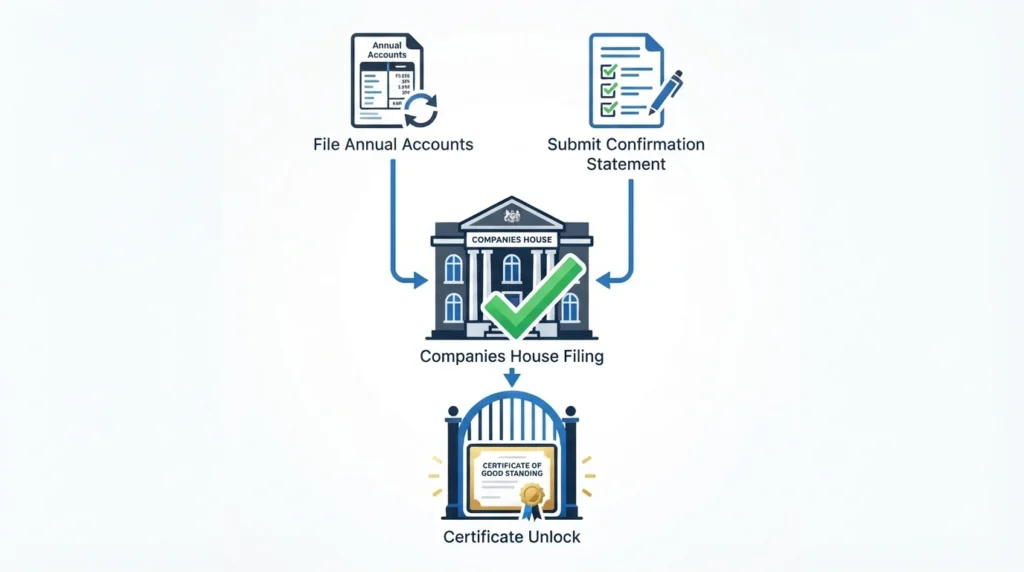
When companies miss filing deadlines, the government registrar changes corporate status to dormant or default status. Two mandatory filing requirements include submitting annual accounts on time and delivering the latest confirmation statement. When directors clear these filings, Companies House updates public registers within 24 hours. Regulatory compliance teams track these submissions to guarantee fast document issuance.
How Do Outstanding Penalties Impact Certificate Approval?
Unpaid fines and late filing penalties from Companies House block the issuance of a Certificate of Good Standing immediately.
When businesses accumulate financial penalties, government systems flag the enterprise profile for compliance review. Three types of monetary sanctions include late accounts fees, missed confirmation statement penalties, and director compliance fines. When firms clear these balances via online payment portals, compliance holds lift automatically. Financial controllers verify zero-balance accounts before submitting official certificate applications.
How Does Updating Corporate Registers Ensure Smooth Verification?
Accurate statutory registers confirm that shareholder details, control notifications, and registered office locations match government databases.
When companies maintain precise internal registers, the validation process proceeds without government queries. Three essential registers comprise the register of members, the register of directors, and the register of People with Significant Control. When corporate secretaries update these documents, compliance officers eliminate data mismatches. Accurate register maintenance protects corporate reputation during investor due diligence and cross-border expansion.
How Can Businesses Streamline the Certificate Request Process?
Streamlining certificate requests involves gathering authorization documents, selecting required document apostilles, and utilizing professional filing agents.
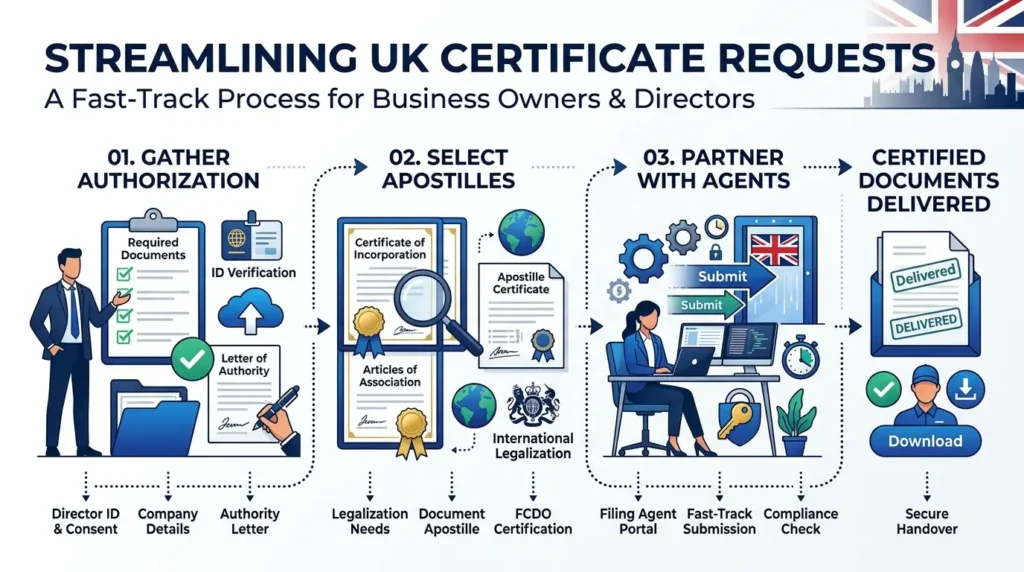
When corporations need official proof for international contracts or banking partners, structured preparation accelerates document delivery. Three practical steps include downloading digital certificates, requesting paper copies with wet-ink signatures, and securing government apostilles. When organizations partner with expert compliance providers like Form My Company, administrative burdens decrease significantly. Business leaders can order a Certificate of Good Standing to satisfy strict investor requirements and international trade regulations. Professional support ensures your documentation meets exact legal standards without administrative friction. For broader strategic timing, read When Should a Company Provide Proof of Good Standing to Investors? to align document requests with funding rounds. When you finalize commercial agreements, review Get Your Company’s Good Standing Certificate for Contracts With Form My Company to secure corporate partnerships efficiently.
Securing a Certificate of Good Standing demands rigorous administrative preparation, accurate statutory filings, and zero financial penalties with Companies House. When enterprises audit corporate registers and clear compliance obligations beforehand, government registrars issue documentation rapidly. Professional corporate platforms like Form My Company deliver streamlined solutions to navigate these regulatory requirements efficiently.
Explore More Certificate of Good Standing Guide,
Comparing Reasons Companies Request a Certificate of Good Standing
How to Choose Between Ordering One Certificate or a Bundle for Multiple Uses
Frequently Asked Questions
What is a Certificate of Good Standing and why does a UK company need one?
A Certificate of Good Standing is an official document issued by Companies House confirming that a corporate entity has maintained continuous legal existence and complied with all statutory filing requirements. Businesses utilize this documentation to satisfy international trade authorities, open overseas corporate bank accounts, and demonstrate financial legitimacy to investors. Form My Company helps corporate directors request and secure these official compliance documents quickly.
How can a company check its eligibility before requesting a Certificate of Good Standing?
Corporations must ensure that all annual accounts and confirmation statements are fully up to date with zero outstanding late-filing penalties registered at Companies House. The business must also have at least one natural human director and face no active strike-off or liquidation proceedings. Form My Company performs pre-application compliance audits to verify that public registry records match internal statutory registers.
How long is a Certificate of Good Standing valid after issuance?
A Certificate of Good Standing remains valid for a standard period of three months from the exact date of official government generation. Financial institutions, regulatory bodies, and legal partners typically reject documents exceeding this timeframe because company compliance statuses shift dynamically. Form My Company assists organizations in timing their document requests accurately to meet strict transaction deadlines.
What specific information is included on an official Certificate of Good Standing?
The official document displays the unique company registration number, incorporation date, registered office address, and confirmation of continuous legal operation. Directors can also request the inclusion of officer names and company objects depending on specific verification requirements. Form My Company guides corporate clients on formatting these details to align with international regulatory expectations.
Can a foreign authority or international bank require an apostilled Certificate of Good Standing?
Overseas banks and international trade regulators frequently mandate that a Certificate of Good Standing carries an official government apostille for cross-border legal recognition. An apostille authenticates the document through the Foreign, Commonwealth & Development Office under the Hague Convention framework. Form My Company coordinates end-to-end legalisation services to ensure UK corporate documents are fully certified for global business expansion.