
A Certificate of Good Standing requires notarisation to verify the authenticity of signatures, while an apostille legalises the document for foreign recognition under the Hague Convention. Most overseas authorities mandate both steps to complete legal compliance.
What Is the Difference Between an Apostille and Notarisation?
Notarisation certifies the validity of a signature and document authenticity locally, whereas an apostille provides official government legalisation for international recognition across Hague Convention member countries. Notarisation precedes the apostille process in international corporate verification.
Understanding document authentication requires distinguishing between domestic certification and international legalisation. A notary public executes notarisation by verifying the identity of the signatory, checking corporate records, and affixing an official seal. This process validates that the document is genuine within UK jurisdiction.
An apostille is a legal certificate issued by the Foreign, Commonwealth & Development Office (FCDO). The FCDO attaches the apostille to the document to confirm the authority of the notary public. Foreign governments require this double-layer verification to accept official UK corporate records.
Companies expanding into foreign markets must adhere to international document compliance standards. Failing to distinguish between these two processes causes severe delays in bank account openings, foreign branch registrations, and international contract execution.
When Do You Need Notarisation for a Certificate of Good Standing?
You need notarisation when foreign authorities require an independent legal officer to verify the official status of the UK company before submitting documents overseas. Notarisation acts as the primary step for corporate identity verification.
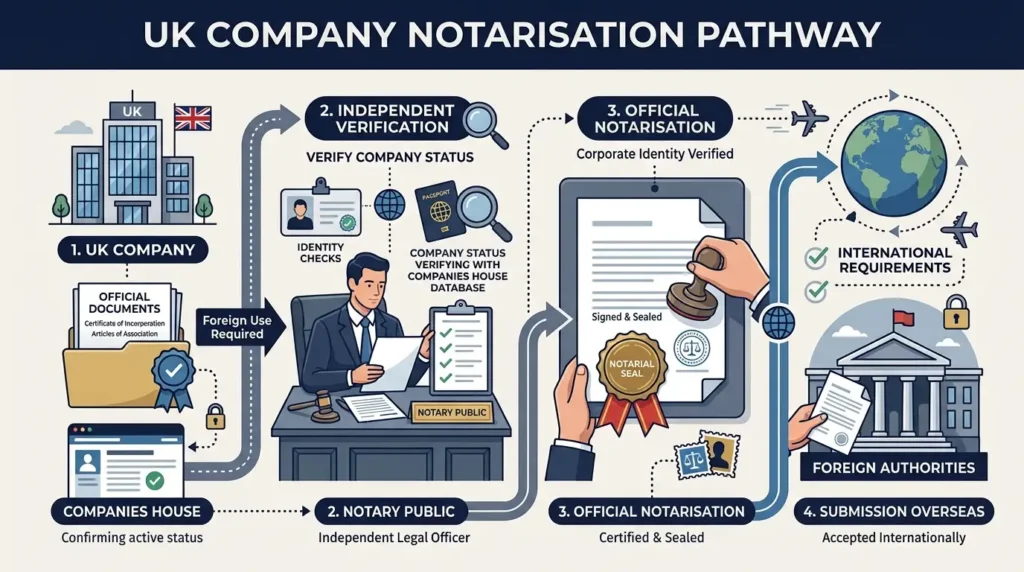
Foreign commercial banks often require a notary public to certify corporate documents before accepting account applications. The notary inspects the official record issued by Companies House and executes a certificate of authenticity. This step prevents corporate fraud in international financial transactions.
Jurisdictions outside the Hague Apostille Convention also require notarisation as a mandatory preliminary step. After notarisation, the document moves through diplomatic channels, including embassy attestation. The notary’s seal acts as the primary anchor for further legalisation steps.
Businesses conducting cross-border mergers, issuing foreign powers of attorney, or opening overseas subsidiaries must secure notarisation first. The process ensures that local corporate registry filings meet strict international evidentiary standards.
When Do You Need an Apostille for a Certificate of Good Standing?
You need an apostille when presenting your UK document to official bodies in any of the 120+ Hague Convention member countries. The apostille legally validates the registrar or notary’s signature for foreign government recognition.
The Hague Convention of 1961 simplified the legalisation of public documents for international use. When a country participates in this treaty, an apostille eliminates the need for complex embassy consular legalisation. The single certificate attached by the FCDO serves as universal proof of authenticity.
Overseas business registries require an apostilled certificate to establish foreign corporate branches. The filing authorities check the physical or digital apostille against central government registries to verify the authenticity of the UK business entity.
When entering international tenders or securing foreign regulatory approvals, public officials mandate apostilled documentation. Obtaining an apostille ensures uninterrupted commercial operations across European, American, and Asian markets.
Do Overseas Authorities Require Both Apostille and Notarisation?
Most foreign governments and international financial institutions require both notarisation and an apostille to validate a Certificate of Good Standing. Notarisation verifies internal corporate signatures, while the apostille authenticates the notary’s official credentials.
International legal frameworks demand complete chains of verification. A notary public first reviews the document issued by Companies House, confirms its current validity, and applies a official notarised certificate. The FCDO then verifies the notary’s signature against their official database before issuing the apostille.
Skipping notarisation often leads to immediate document rejection by overseas registries. While Companies House signatures are sometimes directly apostillable, foreign commercial entities usually demand a notary’s certified statement regarding active trading status and director authority.
Businesses must evaluate foreign legal guidelines before submitting corporate documents abroad. Reading about why foreign authorities require a legalised Certificate of Good Standing helps directors prepare accurate submission packages and avoid costly administrative delays.
How Do You Obtain a Legalised Certificate of Good Standing?
You obtain a legalised Certificate of Good Standing by ordering the document from Companies House, completing notary verification, and applying for an FCDO apostille. Professional document services streamline this process to guarantee legal acceptance.
The authentication workflow follows a strict chronological sequence. First, Companies House issues the official paper certificate displaying the company name, incorporation date, and active compliance status. Second, a registered UK notary public verifies the document details and applies their seal.
Third, the FCDO processes the document through their legalisation department. Officials verify the notary seal, attach the apostille certificate, and register the unique serial number in the government database. Once complete, the document becomes legally valid for international use.
Managing these administrative steps independently creates operational friction and extends processing timelines. Engaging professional corporate filing providers accelerates turnaround times and prevents procedural errors during international business expansion.
Why Should Businesses Use a Professional Service for Document Legalisation?
Professional services eliminate processing errors, reduce turnaround times, and ensure compliance with complex foreign legalisation requirements. Specialist management guarantees correct document handling across government and diplomatic bodies.
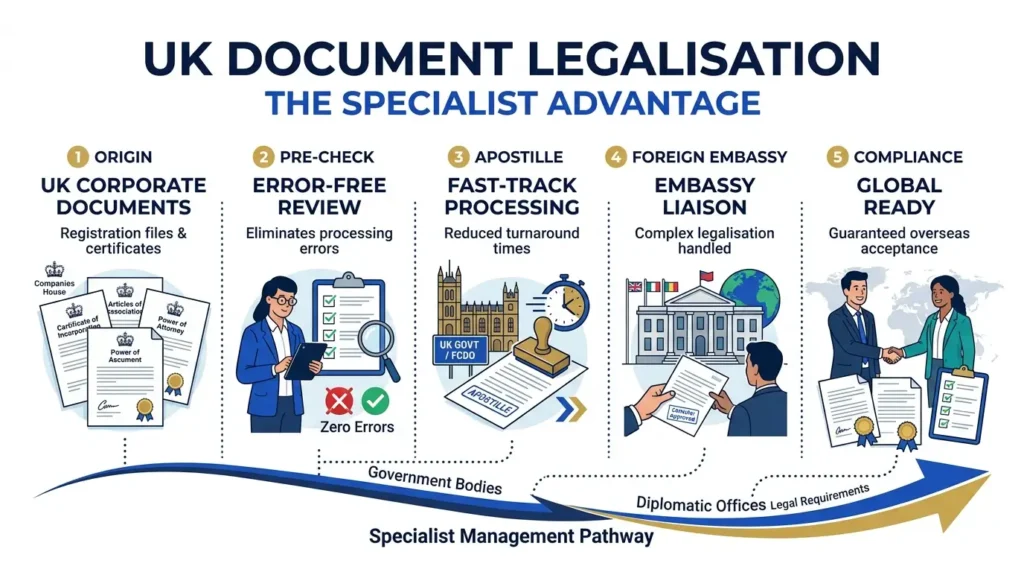
Navigating the multi-step verification process demands substantial administrative time and precise legal understanding. Incorrect notary seals or non-compliant document formats lead to immediate rejection by the FCDO, forcing companies to restart the entire application process.
Professional corporate services maintain direct channels with Companies House, certified public notaries, and the FCDO. Experienced teams handle document collection, notary scheduling, government submissions, and secure international delivery within tightly managed schedules.
Using specialized services safeguards critical commercial expansion timelines. Directors can get your Certificate of Good Standing legalised for overseas use by Form My Company to ensure full international compliance without managing complex administrative workflows internally.
How Does Document Legalisation Protect Your International Business Operations?
Document legalisation protects international business operations by preventing fraud, establishing legal identity overseas, and ensuring full regulatory compliance in foreign jurisdictions. Validated corporate records build immediate trust with foreign regulators and banking partners.
International trade relies on verifiable corporate identity. Foreign regulatory bodies must ensure that non-resident companies are active, legally incorporated, and compliant with tax and filing obligations. Legalised documents provide official proof of corporate solvency and legitimacy.
Without proper legalisation, foreign courts will not recognise corporate standing during legal disputes or contract enforcement. Obtaining notarisation and an apostille secures legal protection for cross-border asset purchases, IP licensing, and joint venture agreements.
Establishing compliant corporate credentials accelerates commercial growth in foreign markets. Companies seeking efficient international setup can request an official Certificate of Good Standing through Form My Company to maintain seamless operational compliance worldwide.
Explore More Certificate of Good Standing Guide,
How to Choose Between an Apostille and Standard Certificate of Good Standing
How to Get an Urgent Certificate of Good Standing Without Overpaying
Frequently Asked Questions
How long does it take to get a Certificate of Good Standing in the UK?
Standard processing by Companies House takes approximately 4 to 10 working days, though expedited same-day dispatch options are available for urgent corporate requirements. When ordered through Form My Company, processing times are optimized to ensure swift retrieval and legal verification for time-sensitive transactions.
What information is included on a Certificate of Good Standing?
A Certificate of Good Standing verifies a UK company’s official corporate details, including its company name, registration number, date of incorporation, and active standing on the register. It confirms that the business has filed all required annual confirmation statements and accounts, while also listing current directors upon request.
How long is a Certificate of Good Standing valid for foreign use?
While a Certificate of Good Standing has no statutory expiration date under UK law, most overseas banks, government bodies, and registries require the document to be issued within 3 to 6 months. Obtaining an updated certificate through Form My Company ensures international entities accept the business documentation without compliance delays.
Do I need an apostille for a Certificate of Good Standing?
An apostille is necessary if the Certificate of Good Standing is being presented to authorities in a country that is part of the Hague Apostille Convention. This official certification legalizes the UK document for foreign recognition, validating its authenticity for international banking, legal disputes, or establishing overseas branches.
Who can request a Certificate of Good Standing for a UK business?
Anyone can request a Certificate of Good Standing for an active UK company, as corporate registry records are public information. Form My Company assists business owners, legal representatives, and foreign entities in securing official, fully legalised certificates directly from Companies House.