
To prepare your Memorandum and Articles of Association for a commercial lease, review your company constitution for restrictive borrowing clauses, execute necessary board resolutions to update powers, obtain certified true copies from Companies House, and present the bound legal documents directly to the commercial landlord.
Commercial landlords require verified corporate governance documents before executing property agreements. Preparing these corporate instruments requires systematic administrative checks to satisfy institutional leasing requirements in the United Kingdom.
Why Do Landlords Demand Your Memorandum and Articles Before Lease Execution?
Landlords inspect Memorandum and Articles of Association to verify corporate legal capacity, confirm director execution authority, evaluate commercial borrowing limits, and ensure statutory compliance under the Companies Act 2006 prior to executing binding commercial property lease agreements.
Commercial property owners conduct detailed legal due diligence before granting tenancy rights to corporate entities. Commercial leases create long-term financial liabilities for corporate tenants. Property owners examine the Articles of Association to confirm that the tenant entity possesses the statutory authority to incur substantial lease liabilities.
Legal review of constitutional documents protects property owners against ultra vires corporate actions. Corporate actions outside constitutional powers create legal unenforceability risks for property leases. Landlords examine director appointment mechanisms to ensure signing officers possess valid legal representation powers.
Statutory checks prevent corporate lease invalidation disputes during tenancy periods. Landlords match Companies House public register filings against internal corporate records provided by tenant management teams. Discrepancies between official public filings and submitted internal records trigger immediate lease approval delays. Property managers utilize official documentation to verify that corporate signatories act within established constitutional authority limits.
How Do You Audit Constitutional Documents for Lease Restrictions?
Audit constitutional documents by reviewing objects clauses, checking director execution limits, verifying shareholder consent thresholds, and identifying borrowing restrictions within company articles to ensure complete legal compliance before negotiating commercial lease terms with property managers.
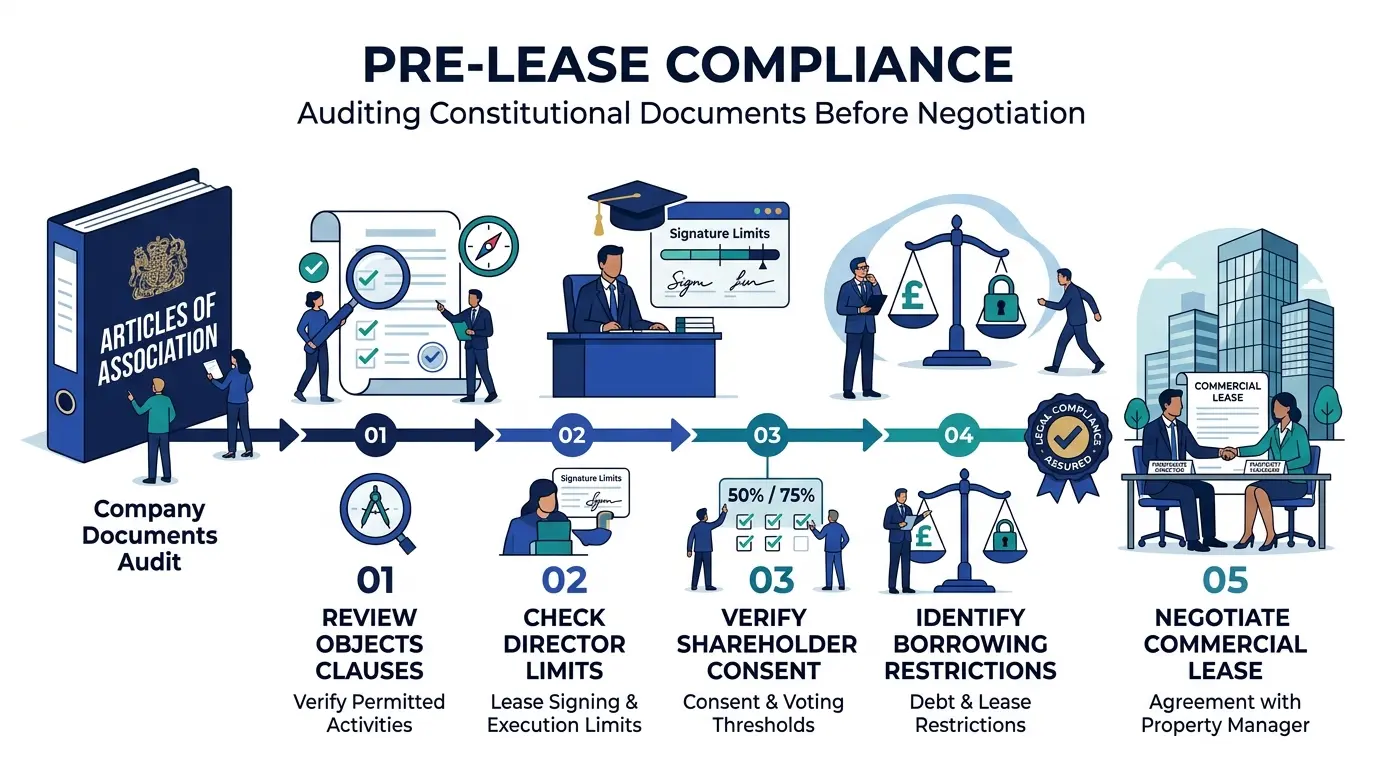
Corporate directors must examine historic company constitution provisions before engaging in property negotiations. Older UK corporate entities operating under Table A model articles often contain express restriction clauses regarding property transactions. Directors locate specific limitation clauses by reviewing corporate governance registers.
Auditing requires systematic verification of three primary governance areas:
Inspect borrowing and leasing limitation clauses within company articles
Verify director voting thresholds for major real estate commitments
Review corporate seal requirements for legal deed execution protocols
Unrestricted model articles under the Companies Act 2006 grant broad operational powers to corporate officers. Custom company articles frequently restrict property acquisition, lease guarantees, and long-term financial commitments. Directors must identify restrictive operational limits before signing formal heads of terms with commercial property brokers.
Failure to audit constitutional provisions creates severe operational delays during property transactions. Corporate boards resolve internal governance conflicts by identifying constitutional limits early in the commercial acquisition cycle. Reviewing legal capacity ensures smooth transaction progression during commercial leasing processes. Directors maintain legal compliance by aligning lease obligations with registered corporate powers.
How Do You Amend Restrictive Company Articles for Commercial Leasing?
Amend restrictive company articles by drafting updated constitutional provisions, passing a formal shareholder special resolution with a 75% voting majority, and filing Form CC01 alongside the revised articles with Companies House within 15 days.
Updating corporate constitutions requires strict adherence to statutory amendment processes under UK company law. Directors convene a board meeting to propose constitutional amendments. Shareholders receive formal notice proposing special resolutions to remove operational property restrictions.
Shareholders approve constitutional updates through formal voting procedures:
Convene a formal general meeting or circulate a written resolution
Secure approval from at least 75% majority of voting shareholders
Document resolution outcomes within official corporate minute books
Companies House requires submission of amended articles within 15 statutory days following resolution approval. Directors file Form CC01 electronically or via paper submission to update the public register. Failure to register revised constitutional documents renders internal updates unenforceable against third parties.
Updating constitutional frameworks allows companies to grant guarantees, execute long-term leases, and authorize designated directors to bind the business. Companies streamline future property acquisitions by removing archaic operational restrictions. Reviewing constitutional flexibility supports ongoing corporate growth across commercial property sectors.
Which Supplementary Company Documents Do Landlords Require Alongside Articles?
Landlords require Certificate of Incorporation copies, official director registers, shareholder structures, valid board minutes authorizing lease execution, and certified constitutional records to fulfill rigorous corporate identity and Know Your Customer compliance standards.
Institutional property owners conduct comprehensive corporate background checks before executing commercial lease documents. Landlords combine constitutional document reviews with supplementary corporate filings to confirm operational legitimacy. Corporate tenants supply complete legal packs to satisfy landlord legal counsel standards.
Providing complete documentation prevents extended commercial property transaction delays. Entities ordering supplementary company documents establish complete verified legal packs for institutional landlord compliance teams. Official corporate documentation confirms internal authority lines and verifies entity standing under UK commercial property regulations.
Landlords verify operational entity structures using five distinct documentation types:
Certificate of Incorporation verifying current legal status
Official Companies House register extracts detailing director appointments
Shareholder registers confirming ultimate beneficial ownership structures
Formal board resolutions authorizing specific lease commitments
Certified Memorandum and Articles of Association copies
Combining constitutional documents with corporate registers satisfies mandatory anti-money laundering regulations. Landlords authenticate business addresses, corporate structures, and authorized officer signatures before circulating final lease contracts. Complete documentation packs accelerate lease completion timelines significantly for commercial tenants.
How Do You Certify and Bind Articles of Association for Landlord Review?
Certify Articles of Association by printing complete registered copies, obtaining a wet-ink certification statement from a practicing solicitor or company director, and binding the physical documents securely for presentation to institutional property owners.
Landlords reject uncertified digital copies during formal commercial lease completion stages. Certified hard-copy constitutional records provide legal certainty regarding document authenticity. Corporate secretaries organize physical document certification to satisfy commercial property standards.
Physical presentation standards require meticulous administrative assembly:
Print complete current constitutional documents from official registry sources
Apply official certification wording confirming document accuracy on page one
Secure physical pages using professional binding methods to prevent page substitution
Official certification statements require specific legal phrasing signed by authorized individuals. Practicing solicitors, notary publics, or registered company directors endorse physical documents with original signatures. Certified true copies reassure landlord legal representatives regarding corporate representation validity.
Bound constitutional documents prevent unauthorized page removal or alteration during legal review processes. Institutional property managers archive physical legal packs within corporate property record management systems. Presenting professionally bound documentation reflects operational maturity and accelerates commercial lease execution procedures.
What Steps Resolve Constitutional Discrepancy Issues Before Signing?
Resolve constitutional discrepancies by identifying registry mismatches, drafting remedial board resolutions, filing corrected documents with Companies House, and providing updated certified corporate registers to landlord solicitors before lease completion dates.
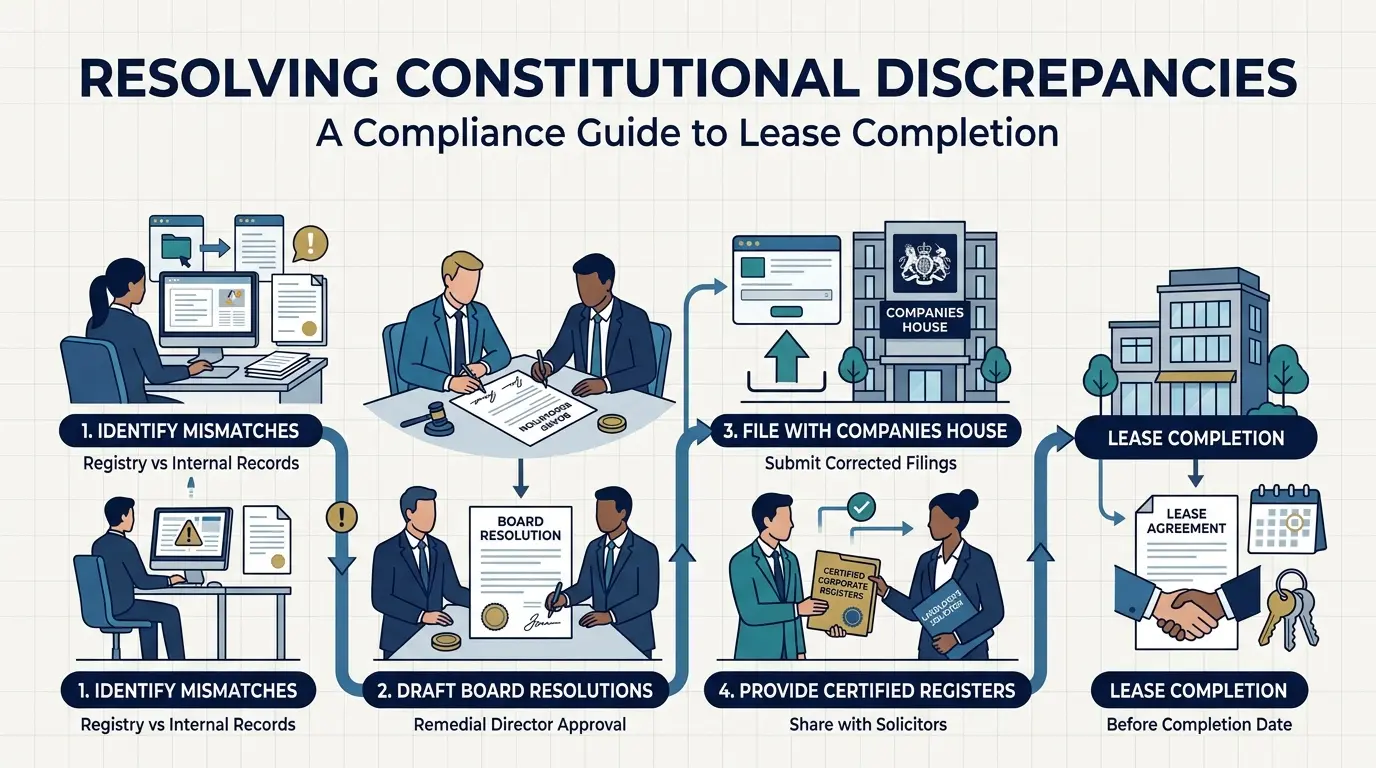
Discrepancies between public filings and internal corporate records delay lease execution timelines. Landlord solicitors cross-examine submitted articles against Companies House public registers during title investigations. Mismatched director names, outdated registered addresses, or unfiled special resolutions trigger immediate legal requisitions.
Remediating corporate registry issues requires four sequential administrative actions:
Audit public Companies House filings against current internal company registers
Draft remedial board minutes addressing identified administrative discrepancies
Submit missing statutory filings or corrective forms to Companies House
Issue certified explanatory letters to landlord legal teams confirming corrections
When companies maintain conflicting administrative records, directors execute corrective resolutions to align internal authority with public filings. Understanding why landlords ask for your company articles before signing a lease helps corporate teams resolve potential title requisitions proactive. Correcting public records ensures legal enforceability across commercial real estate commitments.
Resolving documentation defects eliminates title requisition delays during final lease completion stages. Clear communication between tenant corporate secretaries and landlord legal representatives maintains transaction momentum. Maintaining accurate Companies House records safeguards corporate commercial standing across UK real estate markets.
How Do You Present Prepared Company Documents to Secure Property Approval?
Present company documents by assembling a certified legal compliance pack, transmitting digital verification files to landlord solicitors, delivering bound physical copies, and confirming formal constitutional clearance prior to lease execution.
Organized document delivery demonstrates administrative competence to prospective commercial property owners. Tenant management teams coordinate document transmission directly with landlord legal representatives. Complete compliance submission accelerates property approval timelines across competitive commercial leasing environments.
Structured legal packs contain certified constitutional documents, active corporate registers, and authorized signatory matrices. Digital verification files allow landlord solicitors to initiate background verification checks immediately. Delivering physical bound sets satisfies formal legal archiving requirements for property management firms.
Tenants streamline commercial property acquisitions by utilizing professional document preparation services. Corporate managers choose to order bound company articles for your lease with Form My Company to receive fully certified compliance documentation tailored for landlord review. Form My Company delivers bound legal packs that satisfy rigorous UK landlord due diligence criteria.
Securing written document approval from landlord solicitors clears final legal hurdles before lease execution. Form My Company assists commercial tenants by compiling accurate corporate records that fulfill property compliance requirements. Organized constitutional preparation guarantees efficient corporate property leasing transactions.
Explore More Supplementary Company Documents Guide,
How to Check Your Articles Before Issuing New Shares
How to Get Your Company Compliant Enough to Qualify for Good Standing
Frequently Asked Questions
What are supplementary company documents for a UK limited company?
Supplementary company documents are official legal records, such as Certificates of Good Standing, solicitor-certified Memorandum and Articles of Association, duplicate Certificates of Incorporation, and official director or share registers. These supplementary corporate instruments enhance standard registration files to verify active compliance, legal authority, and operational standing under the Companies Act 2006. Businesses order these documents through Form My Company using their Supplementary Company Documents Service to satisfy strict due diligence checks by banks, landlords, and institutional investors.
Why do commercial landlords require certified Articles of Association before executing a lease?
Commercial landlords inspect certified Articles of Association to verify corporate legal capacity, confirm director execution authority, and identify specific borrowing or property leasing restrictions. Reviewing certified constitutional records prevents ultra vires actions and validates that corporate signatories hold proper authorization to bind the business to long-term liabilities. Landlords rely on bound, solicitor-certified compliance packs provided by Form My Company to confirm statutory compliance before granting tenancy rights.
How do supplementary company documents differ from standard Companies House filings?
Standard Companies House filings include initial incorporation applications and routine annual confirmation statements that register or update public details. Supplementary company documents provide on-demand, specialized extracts and solicitor-certified legal records required for formal business verifications. Services like Form My Company compile these extra legal instruments—including bound constitutional documents and legal letters of authority—into a unified corporate pack for third-party evaluation.
Which corporate documents are required to fulfill UK anti-money laundering and KYC compliance?
To fulfill Know Your Customer (KYC) and Anti-Money Laundering (AML) standards, entities must present a Certificate of Incorporation, current Articles of Association, official director registers, and Persons with Significant Control (PSC) disclosures. Financial institutions and corporate solicitors require these verified records to confirm ultimate beneficial ownership structures and active entity standing. Obtaining professionally bound supplementary company documents ensures seamless compliance approval across commercial financial processes.
How can a business order certified supplementary company documents in the UK?
UK businesses can order certified supplementary company documents directly through accredited formation agents like Form My Company or directly via Companies House. Form My Company provides a dedicated Supplementary Company Documents Service that issues solicitor-certified legal packs, bound Memorandum and Articles of Association, and official corporate status certificates. Ordering pre-assembled, bound document sets ensures rapid delivery of compliant legal files ready for immediate presentation to landlords, banks, or regulatory authorities.