
Yes, every co-founder needs an individual copy of the Articles of Association to enforce constitutional rights, verify director duties, and maintain legal compliance. Access guarantees transparent governance, protects shareholder equity, and prevents decision-making disputes during company operations.
What Are the Articles of Association for a UK Business?
The Articles of Association serve as the legal constitution for a UK private limited company, establishing internal governance rules, director authority, shareholder rights, and administrative procedures. UK company law requires every registered business to adopt these rules during official incorporation.
The Articles of Association define the foundational framework governing internal business operations. Statutory provisions under the Companies Act 2006 require every UK private limited company to establish a constitutional agreement upon registration. This document regulates decision-making mechanisms between corporate officers and equity holders. Company directors execute operational choices within the statutory boundaries established by these internal governance guidelines.
Corporate constitutional documents establish clear boundaries for board power and voting procedures. The regulations stipulate rules for convening general meetings, issuing new equity shares, and executing board resolutions. Without constitutional rules, corporate officers risk invalidating corporate decisions through procedural non-compliance. Statutory Model Articles provide standard operational terms unless founders submit custom-drafted governance provisions during company registration.
Every registered business maintains these constitutional regulations within official corporate files. Companies House archives constitutional records submitted during official incorporation proceedings. Publicly available filings allow third parties, commercial lenders, and regulatory authorities to inspect company governance structures. Statutory compliance requires maintaining accurate, updated constitutional documentation throughout the operational lifecycle of a business enterprise.
Why Do Co-Founders Require Individual Copies of Company Articles?
Co-founders require individual copies to review voting entitlements, verify share transfer restrictions, and audit executive authority. Personal copies ensure immediate reference during board meetings, dispute resolutions, shareholder voting procedures, and external investor negotiations.
Personal possession of constitutional documents protects founding partners from governance uncertainty. Co-founders evaluate voting thresholds before executing significant commercial transactions or changing operational directions. Having immediate access eliminates reliance on executive officers during internal management reviews. Founders confirm their rights regarding dividend distributions, pre-emption entitlements, and board appointment mechanisms.
Share transfer restrictions require continuous inspection during equity adjustments or founder exits. Articles contain specific drag-along and tag-along provisions that govern share sales to third parties. Co-founders audit these clauses to protect minority shareholdings from forced liquidations or unauthorized equity dilution. Understanding statutory valuation formulas prevents legal conflicts when valuation disputes emerge between founding partners.
Corporate governance disputes escalate rapidly when executives lack immediate legal documentation. Reviewing personal copies allows co-founders to verify whether executive decisions require simple majority consent or special board resolutions. Immediate documentation checks prevent unauthorized director actions and protect early-stage corporate assets. Founders ensure company growth remains aligned with original constitutional agreements.
What Legal Rights Do Co-Founders Have to Access Corporate Documents?
Section 32 of the Companies Act 2006 grants every company member the legal right to request an up-to-date copy of the Articles of Association. Corporate officers must supply the requested constitutional document within seven business days of receiving written notice.
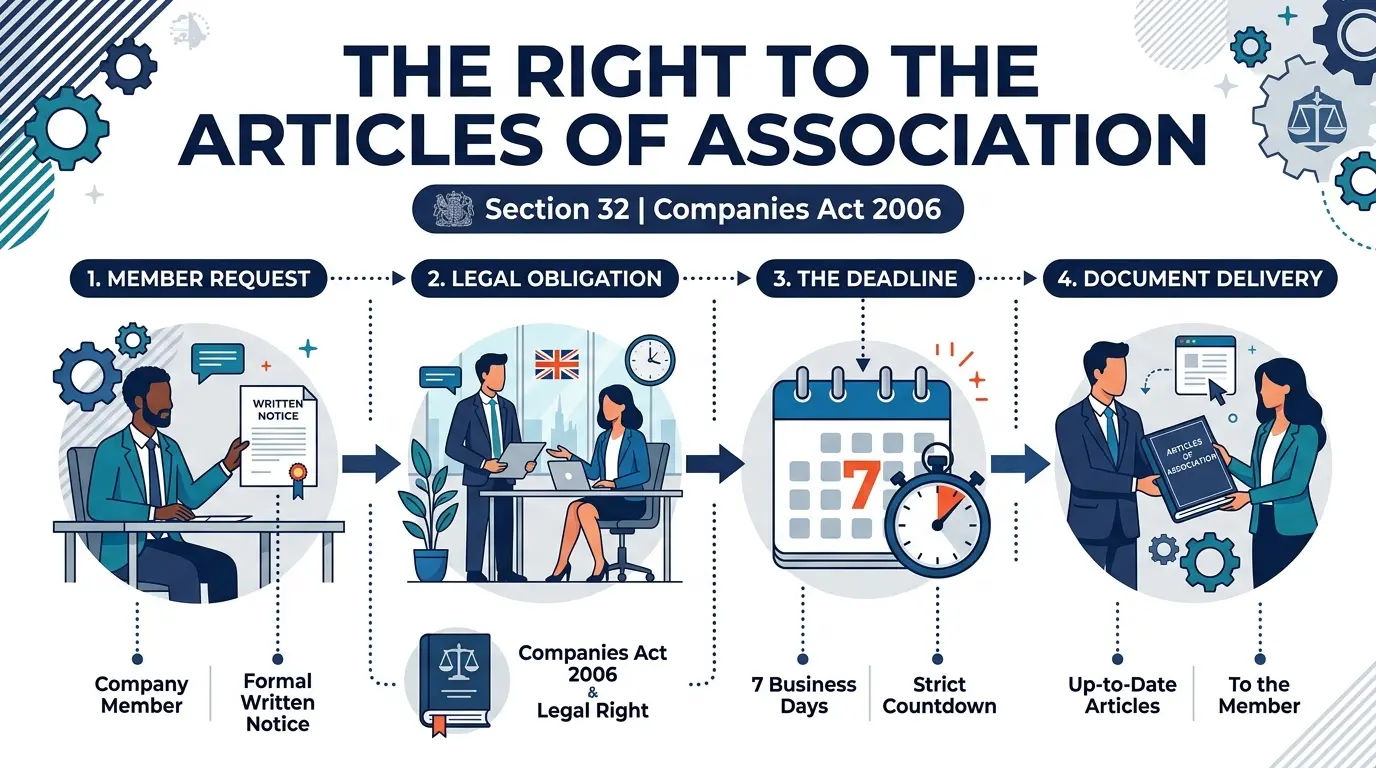
UK company law guarantees shareholder access to core corporate records through statutory mandates. Section 32 of the Companies Act 2006 establishes an absolute right for registered equity holders to demand official constitutional files. Executive officers face statutory fines for failing to deliver compliant copies within the mandatory seven-day turnaround window. Corporate secretaries maintain certified files to fulfill statutory access requests without administrative delays.
Members examine constitutional terms to validate board governance compliance and corporate actions. Equity holders verify whether executive officers hold appropriate statutory authorization to execute binding commercial contracts. Access rights extend to inspecting memorandum records, special resolutions, and register entries concerning share allotments. Transparency rules reinforce fiduciary accountability across executive management structures.
When co-founders encounter administrative refusal from board members, formal statutory remedies apply. Members register written compliance notices directly to the registered office address of the business entity. Continued withholding of constitutional files empowers shareholders to file compliance petitions in court. Legal precedents enforce statutory transparency to protect investor equity and officer accountability.
How Do Articles of Association Protect Co-Founder Equity and Voting Power?
Articles of Association protect co-founder equity by setting pre-emption rights, weighted voting parameters, and share transfer rules. These constitutional mechanisms stop unauthorized equity dilution and ensure major decisions require agreed shareholder consent thresholds.
Pre-emption rights safeguard co-founders against sudden equity dilution during future funding rounds. When companies issue new shares, existing shareholders receive the right of first refusal to purchase pro-rata allocations. Articles specify explicit timelines and notice requirements for executing pre-emption entitlements. Founders exercise these contractual protections to maintain proportional ownership percentages across multiple investment stages.
Voting rights structures establish exact approval thresholds for specific corporate actions. Standard business operations require simple majority approval exceeding 50% of voting shares. Major structural modifications, such as changing company names or altering share capital, require special resolutions exceeding 75% shareholder approval. Co-founders negotiate bespoke voting clauses to secure veto powers over critical operational decisions.
Share transfer provisions control how equity moves when co-founders depart the business enterprise. Permitted transfer clauses define exact terms for moving shares to family members or associated corporate vehicles. compulsory transfer mechanisms require departing founders to offer equity back to remaining shareholders at fair market valuation. Clear constitutional transfer rules prevent unwanted third parties from acquiring sensitive voting stakes.
What Happens When Co-Founders Do Not Have Updated Copies?
Without updated copies, co-founders risk executing invalid board decisions, breaching share transfer procedures, and misinterpreting executive authority. Operating on outdated constitutional terms triggers legal disputes, invalidates share allotments, and delays commercial investment deals.
Operating with outdated corporate documents creates significant legal vulnerability during commercial operations. Companies frequently amend constitutional rules via special resolutions as business structures evolve over time. Co-founders relying on initial incorporation documents overlook modified dividend structures, updated voting requirements, or revised director appointment rules. Misinterpreting operational boundaries leads to unauthorized corporate actions that third parties can invalidate through legal challenges.
Unregistered or unreviewed constitutional modifications disrupt corporate investment proceedings. External investors conduct rigorous legal due diligence before injecting capital into early-stage enterprises. When co-founders present conflicting, outdated, or incomplete constitutional records, institutional investors pause funding negotiations. Identifying procedural discrepancies in historic shareholder votes delays transaction closings and increases legal advisory expenses.
Internal partner disputes frequently stem from constitutional ambiguity and missing documentation. Co-founders who lack current copies struggle to resolve governance deadlocks or enforce board removal terms during operational disagreements. Misunderstanding executive remedies prolongs corporate deadlocks, halting daily business activities. Maintaining accurate documentation eliminates procedural uncertainty and preserves operational stability across the enterprise lifecycle.
How Can Co-Founders Obtain Official Bound Copies of Their Articles?
Co-founders obtain official bound copies by ordering certified documentation through official company formation services or requesting registered records directly from Companies House. Official hard copies deliver physical proof of corporate regulations for banking, legal, and investment procedures.
Obtaining physical governance documents requires reviewing official incorporation records or ordering certified company files. While electronic PDF records satisfy basic digital storage needs, formal corporate actions require physical documentation. Financial institutions, international commercial partners, and institutional investors demand bound constitutional documents during formal verification procedures. Co-founders secure hard-copy records to satisfy institutional compliance checks during commercial expansion.
When businesses require official printed documentation, executive officers utilize specialist corporate service providers. Companies access comprehensive corporate administrative solutions to procure professional bound constitutional records for executive board members. Ordering through Supplementary Company Documents ensures every director receives fully compliant, officially formatted constitutional literature. Professional bound editions provide durable, authoritative references for board meetings and regulatory audits.
Corporate secretaries audit physical records regularly to confirm alignment with public filings. When shareholders update corporate terms via special resolutions, companies must print and bind updated constitutional editions. Distribute revised physical copies immediately to ensure all founding partners operate under identical regulatory conditions. Systematic record distribution supports legal compliance and reinforces operational transparency across corporate governance structures.
How Should Companies Distribute Articles to Shareholder Groups Correctly?
Companies distribute Articles to shareholders by issuing certified digital copies, delivering physical bound documents, or posting files to secure corporate portals. Formal distribution protocols require tracking delivery confirmations to prove statutory compliance under UK law.
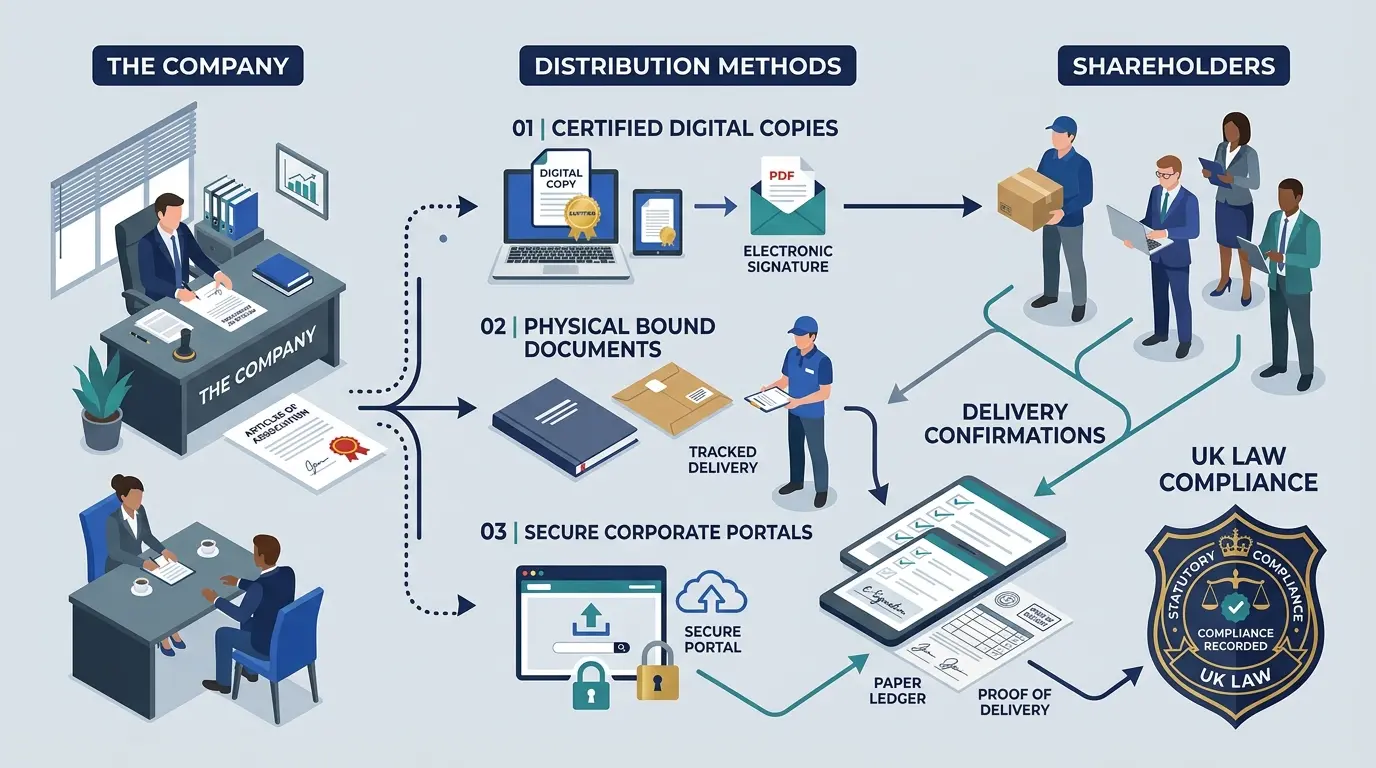
Establishing formal distribution protocols prevents future corporate disputes regarding document access. Executive management teams implement systematic procedures to deliver constitutional files upon share allotment or shareholder onboarding. Officers issue physical or digital copies along with official share certificates to confirm equity ownership terms. Understanding how to share your Articles of Association with shareholders correctly guarantees that corporate managers fulfill statutory disclosure obligations under Section 32 mandates.
Digital distribution platforms provide instant access while maintaining detailed audit trails. Corporate portals track user logins, document downloads, and version history for governance files. When companies adopt special resolutions to amend internal rules, automated notification systems alert registered shareholders immediately. Digital logs offer verifiable evidence that every corporate member received updated constitutional documentation.
Physical distribution remains essential for formal board management and legal verification procedures. Companies supply bound hard copies during annual general meetings and formal director appointments. Executive management teams choose to get extra bound Articles for every director from Form My Company to establish physical corporate archives for executive leadership. Maintaining physical records guarantees uninterrupted access during legal reviews, compliance audits, and banking procedures.
Every co-founder requires direct access to an updated copy of the Articles of Association to enforce governance rights and maintain regulatory compliance. Transparent documentation prevents shareholder disputes, protects equity structures, and ensures lawful corporate decision-making. Form My Company assists UK business founders by providing certified corporate documentation, official filings, and professional bound company records to support compliant corporate governance.
Explore More Supplementary Company Documents Guide,
How Many Copies of Your Articles of Association Should a Company Keep?
Why Do Landlords Ask for Your Company Articles Before Signing a Lease?
Frequently Asked Questions
What are Supplementary Company Documents in the UK?
Supplementary company documents are official filings, certificates, and certified corporate records—such as a Certificate of Good Standing, bound Articles of Association, or formal resolutions—that extend beyond initial incorporation papers. These certified records verify active legal status, director credentials, and ownership structures to meet strict regulatory and compliance standards. Form My Company provides a comprehensive Supplementary Company Documents service that supplies solicitor-certified packs and bound official records for UK limited companies.
Why do businesses need a Supplementary Company Documents service?
UK businesses require supplementary company documents to satisfy third-party compliance requirements for bank account opening, international trading, commercial leases, and investor due diligence. Banks and regulatory bodies demand updated physical or certified proof confirming active status, voting structures, and director authorities before approving key transactions. Utilizing the Supplementary Company Documents package from Form My Company ensures corporate records are legally verified, professionally bound, and audit-ready.
What documents are included in a supplementary corporate pack?
A standard supplementary corporate pack can include solicitor-certified copies of the Certificate of Incorporation, bound Memorandum & Articles of Association, Statements of Capital, and official Letters of Authority. It may also feature Certificates of Good Standing, current Person with Significant Control (PSC) notifications, and board resolutions. Form My Company tailors its Supplementary Company Documents service to compile the exact certified certificates and bound records required for your specific corporate structure.
How quickly can you receive certified supplementary company documents?
Processing and delivery times for certified supplementary records depend on whether standard or priority solicitor certification and dispatch options are selected. Most physical bound packs are processed, verified by a qualified solicitor, and dispatched directly to registered UK business addresses within a few business days. Ordering through Form My Company streamlines this procedure, providing fast access to officially formatted Supplementary Company Documents.
Who is eligible to order Supplementary Company Documents from Form My Company?
The Supplementary Company Documents service from Form My Company is designed for UK-based private limited companies and corporate directors needing formal, solicitor-certified documentation for official submissions. Existing customers who incorporated their business through Form My Company can order supplementary packs, duplicate certificates, or extra bound Articles directly. This service offers a trusted route for growing enterprises that need verified corporate proof for banks, auditors, or new commercial partners.