
To sell or transfer company shares in the UK, directors and shareholders must follow the pre-emption rights, valuation rules, and approval procedures outlined in their Articles of Association. Following these governing rules ensures all share transfers remain legally binding, valid, and compliant with Companies House requirements.
What Are Company Articles of Association During a Share Transfer?
Articles of Association serve as the legal constitution of a private limited company, setting out statutory rules for share transfers, director powers, pre-emption rights, and shareholder voting thresholds. They legally bind all legal members and establish strict compliance protocols for equity sales.
Private limited companies operating in the United Kingdom rely on their Articles of Association to establish internal corporate governance. The document forms a statutory contract between the company, its appointed directors, and its individual shareholders. When a shareholder decides to sell or reallocate equity, the provisions within the articles dictate the precise statutory sequence. Executing a share transfer without consulting these rules renders the transaction void under UK corporate law.
Companies House provides default Model Articles for private companies incorporated under the Companies Act 2006. However, 73% of UK limited companies adopt bespoke or amended articles to protect existing investor equity. These customized clauses establish precise restrictions on who can purchase company shares. Reviewing the original incorporation documents ensures that sellers identify pre-sale notifications, mandatory board consent rules, and transfer restrictions before drafting sale agreements.
Corporate shareholders must examine statutory transfer definitions embedded within their governing documentation. Transfer clauses cover voluntary share sales, court-ordered equity transfers, inheritance transmissions, and forced buyouts following employee departures. Identifying the exact mechanism ensures full statutory compliance across all corporate restructuring activities.
How Do Pre-Emption Rights Regulate Share Transfers?
Pre-emption rights require a selling shareholder to offer their equity to existing shareholders before selling to external third-party buyers. These statutory provisions protect original founders from dilution and maintain internal control over company ownership structures during equity transactions.
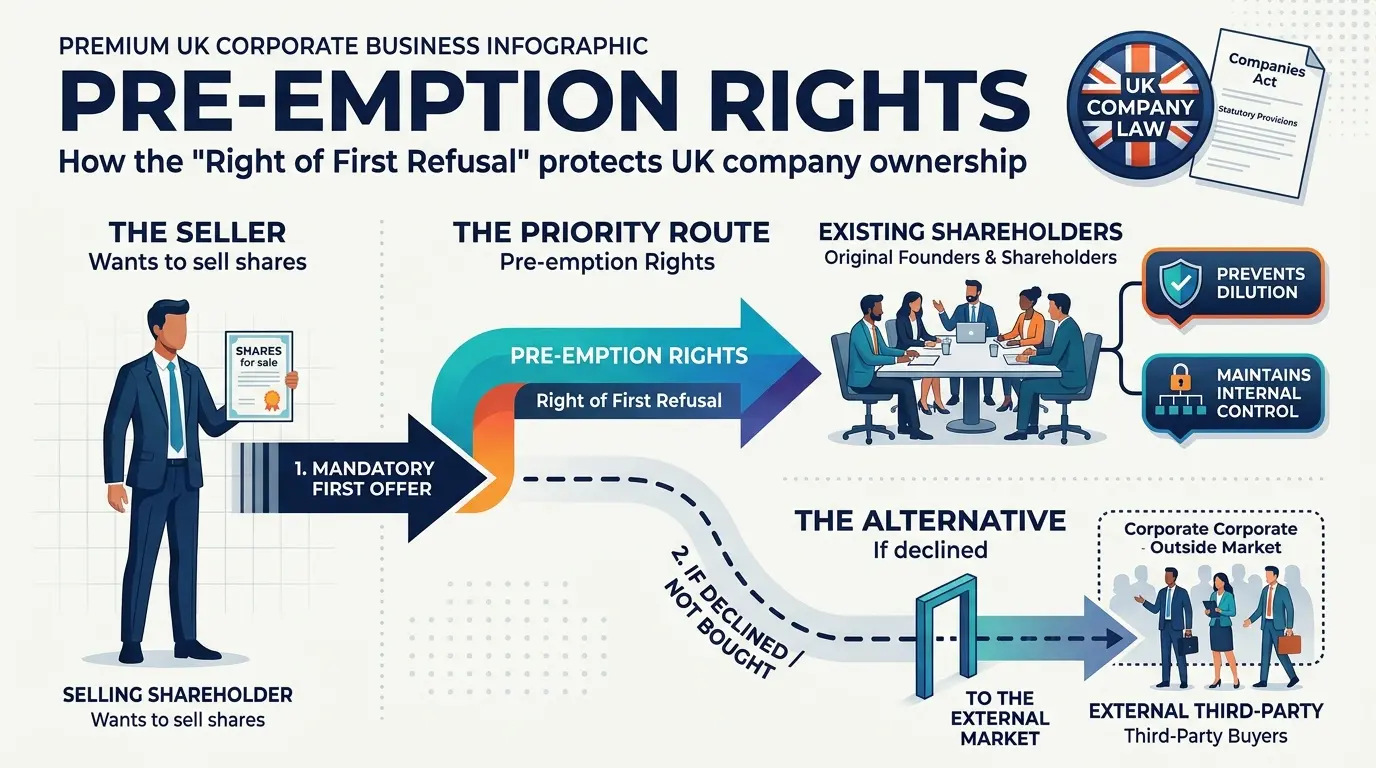
Pre-emption rights operate as a legal right of first refusal for existing company members. When a shareholder intends to dispose of equity, the articles require them to issue a formal transfer notice to the board of directors. The notice specifies the number of shares, proposed price per share, and seller identity. Directors must then circulate this offer to current shareholders on a pro-rata basis according to their current holdings.
Existing shareholders receive a defined statutory window, typically 21 to 28 days, to accept or decline the share offer. If existing shareholders purchase all available equity, the transfer completes internally through standard legal instruments. If existing members refuse or only partially purchase the offered shares, the selling shareholder gains legal authorization to sell the remaining balance to external third-party buyers at the same price.
Transfers executed in breach of pre-emption rights trigger immediate legal challenges from existing investors. Board members who approve unauthorized transfers face potential breach of duty claims under Section 171 of the Companies Act 2006. Shareholders can verify or update their corporate constitution by procuring statutory Supplementary Company Documents to confirm existing pre-emption clauses.
How Do Board Approval Clauses Control Equity Sales?
Board approval clauses give company directors absolute legal discretion to refuse or register share transfers within private limited companies. Directors must exercise this statutory power in good faith to advance the long-term commercial interests of the company.
Private company articles frequently grant directors the statutory authority to decline share transfer registrations without providing detailed justification. This power prevents competitor acquisitions, unauthorized changes in operational control, and unvetted investors from obtaining access to internal financial registers. Directors evaluate prospective buyers against reputational, regulatory, and commercial metrics prior to issuing formal transfer consent.
When a selling shareholder submits a executed Stock Transfer Form (J30), the board must convene within two months to formally consider the transaction. If directors refuse the transfer, they must send a formal notice of refusal to the transferee within two months of the submission date. Failure to deliver notification within this statutory timeframe forfeits the board’s right to reject the share transfer.
Directors must record all transfer decisions within official board minutes. If directors exercise refusal powers maliciously or to advance personal interests, injured shareholders can apply to the High Court under Section 994 of the Companies Act 2006 for relief against unfairly prejudicial conduct. Understanding statutory transfer boundaries is easier when founders review what are the share transfer rules in articles of association? to prevent board deadlocks during investor exits.
How Do Drag-Along and Tag-Along Provisions Work?
Drag-along clauses allow majority shareholders to force minority shareholders to join in the sale of a company, while tag-along rights protect minority investors by guaranteeing them the right to join a majority-led share sale under identical financial terms.
Drag-along provisions protect majority investors who secure an offer to sell 100% of the company to an institutional acquirer. Most corporate buyers require full ownership rather than partial equity stakes. When a designated majority threshold (typically 75% or 90% of voting shares) accepts an acquisition offer, drag-along rights legally compel remaining minority members to sell their equity. This clause prevents individual minority shareholders from blocking high-value corporate acquisitions.
Tag-along provisions safeguard minority shareholders against being left behind during major ownership transitions. If a majority shareholder sells their stake to an external acquirer, tag-along clauses mandate that the buyer must extend the same offer to minority members. This mechanism ensures that small investors receive the same valuation per share, payment terms, and exit timing as majority equity holders.
Integrating drag-along and tag-along mechanisms requires precise legal drafting within corporate articles. The provisions must clearly define triggering thresholds, valuation methods, notice periods, and power-of-attorney authorizations. Companies operating with incomplete default articles can easily get bound articles for share transfers from Form My Company to establish enforceability during future corporate exits.
How Are Share Valuations Determined Under the Articles?
Articles of Association specify mandatory share valuation procedures, dictating whether equity is sold at fair market value, nominal value, or a price determined by an independent chartered accountant during compulsory or voluntary share transfers.
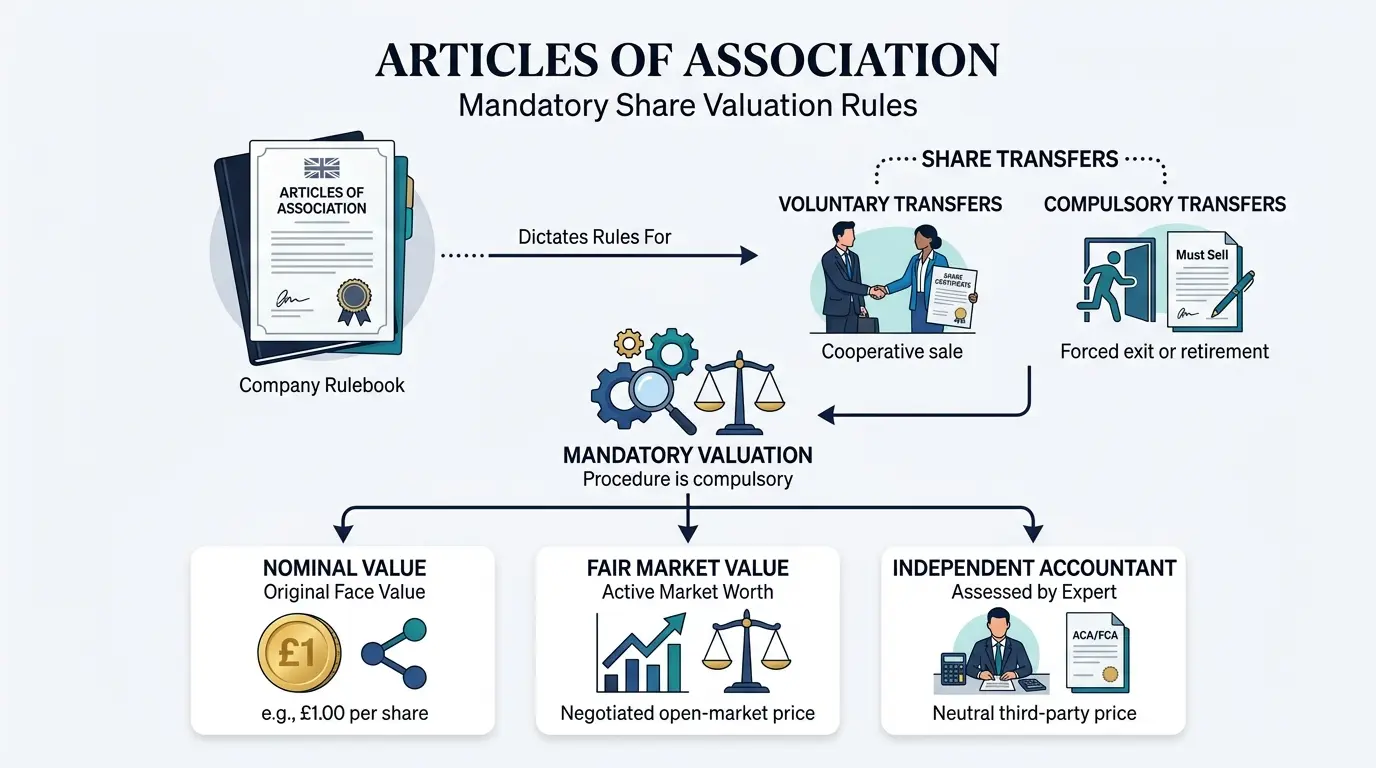
Valuation disputes create significant friction during corporate share transfers. To prevent valuation standoffs, company articles establish objective formulas or valuation mechanisms. Common methods include fixed asset valuations, multiple of earnings formulas, or independent expert assessments. Articles clarify whether minority discounts apply when valuing non-controlling shareholdings.
Compulsory transfers often trigger specific valuation rules. When an employee-shareholder departs the business, bad leaver provisions in the articles may mandate selling their equity back to the company at nominal value (e.g., £1.00 per share). Conversely, good leaver provisions allow departing executives to receive full fair market value assessed by an independent auditor.
When disputes arise regarding share valuation, the articles designate an independent accounting expert to issue a binding determination. The appointed valuer reviews historical company accounts, forward projections, and market comparables to set the final transfer price. This statutory mechanism prevents costly litigation and maintains transaction momentum.
What Documentation Is Required to Execute a Share Transfer?
Executing a share transfer requires a completed Stock Transfer Form (J30), payment of UK Stamp Duty where applicable, formal board approval, cancelation of old share certificates, and issuance of updated share certificates to new members.
The legal process of transferring shares follows a standardized statutory sequence. Once the seller complies with all article provisions, the buyer and seller execute a Stock Transfer Form (J30). This document details the transferor, transferee, share class, quantity, and total consideration paid for the equity transaction.
Execute Stock Transfer Form J30 with full legal names and consideration
Calculate and pay UK Stamp Duty at 0.5% on transfers exceeding £1,000
Convene a formal board meeting to approve transfer registration
Issue new share certificates within two months of registration
Update the statutory Register of Members and confirmation statement
Form My Company assists businesses with legal documentation management during corporate restructures. Form My Company ensures that revised company records align directly with Companies House statutory requirements.
How Are Register of Members and Companies House Records Updated?
Legal ownership of private company shares transfers only when the company updates its internal Register of Members, not when the Stock Transfer Form is signed or when filings are submitted to Companies House.
A common misconception among business owners is that submitting filings to Companies House completes a share transfer. Under UK law, the Register of Members serves as the primary legal evidence of share ownership. Until the company secretary or director enters the transferee’s name into this statutory register, the seller remains the legal owner of the shares and retains all voting and dividend rights.
Directors must update internal statutory registers immediately following board approval of a share transfer. When the transfer involves an individual acquiring over 25% of company voting rights or capital, the business must update its Persons with Significant Control (PSC) register within 14 days. These regulatory updates ensure ongoing transparency across UK corporate structures.
Companies House receives share capital updates through the annual Confirmation Statement (Form CS01). While Companies House records reflect historical shareholding data for public record purposes, internal corporate books remain the definitive legal record. Maintaining absolute consistency between internal registers and registered articles protects business owners against shareholder ownership disputes.
Explore More Supplementary Company Documents Guide,
How to Present Bound Articles During a Funding Round
How to Share Your Articles of Association With Shareholders Correctly
Frequently Asked Questions
What are Supplementary Company Documents, and why does a UK business need them?
Supplementary Company Documents are secondary corporate filings and customized governance materials, such as amended Articles of Association, board resolutions, and legal declarations, that supplement basic company formation records. Form My Company provides these essential legal documents to ensure private limited companies remain compliant with the Companies Act 2006 during internal corporate changes, equity transfers, and structural reorganizations.
How do I update my company’s Articles of Association after incorporation?
Updating a company’s Articles of Association requires passing a special resolution with a minimum 75% majority vote from voting shareholders. Once approved, the revised articles alongside the resolution must be submitted to Companies House within 15 days of adoption. Form My Company assists UK businesses with drafting, binding, and filing updated articles to reflect custom share transfer rules and voting rights accurately.
Which additional legal documents are required when transferring company shares?
Executing a valid share transfer requires a completed Stock Transfer Form (J30), updated share certificates, written board approval minutes, and compliance check records against the company’s governing articles. Businesses often require Supplementary Company Documents to verify pre-emption rights and update internal statutory registers. Form My Company supplies these structured legal templates to ensure all equity transactions remain binding and statutory compliant.
What is the difference between standard Model Articles and tailored corporate documents?
Model Articles serve as the default legal framework provided by Companies House, offering general governance rules suitable for simple business structures. Tailored corporate documents introduce bespoke provisions, such as drag-along rights, bad leaver clauses, and custom shareholder restrictions designed to protect original founders and investors. Form My Company helps businesses draft and adopt customized supplementary governance files tailored to their operational needs.
How long does it take to obtain bound Supplementary Company Documents in the UK?
Drafting and issuing formal corporate documents typically takes between 24 to 48 hours depending on the complexity of the custom clauses required. Official hard-copy bound documents are processed and dispatched immediately after board approval or statutory filing completion. Form My Company delivers bound Supplementary Company Documents with quick turnaround times to support upcoming share sales, director appointments, or legal audits.